
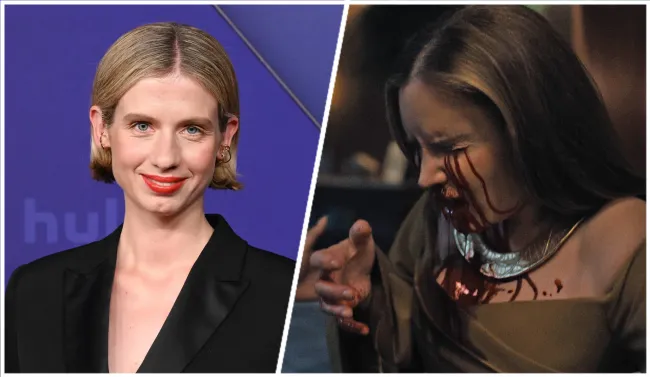
Weronika Tofilska is responsible for directing perhaps the bloodiest episode of television ever: the season finale of Something Very Bad Is Going to Happen.
To protect themselves from the copious amounts of the fake red substance used in the “big bloodbath” scene, the crew wore protective shoes and raincoats, Tofilska tells Gold Derby. “Definitely the clothes that we wore that day were throw-away.” The director estimates that about 90% of the blood you see on-screen is practical, and visual effects were mostly only used to digitally remove blood where it wasn’t supposed to be.
Something Very Bad Is Going to Happen was created by Haley Z. Boston, who also served as showrunner, and produced by Matt and Ross Duffer. It tells the story of Rachel (Camila Morrone) and Nicky (Adam DiMarco) in the horrific week leading up to their wedding at his family’s cabin. Tofilska directed four episodes, including the pilot and the finale, and is submitting the finale for Emmy consideration.

Two years ago, Tofilska received an Emmy nomination for directing Baby Reindeer. Earning a bookend nod for Something Very Bad Is Going to Happen would “mean a lot,” the director explains, especially since “horror and comedy are quite under-appreciated genres in terms of awards.”
Tofilska also talks about her early conversations with Morrone, the major differences between directing horror and other genres, and why this cast, which includes industry vets Ted Levine and Jennifer Jason Leigh, was “one of the most lovely groups of people” she’s ever worked with.

Gold Derby: What went through your mind when you initially read that last script of the season?
Weronika Tofilska: I was very excited because it really delivers on the promise of the title, which was obviously a worry. When you join a project, you don’t always read all of the episodes. I read the first few, and I had a little bit of a tip from the producers and Haley of what kind of ending it was, but I didn’t know exactly the scale of it, and how it all comes together. I was very excited, to be honest, as that was another plus in terms of why I love the show and why I wanted to do the show. As a director, there’s definitely a lot of fun in doing something on that scale.
How much of the blood was practical, and how much was digital?
I don’t want to give a percentage, but if I had to guess, I would say 90% was practical. It was actually a huge effort in terms of all of the departments coming together: makeup, SFX, VFX, production design, costume. We had to agree on a color for the blood. I learned all this during the show, that there are different colors and names, and I wish I knew exactly what the name of our blood was now. [laughs] We added some of the blood in VFX, but mostly it was removing elements. A lot of the characters that were bleeding in real time had rigs, so there was piping going all around their faces. The blood was dripping, and the VFX was actually removing those elements and moving the blood across their faces.
Camila told us how “incredibly sticky and claustrophobic” the fake blood was. Did you get any of it on you?
Oh, yes, for sure. There was a whole meeting before that day of the shoot for the big bloodbath where we talked about all the protective shoes that you needed to wear, and I had a raincoat. It was just everywhere really. Definitely the clothes that we wore that day were throw-away.
You are submitting the finale for Emmy consideration for directing. Tell us about that decision.
I gave it some thought, because I did love all the episodes. I was thinking about submitting the pilot as well, but I thought that the finale had so many different elements to it. For a director, I feel like we put so much into it, on every level. The pilot was very much all about establishing the world and building the atmosphere and introducing characters. But in the finale, there were so many things that I was juggling, and I was happy with how it came together. I just thought, “Go big or go home,” in the way that we sort of did in the last episode.

How is directing a horror project different from any other genre that you’ve worked in?
I wouldn’t say there’s a fundamental difference. It’s not a completely different beast. The best horrors, the ones that I love as a viewer, are the ones that actually are not just horrors — they’re dramas, or they’re comedies, or all of the above. You really want those films to have layers to them. They have these elements of performance, like talking about characters with actors, and digging deep under the surface. Building tension and atmosphere are really important, and there are set pieces in horror that are very specific. In Something Very Bad, the pilot was all about building that tension, and then the finale was all about the release of that tension. That’s the unique element to it: how do you build that suspense and set up the mystery? It’s rhythm and pacing and camera movement and performance and editing and music, all coming together in the right way.
Something unique about this show is that all of the directors are female, the showrunner is female, the lead star is female. How unusual is that in today’s climate?
I actually have realized that I was part of a lot of projects that had all-female directing. Baby Reindeer, the show that I did before, was only two directors, me and Josephine [Bornebusch]. And then I did this show called Hannah, which basically throughout all three seasons had exclusively female directors. Hopefully it will become more of a common thing and less of a big deal. Because it’s a unique thing, it’s worth mentioning now, but I think in the future, hopefully, that’s gonna be less of a rarity.
What conversations did you have with Camila Morrone about getting into the character of Rachel?
Camila is a very naturalistic performer, and that’s what we were going for with Rachel. When I talked to Haley initially about her script, what I loved about it was the feeling of how this extremely modern couple talks in a very natural way. They’re very funny and charming together. There’s something very everyday and modern and fresh about them, and in the world that she enters, everyone around her is quite weird. It was about building this character from the inside out, and tapping into what she has in common with Rachel. Camila is very funny, she’s very charming, she’s very witty. She’s not exactly like Rachel, and that’s where Haley comes in. There’s a lot of Rachel in Haley, and Haley in Rachel.
The cast also includes people like Adam DiMarco, Ted Levine, and Jennifer Jason Leigh. What was the vibe like on set when the cameras weren’t rolling?
Well, this was one of the most lovely groups of people that I’ve worked with. No shade on anyone else that I worked with before. [laughs] It was just uniquely that way, and the whole crew and the atmosphere on set was really lovely. We were in Canada, and famously, Canadians are so nice, and I think that rubbed off on everyone. It was an extremely nice set, even though the subject matter was quite dark.
Finally, what would it mean to you and the entire team at Something Very Bad Is Going to Happen if the Emmy voters were to embrace this show?
It would mean a lot. Horror and comedy are quite under-appreciated genres in terms of awards, and there’s so much that goes into it. These performances are brilliant, from Camila to the whole cast. I think it’s time for people to appreciate the craft and the talent that is put into these kinds of less “prestige” genres.
This interview has been edited for length and clarity.
