
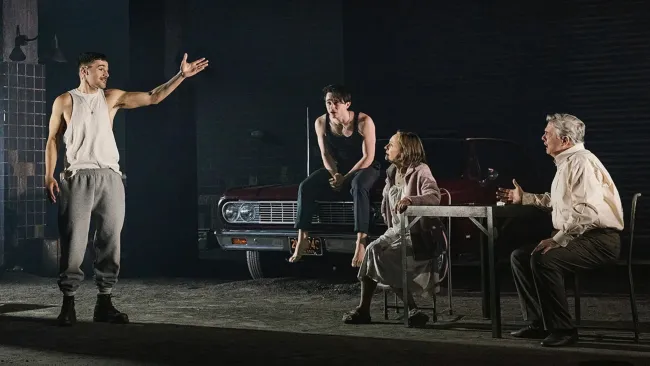
By Joe Mantello‘s own admission, his Tony-contending revival of Death of a Salesman didn’t leap onto the stage at New York’s famed Winter Garden Theater fully-formed. “There was such a long gestation period for this particular production,” the director tells Gold Derby. “And we gathered folks along the way over the years, so it’s deeply satisfying as a director.
In fact, Mantello first broached the idea of directing a production of the great American tragedy starring Nathan Lane as Willy Loman over three decades ago, when he directed the Tony-winning actor in the original production of Love! Valour! Compassion! by Terrence McNally. During the intervening years, Mantello rounded out his Loman family with frequent collaborator Laurie Metcalf as Linda Loman, Christopher Abbott as Biff, and Ben Ahlers as Happy. That quartet — along with the rest of the revival’s cast — earned the Best Ensemble Performance award from the New York Drama Critics’ Circle, which delights Mantello to no end. “There’s no higher praise as a director, and certainly for the company,” he beams.

Meanwhile, Mantello has received directing honors from the Outer Critics Circle, Drama League, and Drama Desk voters. His Best Director nomination at the 2026 Tony Awards is one of nine nods that Salesman received, including Best Play Revival and Best Actor for Lane’s acclaimed turn. In an extended conversation, Mantello discussed the ideas that didn’t make it to the Salesman stage, and his work on Little Bear Ridge Road, which played Broadway in the fall.

Gold Derby: Nathan has told the origin story of this production many times; now that you’ve finally done Salesman together, what most surprised you about your collaboration?
We’ve known each other for such a long time, and the way that comes into play in a rehearsal room is that you know each other’s strengths, weakness, and tricks. One of the things I said to Nathan early on was, “I want you to do something here that you’ve never done before, so I’m going to really push you. But I also want you to know that I believe you can do it, and that I’m not going to let you stumble. Trust me, and let’s push each other.”
Did you have any trepidation about your ideas to reimagine what Death of a Salesman could look like?
With a masterwork like this, you’re always part of a larger conversation, right? You’re aware of the kinds of productions that have come before you … so you’re aware that you’re fitting into the ongoing conversation about this play. The first question is, what do we have that’s additive to this conversation? I had lots of ideas, some of which we tried which were truly terrible, but we knew they were terrible, and that’s OK.
At one point, in the flashback scenes, there were going to be younger versions of Linda and Charley [the Loman family’s neighbor] as well. We had a five-day workshop in the fall where we did that, and I just thought, “This is awful!” The younger versions of Biff and Happy worked … the other [two] were just too clever by half.
The thing we played around with most in previews was the hotel scene in Boston, and exactly where older Biff came in and how much of a participant in the scene [he would be]. We did a version where he was very much a participant, and we did a version where he wasn’t in it at all. We experimented over the course of our preview period with how to best use him in the most effective way.

Speaking of Biff, you’ve worked with Nathan and Laurie many times before, but I was equally impressed with Chris as Biff and Ben as Happy. How did you know that they were right to round out the family?
Chris is an actor I’ve admired for a really long time … I’ve known him and followed him for years. Ben was someone that I did not know, and our brilliant casting director Taylor Williams brought him to my attention. We had a session where we paired Chris with different actors, and [Chris and Ben] just had an incredible chemistry together. You believe that they’re brothers with all the complications inherent in that relationship. There’s a tenderness between them that I would find so moving.
I thought the way you and Ben Ahlers conceptualized Happy was extremely effective, as he feels like a peer to Biff in this production.
Part of it came out of reading the script over and over and seeing how, as a young boy, Happy kept saying: “I’m losing weight, I’m losing weight, I’m losing weight.” One of the things I said to Ben was, “I really want to feel someone who’s come into his body, his sexuality, and his sensuality.” I mean, he was going to be wearing even less in that first scene, not in a provocative way, but just somebody who’s so keyed into [the fact] that his father made this idea of them being Adonises so primary in their minds.
You do some unexpected work with temporality by introducing subtle anachronisms into the play. How tricky was it to figure out how delicately to tread there?
It was a really interesting process with our costume designer, Rudy Mance, because we know what 1949 looks like and we know what 2026 looks like. But we were shooting for something that straddled both times. The most anachronistic costume is Howard’s, played by John Drea; that was the one where we really pushed it. Some of it came out of Miller referring to those scenes not as “flashbacks” but as “concurrences,” so they were absolutely happening at the same time for Willy. There was a sense of trying to give the audience a little bit of that disorientation: Is it now? Is it 1949? That’s a reel-to-reel recorder, but also a Starbucks cup. It was a dizzying thing that we were looking for so that audience was asking themselves the same question.
There are a few moments where you really capture that cacophony of voices in Willy’s head. What did you hope to accomplish with that choice?
That idea came from Nathan months before we started rehearsal. It’s like a siren’s call; they’re asking him to stay, and him shushing them doesn’t come out of distress. It actually comes out of a liberation — he doesn’t need those voices any more. It was a great idea that he had.
Another evocative moment is Willy planting his garden in the dark by flashlight. Lighting is very important to what you’re doing throughout the production.
In that moment, Will is very close to making that final decision [to commit suicide], and he’s desperately trying to leave something behind, and having a conversation with Ben and himself about whether it’s the right move to make. There is a moment where he wants to stay, and I said to Nathan, “You should look at the entire space we’ve been in the entire night, and shine light on your entire family.” What I get in that moment when the flashlight hits each one of them is the real emotional cost of the devastation of buying into this dream, this lie. You see that this is a tragedy not just for this man, but for this entire family — and they’re destroyed by it.
Are there particular moments in the production where you’re particularly pleased with how all the contributions from the cast and crew came together?
The most satisfying thing to me when I watch it is the dynamic between the four actors playing the Lomans. You can shape it, you can edit it, you can gently push it into a form, but you can’t give a group of actors a chemistry that I think the four of them have. When I see Laurie and Chris and Ben do the “Attention must be paid” scene, and then Nathan comes in, it’s all so specific and so lived-in. I just never tire of watching it.

Are there any other Arthur Miller plays that are particularly top of mind for you right now?
I don’t tend to think like that. I don’t have a list of plays that I want to do. I certainly wanted to do Virginia Woolf with Laurie, which we did for nine performances. There’s something about scaling the enormity of these plays that asks everything of you, so I’m eager to have that experience.
Do you feel like the domestic dramas you’ve directed in the past — The Humans, Other Desert Cities, and this season’s Little Bear Ridge Road — prepared you to take on this challenge?
Nathan and I were talking about this: When you have the opportunity to scale these mountains, you have to have a lot of life experience and professional experience behind you, because they’re sturdy and they support you as you try to figure them out, but they’re also so fragile. You have to have a confidence and blind faith based on everything you know, right? You bring everything that you know in the room. Especially with something like this where we were really trying to not make any assumptions about the play. You have to trick yourself and say, “32-year-old Arthur Miller just handed me this play in 2026 — how are we going to do it?”
I will be very honest with you, there were times along the way in rehearsal where I almost lost my nerve. I thought, “This is really ridiculous — where’s the kitchen?” But when you’re surrounded by collaborators like this, and you’re all figuring it out together, you get to the other side and you think, “I’m so glad we did it.”
Speaking of Little Bear Ridge Road, how excited were you to see Samuel D. Hunter get a Best Play Tony nomination?
He’s one of our wonderful writers. There’s this idea that because he writes in miniature, it should be relegated to off-Broadway. I thought that what he was writing about in that play, though it was very intimate, deserved to be on Broadway. I certainly wish more people had seen it; it was an enormous hit at Steppenwolf. But for me to have this experience to go from opposite ends of the spectrum, I just feel so fortunate this season.
This interview has been edited and condensed.
