
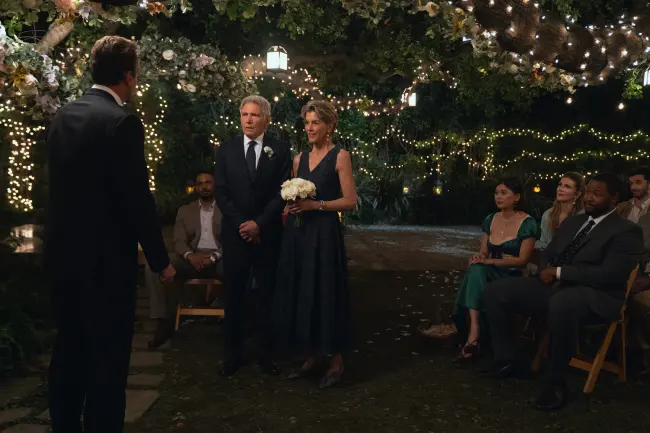
Everybody loves a wedding, including the cast and crew of Apple TV’s Shrinking, who gathered for a milestone celebration to kick off Season 3 as Paul (Harrison Ford) and Julie (Wendie Malick) finally tied the knot.
Bringing together the star-studded ensemble — which includes Jason Segel, Christa Miller, Jessica Williams, Lukita Maxwell, Luke Tennie, Ted McGinley, and Michael Urie — was a joyful milestone for the Emmy-nominated comedy, but orchestrating a crowded, multinight celebration also presented a unique set of logistical and creative challenges for the show’s crew.
Here editor James Renfroe, costume designer Allyson B. Fanger, director of photography John Brawley and re-recording mixer Earl Martin reveal how they pulled off the perfect ceremony.

Gold Derby: How did you keep a big wedding scene authentic and true to the characters and the world of Shrinking?
James Renfroe: What I’m looking for is authenticity. I’m looking for stuff that feels real, especially in a show like this where you’re balancing comedy with emotion. What’s nice about a scene like this is there was so much coverage. The wedding sequence was shot across three nights, and I think my initial selects pull was over an hour. The initial build for it was 14 minutes, so we worked our way down and tried to hold onto what’s important in the scenes and within the characters. I think we landed at seven-and-a-half minutes for the whole wedding.
Allyson B. Fanger: I do love a scene with everybody in it. I love a wedding because I get to have fun with a palette. I sort of riffed the palette off Gabby’s dress, which you didn’t really see in this clip, but it had all these colors going through it. Julie’s dress is obviously the first thing that you need to think about, but that had to come from her closet because it was sort of a last-minute situation. Everybody was sort of a last-minute situation, so you couldn’t overdo the looks, either.
John Brawley: When we’re shooting a big scene like that, we usually bring in some extra cameras because when you’ve got all the cast there, you don’t want to miss any of those reactions. We try and allow a very spontaneous environment. Obviously we do the words as written, and then there’s a lot of improv that can happen as well, so you don’t want to miss it. A lot of the time with comedy, you don’t want to wear out the material by doing it a lot of times, so we often would cross-shoot. That way you’re always getting both sides of a conversation, which helps with the continuity and protects the actors’ timing in terms of their pacing. It’s about being authentic and letting the actors do what they need to do, finding a way to still make it look great while keeping it very grounded and naturalistic.
Earl Martin: For the sound, hopefully you didn’t notice it because then something would be wrong, but we really wanted it to feel like you’re there. Like you’re sitting in the audience watching this, you’re part of the wedding party, and you’re feeling what other people are feeling. It shouldn’t feel like you’re on a set. You’re getting the little reactions from the people there, as well as the little background sounds that just make it feel natural and relaxed. From there, you’re in the wedding party, you’re on the dance floor with them, you hear the music in the background, but you’re also hearing the conversations so you’re able to filter into that. You still feel like you’re part of the party.
Jimmy’s speech is cut off early by a kiss. How did you approach balancing the humor and the pacing?
Renfroe: We tried a couple of different spots for it. Initially, he gets the full line out, and then we tried seeing how much we could cut it off and if we could still hear Jimmy saying, “Oh, you’re just going to keep going.” It sounded funny, so we kept that in. The timing for it, especially in comedy, is vital.
What were the initial thoughts when putting together what the bride and groom were going to wear?
Fanger: Wendie and I tried a lot of dresses on and she really fell in love with that one, and then that sets the tone for the wedding. That dress was just sort of the perfect Julie dress. It said all the things it needed to say. It was smart, it fit well, and it showed her incredible arms — which was really important. Harrison is so grumpy, but he has impeccable taste. He’s the most detail-oriented actor I think I’ve ever worked with in my entire long career. He’s really smart. He knows clothing; he knows fit. He will spend a lot of time with me on something like that, making sure it is just right. And I really love that. I love that he will take the time to spend with me and understands how important it is. He was really grumpy about the pocket square, though. He did not want the pocket square, but he wore it because it was in the script. But he did the work with me.
Throughout the scene, you are going from the smaller moments between the couple and then expanding out larger to the crowd. How did you balance when to do what?
Brawley: We tend to start with the closer coverage and then we usually finish by doing the looser coverage. As we were saying for a scene where you’ve got so many other cast members there, you sort of just keep extra cameras running as insurance. With those ones, we would often do group shots or try to pick things out. The operators have a lot of license; even between takes they might do something different, focusing on one particular person or whatever’s happening for them. You just have to kind of let it happen and trust that your crew is going to get those moments as they unfold.
When you do have a big wedding scene like this, how do you deal with the ambient sounds, the guests, the drinks, and everything that’s involved? What’s the biggest challenge?
Martin: Really, the biggest challenge is trying to incorporate the natural recording from the set, because you have lots of different cuts that might be from completely different takes. You have certain voices, like Michael Urie’s, which are louder than others and carry over. If they’re saying something very prominent that’s cutting through, but then you cut to a different take where that drops out and maybe he’s saying something else entirely, it becomes a balance. It’s a matter of going in to find individual mics and other elements that you can layer in so it all captures the excitement of that party while perfectly matching the visuals.
This article and video are presented by Apple TV.
