
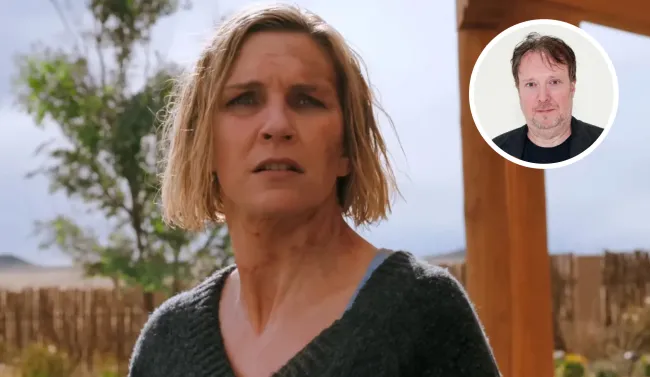
Pluribus began infecting viewers six months ago, becoming the latest breakout hit for Apple TV and creator Vince Gilligan and an instant Emmy contender. And not unlike a certain alien hive-mind virus, the show’s earworm of a theme is tough to shake. Written by Dave Porter, Gilligan’s go-to composer since Breaking Bad, the Pluribus main title is a small part of fully realized musical soundscape that’s unlike anything the collaborators have attempted before.
As Gilligan notes in the soundtrack liner notes, “When we started talking about Pluribus, we knew it would have a global scope. But how could we express that musically? Apple TV, God bless them, encouraged us to take bigger swings than we’d ever taken before. For the first time, Dave was able to have his compositions performed by a symphony orchestra and full choir.”


In this exclusive interview with Gold Derby, Porter reveals how he went full “pit bull” to land the Breaking Bad gig, explains the ideas at play in the Pluribus theme, and breaks down the show’s other greatest-hit music cues.
Before we jump in on Pluribus, let’s rewind to the beginning. How did you begin working with Vince Gilligan on Breaking Bad?
I had only just gotten to L.A. a couple of years before. I was still finding my footing. I heard about the pilot through friends: music editor Tom Villano and music supervisor Thomas Golubic. Thomas was just hired for the music supervisor position [on Breaking Bad]. He had me over to his place and we watched the pilot together, and talked about general things, our feelings about the music and the show as a whole. So I got really lucky to get an early view of it. Then I was a pit bull after that, pursuing my chance to get involved with it as well.
They put some of my music in early cuts — temp music, placements and things like that that — and when it came time to hire a composer, to the best of my knowledge, they didn’t speak to anybody else. So a little good fortune there, it never hurts. I was lucky that it was on a network at the time that was just coming up, right? AMC at the time was known for old movies and not for scripted TV. Mad Men was ahead of us by just a few months, and there was an opportunity there.
You had to hustle to get Breaking Bad. You got it. It was a huge success. You composed for El Camino and Better Call Saul. Vince is incredibly loyal. He’s worked with a core group of people, including you and Thomas, from Breaking Bad all the way through to Pluribus. At this point I assume there’s a bit of osmosis between you all and Vince, like a hive mind?
Yes. I think it’s an interesting point you raised because there are so many of us that have been around almost 20 years now, believe it or not, since the beginning of Breaking Bad. And yet, we explored a lot of avenues creatively.
What was the difference in the approach from composing for Breaking Bad versus Pluribus?
I got to be involved with Pluribus a little bit earlier and got a sense of what they wanted to do as they were figuring out what they wanted to do. It’s the first time since Breaking Bad that we’re building an entirely new universe from scratch, so that required a lot of thought and a lot of discussion. Vince’s mandate was that we want to plant our flag in the ground and say we are doing something new. The great storytelling is still going to be here, I promise, but this is a whole new thought process, a whole new universe we’re building here.
We took our process down to the studs and thought about, in my case, how we use original music. What role is it going to play? What should it sound like? Should it be spare in its usage, like we’ve done in the past, or are we going to be more overt about it? All those conversations were had, and we threw out some things that we used to do and we kept other things that were applicable to Pluribus.
After you got to that point, when did you say, “I want to use a symphony, use a choir, use these tools that I haven’t necessarily used before to create this this theme”?
That was part of creating a fresh sensibility for this show. I write a lot of orchestral music for other projects, but never for Vince Gilligan. So it was an avenue where we could do something new, which was challenging and exciting, too. And we had the means to do it. Let’s be honest, not every project, especially in television, has that ability. That’s a rare gift to have.
But it was also applicable. There was definitely a place for us to employ the power and the scope that a big orchestra and a choir in different ways can really bring to the score, and it worked because this story can back it up.
It’s global in scale … it’s bigger than that, it’s about humanity itself, right? So we knew we were going to have those moments where we could get that big and employ that power, but at the same time being careful not to overuse it, because the story is also a very personal one.
With the theme song, it’s literally in every episode, we hear it constantly. How do you approach something that’s going to be so omnipresent and yet never feels stale?
Well, thank you for that. I approach it with a great fear and trepidation, to be honest. I was terrified, as I always am with show themes. It’s one of the hardest things we do as composers for TV is television theme songs. To encapsulate what you want to say about that show — in our case in less than 20 seconds — but also be memorable and give you a big hug and welcome you into our world, right? Welcome you into our place and get you into our head, the headspace of our show, which is hopefully unique to our show, that’s a big challenge. We spent months on it, for sure, and there many, many iterations.
How many?
We got to “U”…
As in A-B-C-D-E-F-G…?
Yes.
That’s more than 20.
Yes, it was a lot. I wish I could say I had a secret sauce, but it’s really about trial and error and discussion. A lot of discussion with Vince directly about what are most important things and what we can distill all of this down to. You just can’t get to them, but you pick one that works best and resonates most for a main title. And in this case, what I really wanted to portray was the dichotomy of everything we’re presenting, the two sides of every coin and the discussion we hope this show brings — and seems to have brought to people, which we love about it.
It’s purposefully a two-part vocal piece, but really important to note, it’s sung by the same woman. Her name is Kenya Hathaway. You’re getting that story from the same woman, same voice doing the yin and the yang, right? The devil and the angel on either shoulder. The power of individual creativity and the power of groupthink. The fact that we as humans are striving more and more to live a life that is solo, with just us and our technology, and trying to isolate ourselves as much as possible while at the same time realizing that we simply can’t. We cannot exist fundamentally in any way we would want to without the collective.
That was the thought process. That’s what guided me, along with keeping it simple and hopefully memorable.
It is is memorable. To me it is a little reminiscent of the haunting melody in Rosemary’s Baby, which also references the dichotomy of being a mother, the joy and the pain, the love and the fear.
That’s very cool. It’s the first I’ve heard that and I have to say I didn’t think that, but I, but at the same time, it totally makes sense, and I’ll take it any day of the week.
I don’t know if you’ve invested any time — hopefully not — in going down the rabbit holes online about what Pluribus means. But there have been discussion threads and subreddits that claim the theme song is actually trying to transmit the alien virus in some audio form. True or false?
I don’t want to debunk anything, because we want people to have fun with this. But, honestly, the story that we’re trying to tell in that main title is much more about the humanity part of the equation than it is the alien hive mind part of the equation. But never say never.

Another part of Vince’s DNA is The X-Files, which had a very memorable theme song composed by the late Mark Snow. I was curious if there were any TV themes that you admired? I don’t mean the old-school “Gilligan’s Island” jingle-type themes, but any personal favorites or composers of the form?
I’m not a huge student of the genre in that sense, and I don’t listen to a lot of film and TV music in my spare time, but something that certainly was enormously influential to me — especially when I was young, and if I think about something that might have deep in the recesses of my mind played some role in how I approached the theme for Pluribus — it might be the theme for Twin Peaks.
Obviously the orchestration is entirely different, the music is entirely different, but there’s something about that combination of haunting, but still warm. Not wholly dark or obsessively evil, right? There’s something seductive in its invitingness and it’s warmth, but at the same time, gives you the little tingles in your back. I think that’s what I was going for.
One last question about the theme song. We only hear a small snippet at the beginning — you said about 20 seconds — but if you on YouTube or Spotify or Apple Music, and you click the Pluribus theme, it’s a two-minute-plus track. There’s more than just the vocal back and forth. How did you approach the whole composition, extending beyond what we hear in the opening moments?
That’s a great question. Actually, the extension of it, past the part that you hear in our opening titles came much later. I had worked on most of the show at that point, so I had a much better sense of the show then I did when I had to write the original 20 seconds. It was a fun experiment and a joy to go into it and figure out where would it go from there musically. I believe we use some of it in the end credits. But it was not designed to be to scored to the picture to any particular moment from the show. It’s about the show as a whole, and the kinds of questions we’re asking, and the journey that Vince and our writers are taking us on.
It was a fun thought experiment, to expound upon something that I fought so hard to be very simple. The beauty of that is then you have nowhere to go but fuller and more complicated and add more voices to the mix. I had a great deal of fun making that.
How did you approach creating motifs for the various characters in the show?
We talked a lot about that, and it’s something that we do very sparingly. Often I have found through so many years of working on Vince Gilligan’s shows that themes are tough to do for his characters because they’re constantly changing. From one episode to the next, and certainly from one season to the next, these folks are not the same characters. You can, of course, adapt themes and make them go new places and reorchestrate them in different ways, but that can be cloying to me if you’re not careful with it. So more often I’m choosing palettes more than I’m choosing themes. Where we are doing themes, I’m more often doing them about relationships than I am individuals. There’s a very specific theme for Carol (Rhea Seehorn) and Helen (Miriam Shor), because even though we lose Helen in Episode 1 — spoiler alert — her role in the story is enormous, right? She’s foundational to who Carol is and how she responds to this crazy situation she’s been put in. So in the moments where we need to, reinforce the importance of their relationship, we have a theme for that.
In the case of one of my favorite characters, Manousos (Carlos Manuel Vesga), he’s so stubborn and regal in his way, that I have a very careful choice of low brass for him, which works great for his character. It’s little choices like that rather than overt themes. We don’t want to hit people over the head with it, but if used judiciously it can be a very powerful tool.

I was listening to the Pluribus score on Apple Music, and I always find it interesting to see which tracks, especially for soundtrack albums, pop with listeners. If you look, there are always a handful of tracks with asterisks, which means they’re being listened to, downloaded, streamed the most. I wanted to do a little rapid-fire with you about the most popular Pluribus tracks beyond the theme song. The first one is “The Event.”
This is the big climactic moment when all the s–t hits the fan in the pilot episode. That [music] needed to make a big impact.
“A Carol for Carol.”
That’s actually an end-credit piece that doesn’t appear in the breadth of the show. It comes from some experiments, when I first started working on the show and began working with my amazing choral group in Vienna. It was born out of some experiments, and to me, it spoke of the show and was informative to me as a test bed for a lot of the music I wrote later. I was happy to find a spot for it.
“Diabaté… Koumba Diabaté.” One of my favorite characters.
Yes, so much fun. That track is an outlier. You’ll remember it comes from the poker scene in Vegas, and it was my very loving homage to John Barry and all those amazing scores that he did for 007.
And the last one is “Because We Love You.”
That’s from the finale. This is a very heartbreaking moment that I tried to capture, where Carol so desperately wants this connection, and wants to believe in Zosia (Karolina Wydra), and therefore the others, but gets her heart broken. The realization becomes what we all knew — and she knew — it ultimately had to be.
Those are your greatest hits from Pluribus, according to the fans, but do you have any other personal favorites that we didn’t talk?
Boy, let’s see. You’re going to put me on the spot here. The music for Carol and Helen is really important. There’s just a tragedy in that, but also hopefully a little optimism, which is so much of what this show is. It finding the diamond from the ashes.

I also love Manousos, and I’m really excited about where that character can go and where we can go with him musically. One of my favorite pieces that wasn’t listed — and I’m going to try to remember the name of it — I believe it’s called “Twelve Fellow Survivors.” It’s when Manousos finally gets the video from Carol and realizes that there are other survivors and he decides he’s going to go try to find her. It was a chance for me to do a very stirring piece, an emotional piece on a level that we don’t often do. Unlike the shows we’ve done in the past, we’ve got real heroes here. There are no antiheroes. These are difficult heroes. They’re difficult to love, for sure. But it’s opened the door for me to be able to do some music like that to explore the breadth of the show.
As shown by the pieces you just picked out to me, I love that there’s such variety in what people are listening to. That’s a great sign for me.
The show and the music are really is resonating. Pluribus has developed a deep fandom already, and I think it’s only going to grow as more people discover it. I know Vince has said it’s going to be a while before we see Season 2, but is that something that you as a composer are already thinking about? Or is it way too premature at this point?
For me, way too premature, because, like you, I know nothing, and I have no clue where this thing is going go. I couldn’t even hazard a guess. No, until I hear from them, which is going to be a minute, I’m not going to second guess it or think too much about it. I’m going to move on to some other things — for the first time in a long time I’m working on some music of my own, which has been a joy — so that I’ll come back to Pluribus fresh and we’ll see.
I’m as excited as everyone else to see where it goes.
