
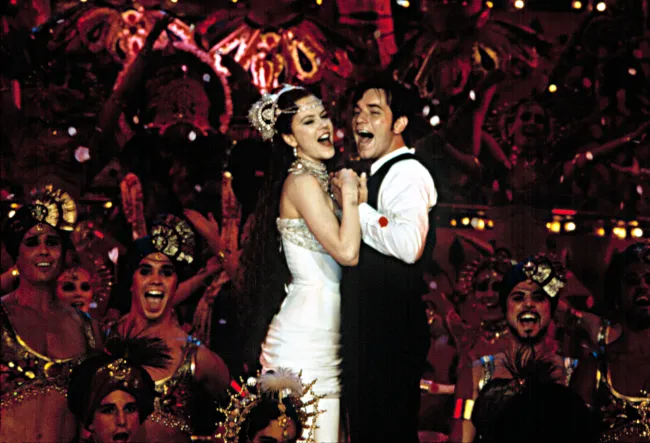
Baz Luhrman’s spectacular, spectacular Moulin Rouge! has cultivated several indelible moments in the 25 years since its release. Whether it’s the movie’s doomed lovers Satine and Christian (Nicole Kidman and Ewan McGregor, respectively) striking sparks on top of a giant elephant or a tuxedo-clad Jim Broadbent belting Madonna’s “Like a Virgin,” the Australian director behind Strictly Ballroom and Romeo + Juliet shook up the movie musical to 11. And it was rewarded handsomely for that achievement with eight Oscar nominations, including Best Picture and Best Actress for Kidman, along with Best Art Direction and Best Costume Design, the two statuettes that it took home.

But of all the movie’s iconic scenes, its rendition of the Police classic “Roxanne” remains the standout moment. The “El Tango de Roxanne” sequence — as it’s labeled on the film’s soundtrack — brings all the main characters together to kickstart the movie’s grand finale. Satine, the courtesan carrying on an illicit affair with decidedly unwealthy writer Christian, is forced to go to the villainous Duke (Richard Roxburgh) and seduce him in order to retain the ending of the play-within-the-film, “Spectacular Spectacular.” Unfortunately, Christian’s jealousy is starting to eat away at him.
With everyone on edge, one of the show’s players — the narcoleptic Argentinian played by Jacek Koman — recounts a local legend from his native land that’s similar to the plot the audience is watching. Turning the Police’s “Roxanne” into a tango, the Argentinian and fellow Moulin Rouge dancer Nini (Catherine O’Connell) play out the jealousy, passion, and betrayal that is starting to build between the central couple.
The dance captain
The person tasked with creating that tango was Moulin Rouge! choreographer John “Cha Cha” O’Connell, who has been dancing since the age of 6. Raised on Old Hollywood musical stars like Judy Garland, Cyd Charisse, and Fred Astaire, O’Connell met Luhrmann in the 1990s through their shared agent at the time.
“[She] put us together, kind of on a blind date,” O’Connell tells Gold Derby now. “I remember going to his apartment. It was so scarce. He had no furniture. I had to sit on the floor on newspapers. I thought, ‘This guy’s nuts,’ and he thought I was a bit insane, too.”
After finishing Romeo + Juliet, Luhrmann started pitching O’Connell the idea for Moulin Rouge! and the choreographer immediately started doing research, helped by the fact that he had full access to 20th Century Fox’s archive. “I spent a few months just looking at that,” he says of watching the likes of Ray Bolger and Maurice Chevalier. “I would take interesting things to Baz and show him … what we could possibly do as a basis of inspiration.”
O’Connell also started researching various dance styles, like Argentinian tango and classical Indian dance. According to writer and dance historian Katerina Pantelides, the sequence holds some factual authenticity as the tango started making waves coming out of Argentina in the 1890s. “Some people think it was developed in the brothels, but we know it developed in working class districts,” she explains. “It’s a mix of Spanish flamenco and Italian folk dance.”
Before “Roxanne” made it to the screen it took shape on a piece of butcher paper — part of the collaboration process between Luhrmann and O’Connell. “We’d have [the butcher paper] on a big easel and just toss ideas around … and we’d sketch stuff out,” O’Connell explains. “There’s a lot of creative freedom because I’ve never heard [Luhrmann] say, ‘That’s too much.’ The producer might say that, but not Baz. There’s a lot of creative freedom, in terms of the ideas, and then he virtually leaves me alone to work with the dancers, and then he’ll come and have a look and give notes, and it sort of goes from there.”
Learning the steps

For his part, Koman had been close to Moulin Rouge! since its early days as a series of workshops Luhrmann organized as he put together the script. The dancer was in the second of the three workshops, initially reading for the part of Toulouse Lautrec, which would eventually go to actor John Leguizamo.
“We would just sit at the table, read, talk, and comment on ideas, on the script, and on scenes,” he recalls. While he doesn’t remember his exact thoughts when Luhrmann offered him the Argentinian role, Koman knew it involved dance, and “Roxanne” already held a special place in his heart. “Roxanne was always one of my great favorites,” he says. “I remember when I first heard [it], and it’s kind of vaguely a bit of a reggae rhythm.”
O’Connell’s choreography process is to segment and build out each dance. “Often I will get the best couple, or the best dancer, and just work with them one on one,” he explains. “Then I will map something out and I’ll just take it to the rest of the dancers and say, ‘Learn this.’”
In the case of “Roxanne,” he started working with O’Connor and a dozen of the company’s strongest dancers and let them improvise. “Let’s just start throwing Caroline around the room,” he says. “And then when that started to happen you would see great shapes.” He also made a point of incorporating traditional tango steps into Koman and O’Connor’s routine. Koman himself spent a month with instructors specifically learning Argentinian tango though admits O’Connell tended to focus more so on ballroom tango for the sequence.
Intensity was the name of the game. Shot over 10 days with 70 dancers, the dance sequence required several segmented planning sessions O’Connell and Koman, as well as 35 male dancers, and an entire quasi-corps de ballet performing alongside them. “There’s a language of movements and the man is leading,” says Koman. “But it’s such a conversation. Every move specifies what should be the move of the partner. They follow each other. A move follows another move in a very, quite rapid sequence.”
The dancers often had early start times, heading into makeup at three in the morning. “The first day we didn’t shoot till four in the afternoon,” says O’Connell. “They’re there at three and have to sit around waiting. Then they have to get up and dance like their life depended on it. That’s the hard part of doing a film.”
Put on the red light
The tango sequence was filmed in a large space known as the Showgrounds, with five strategically placed cameras capturing everything. Smoke permeated the room — though it was imperceptible on camera — as Koman kickstarts the number with a loud and guttural “Rox–anne,” showing off the Mongolian throat singing he was working with at the time. “
“[Musical director and co-composer] Marius de Vries fell off his chair when he heard it,” says Koman. “He said, ‘Wouldn’t it be amazing if you actually did sing “Roxanne” with that voice?’ He recorded it and then we went to Baz.” But Koman still had to campaign to sing the song, which was originally intended to be performed by José Feliciano, who still can be heard singing some of the flourishes on the finished track. The sound mix heightens the fear and tension of what the characters are feeling.
“You start and you hear these slaps,” says Pantelides. “It doesn’t even sound like a musical instrument. It sounds like the sound of something or someone being hit.”
After 10 days O’Connell and Luhrmann were left with nine hours of rushes for the tango number. “They gave me access [to the rushes] for a week, which is really rare,” the choreographer says. “They said, ‘Can you just narrow this down to the best half-hour?’ I spent a week just looking at stuff and saying, ‘Well, you should put this in this.’”
Both Koman and O’Connell do wish that Luhrmann’s rapid-fire editing style — it’s said there are two to three cuts per second in Moulin Rouge! — had allowed a grander opportunity to see the actual dancing. “Because I had the privilege of seeing it in its entirety … I expected that most of it would still be there,” says Koman. “But, for me, it kind of lost something.” Koman throws out the idea that Luhrmann could easily do a VR showcase for that sequence, or something wherein viewers could see the dance sequence full-out. (Various YouTube videos do break down the sequence without the editing.)
Even condensed, “Roxanne” remains one of the standout sequences in Moulin Rouge!, boasting a fantastic blend of contemporary music that’s perfectly adapted to the film’s period era. A quarter century later no one wants “Roxanne” to turn off the red light.
