
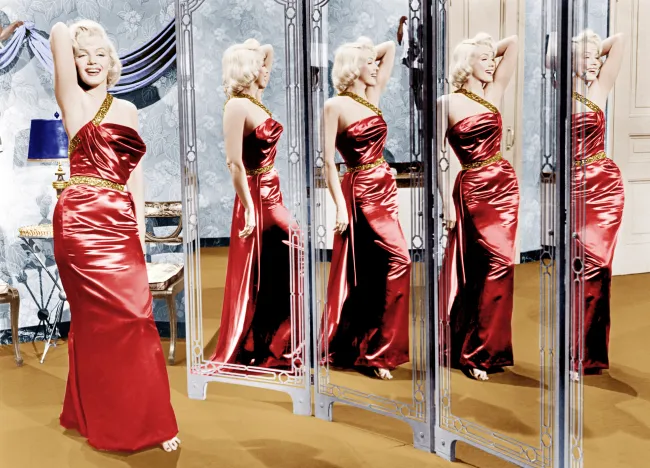
Marilyn Monroe represents numerous things in the long history Hollywood, epitomizing both the glamour of the film industry in its golden age as well as tragedy that can befall residents of the City of Angels. But one key part of Hollywood that eluded Monroe across her two-decade acting career and 32 features was an Academy Award nomination.
Though nominated for two Golden Globes and two BAFTAs during her lifetime, the Oscar always remained just out of reach. That fact still surprises both longtime and new fans of Monroe 100 years after her birth as Norma Jean Mortenson on June 1, 1926. (Monroe died on Aug. 4, 1962, at age 36.)

What was it about Marilyn that kept the Academy from recognizing her talents while she was alive? “I think there was a certain snobbery possibly going on in the circles that would vote,” Greg Schreiner, Monroe historian, collector, and founder of Marilyn Remembered, tells Gold Derby. “There’s a lot more depth to her performances than anybody I think back then gave her credit for.”
Niagara calling
Monroe’s first major role, in the little-known 1948 feature Ladies of the Chorus, showcased her beauty and sexuality, which was often played up in later features. With that came a tendency to see her performances as indicative of “dumb blonde” parts. But “dumb blonde” was certainly a misnomer when discussing Monroe, especially when looking at the movies she should have received an Academy Award nomination for.
One of her earliest awards-worthy films is 1953’s Niagara, which arrived in theaters during a banner year for Monroe. As Andrew Wilson, author of I Wanna Be Loved by You: Marilyn Monroe, A Life in 100 Takes, explains, Monroe’s role as Rose Loomis is the ultimate subversion of her sexuality. “It shows her acting in a way almost like, I would argue, a silent film star,” he notes. “Because she does so much with her physicality and body.”

Directed by Henry Hathaway, Niagara follows two couples at the famed Niagara Falls. Monroe plays opposite Joseph Cotten in the role of a woman living in a sexless marriage. One sequence in particular — a dialogue-free walk across various sets — shows Monroe’s ability to make the banal a highly sexualized activity. And yet she was already making a point of showing her intelligence in how she was approaching roles by taking acting lessons with the acclaimed teacher Michael Chekhov.
“This dissonance between her physical presence and the fact that she was trying to be intellectually aspirational at the time was dismissed as being nonsense,” argues Wilson. “It’s only now we can appreciate the full meaning and complexity of what she was going through.”
Despite Niagara’s success at the time, the movie received no Oscar nominations. The demure Audrey Hepburn won Best Actress for the romantic dramedy Roman Holiday while Donna Reed left with Best Supporting Actress for the wartime romance From Here to Eternity.
Stop and go
After Niagara, Monroe took on a role that was incredibly close to her heart in 1956’s Bus Stop (1956), an adaptation of the William Inge play directed by Joshua Logan. “She really worked so hard to make that role her own,” Schreiner says. It’s easy to see why. Monroe purchased the rights to the Inge play in the hopes of releasing it under her own production company, Marilyn Monroe Productions. She plays Cherie, a saloon singer relentlessly pursued by a naive cowboy played by Don Murray.
Logan himself almost turned down the directing job after leaning into stories citing Monroe as talentless and unprofessional. In his autobiography, Movie Stars, Real People, and Me, the director writes: “I nearly missed one of the high spots of my directing life because I had fallen for the popular Hollywood prejudice about Marilyn Monroe…I could gargle with salt and vinegar even now as I say that because I found Marilyn to be one of the great talents of all time.”
An uncredited producer, Monroe hand-picked Logan as director and Milton Krasner as cinematographer. She also went through a complete physical transformation for the part, adopting an Ozarks accent and employing the Method to shape her performance. “She becomes that character so closely that you just can’t divorce yourself from it,” Schreiner says. “You don’t see Marilyn at all, you’re seeing another character.”

“It’s a reflection of the time where she was just considered to be a ditzy dumb blonde, even [by] the people running the studio,” Wilson adds. “Natasha Lytess, an early acting teacher, said of Marilyn that people view her through this kind of prism, and when they see her as just a typical Hollywood blonde, it’s not their fault. Marilyn’s soul just doesn’t fit her body, so they weren’t seeing the complexity of Marilyn’s acting skills or her ability to act.”
While Bus Stop would receive a Golden Globe nomination, Monroe wasn’t gifted an Oscar nom, although Murray scored a Best Supporting Actor nod. Seeing her leading men recognized in lieu of her own performance happened frequently. For example, Jack Lemmon was given a Best Supporting Actor nod for the classic gender-bending comedy Some Like it Hot, but Monroe’s performance wasn’t among the film’s six nominations. (She did receive a Golden Globe nod, at least.)
The final years
At the time and still today, stories have proliferated about Monroe’s tardiness and unprofessionalism on set. She routinely brought along acting coaches to help guide her performances, often leaving them to butt heads with the actual director. “Marilyn did have a lot of insecurity, and I think that manifests itself in her wanting to have someone there that she felt was on her side,” Schreiner says. “It may have influenced people that go, ‘We don’t want to vote for somebody who’s causing such a problem.’”
“Some of her personal problems — obviously her drug addiction, her sense of perfectionism — and the fact that she wanted to do as well as she could, so her anxiety levels when it came to shooting were off the scale, I think all those things played some kind of part [in her lack of Oscar recognition],” adds Wilson. The author goes so far to say that, while it certainly couldn’t have prevented her early death, an Oscar nomination could have made her feel like part of the wider film community.
Monroe’s final completed feature, 1961’s The Misfits, is also perceived as a missed opportunity for Oscar recognition. Directed by John Huston and written by Monroe’s then-husband, playwright Arthur Miller, the movie was called a “valentine” by Miller to his wife. Unfortunately, their marriage fizzled before production started and Monroe was forced to live out several painful moments that Miller had put on the page.

“I find it so painful to watch that film, but it shows her ability to convey trauma and raw energy and emotional instability,” Wilson says. Anne Bancroft would win Best Actress that year for playing Anne Sullivan in The Miracle Worker.
Due to her popularity, Monroe always represented a divide between art and entertainment in Hollywood. And while both Schreiner and Wilson are happy that the Academy and the wider world is giving the actress her flowers during her centennial, it’s hard not to feel gloomy that it came so late. “She’s got to be probably the greatest star that’s ever been produced in Hollywood,” Schreiner says.
Academy Award or no, Marilyn Monroe remains a legend — and we’ll be saying that for another hundred years.
