
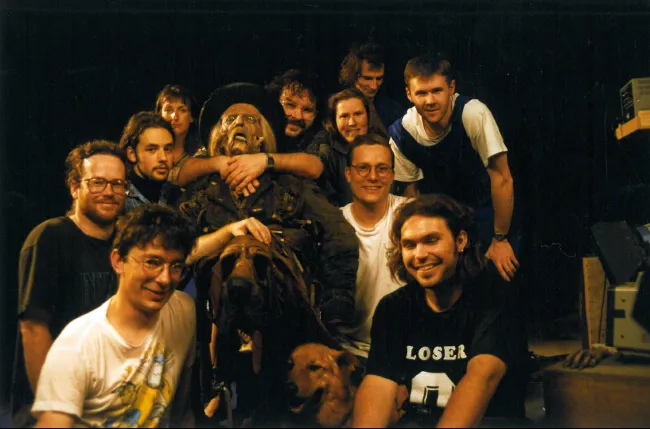
Released on July 19, 1996, The Frighteners was the first film that Peter Jackson wrote and directed for Hollywood. Mind you, it wasn’t written and directed in Hollywood. That’s one of the most important details from its production, which generated lackluster box office 30 years ago but led directly to Jackson helming three Lord of the Rings films (and another three Hobbit movies). Just as importantly, it helped give birth to Wētā FX (formerly Wētā Digital), the visual effects house that has won eight Academy Awards and worked on hundreds of blockbuster films, from the MCU to Planet of the Apes to Avatar.
In fact, virtually every part of the film was an evolution, and expansion, of what its makers didn’t yet know was possible. Beginning as a script for Robert Zemeckis to direct for his big-screen Tales From the Crypt series, its status as a calling card for Jackson’s, and Wētā’s, limitless possibilities was earned by conquering one challenge — technical, creative or both — after another. Yet talking to Jackson and Richard Taylor, the director’s longtime collaborator and founder of Wētā, you’d think the process was so traumatic that it left them in a fugue state. “I haven’t actually seen this film in 30 years,” Jackson admits to Gold Derby. “So you’ll have to excuse me because I remember it very fondly, but I haven’t seen it for a long time.”


Despite that disclosure, Jackson and Taylor both offered an almost forensic account of the making of The Frighteners, both as the filmmaker’s entrée to Tinseltown and as a proving ground for the special effects maven’s future award-winning company. Commemorating its 30th anniversary, the duo recounted the film’s initial development process, the hurdles they faced in marrying practical and then-brand new digital effects to tell their story, and its eventual role in all of Jackson’s future work — not just inspiring it, but truly making it possible.
Gold Derby: I understand that this was originally sent off to Robert Zemeckis, who considered directing it himself at some point. But how close did it actually get to becoming a Tales From the Crypt film?
Peter Jackson: Tales From the Crypt was the way it began, because what happened is that our agent at the time, Ken Kamins, contacted us and we’d just finished Heavenly Creatures. Ken thought it was a good opportunity for us to strike with some more work, and he called us and said, “Hey, Bob Zemeckis is looking to make a series of Tales From the Crypt movies. Have you guys got any script ideas?” And so, Fran and I thought about it for a while and we concocted this story about this ghost conman. Once we got a story sorted out, we went to L.A. and we had lunch with Bob in Santa Monica, and he really liked the idea and he got us to write the script. But at some point Bob said to us, “I think it deserves to be a standalone film,” and then he asked me if I’d make it.

I think you’d gone a bit down the road on a remake of The Creature From the Black Lagoon, if I’m not mistaken. Was that happening around that time?
Jackson: I hadn’t done that, no, that’s a wild rumor. I was never involved in The Creature From the Black Lagoon. We did write another script for a franchise, a Dark Horse franchise about Concrete, a big concrete guy. It’s all a bit of a blur now, but at some point in all of this, we also wrote a Concrete script as well. We were writing a few scripts, Fran and I, for Hollywood films.
As much as you’d shown your versatility with Heavenly Creatures, your reputation at that point was largely cemented because of Bad Taste and Braindead [released in the U.S. as Dead Alive]. Were you dialing that sort of mischievous humor back for this bigger project, or leaning into it in this script?
Jackson: That was always the tone. Anything I’ve done that’s remotely involving a horror films, what you’d call a horror film, has always been with a large amount of comedy as well. So I’ve never made a serious horror film. So it’s my natural instinct to do that.

How much was the initial decision to utilize Wētā for the visual effects a matter of practicality and/or when did it become an opportunity to showcase the company’s capabilities?
Jackson: Well, Wētā Workshop already existed by Richard. And we had formed Wētā Digital when we made Heavenly Creatures — where we had one computer. So we were interested in CGI effects, which were all a new thing back then. And so we wanted to blend practical effects that a Wētā Workshop would do with CGI effects, but we only had one computer. So on The Frighteners, we ultimately ramped it up and we ended up with 30 computer artists and 30 computers. And we just got what we needed to get the shots made. There was a lot of CGI shots in that movie.
Richard Taylor: I believe it was record-breaking — I may be corrected, but 550 digital effects shots was the highest number of effect shots in any movie at that time, and it was hailed at the time.
Jackson: And we definitely broke ground in the digital effects world because nobody had really done cloth very well, but we had a very clever CGI artist, Gray Horsfield, who spent a long time working at the program to be able to do cloth. Because the Reaper, who ended up being one of our main villains, was a completely cloth guy. So cloth hadn’t really been done in the CGI world that effectively prior to The Frighteners.

Taylor: We had intended doing a lot of the Reaper as a practical puppet, and what Gray did is he looked at the practical puppet shots that we had done — for instance, we strapped a full-sized Reaper onto the roof of the hero car that Michael would ultimately drive and ran that around the neighborhood filming it. Gray was able to take that footage and inspire what he ultimately did with his software writing to create the beautiful work that we see in the movie. I actually think the cloth work on the Reaper is one of the highlights of the film from a technical perspective, because it’s unlike any Reaper we’ve ever seen where the fabric sort of flows after the Reaper, and almost looks like treacle running down the hills.


Jackson: I think on one level that was Gray trying to do cloth and not quite being able to achieve it perfectly. But what he ended up with was this silky, oily feel, which actually suited the movie.
How much did Robert Zemeckis facilitate the eventual casting of Michael J. Fox?
Jackson: I think it was Bob’s personal contact, his relationship with Michael that went a long way towards Michael trusting Bob, and therefore trusting us in order to commit to the film. I remember I was at the Toronto Film Festival with Heavenly Creatures, and Michael flew himself up from New York to Toronto to meet with me in the hotel room to talk about The Frighteners. We got on well, and soon afterwards he was in on the film.
Looking at the cast, you have Dee Wallace, Jeffrey Combs, John Astin — all genre luminaries. How much of that was deliberate and how much of it was just the happenstance of finding the best person for each role?
Jackson: There’s a little bit of both really… I mean, the actors that you mentioned were all the best at their auditions. I remember we auditioned George Carlin for the judge role, so we were auditioning non-genre people as well, but it just happened that we liked the performance of the people that got cast the best. I mean, John was fantastic. And Dee, being a genre fan, I certainly knew who she was, and so it was fun to work with her.

Taylor: I want to quickly mention R. Lee Ermey coming into our lives. There’s a lot could be said about R. Lee Ermey, but I only knew him from Full Metal Jacket, and Peter tells me to build a bottom that will fart on R. Lee Ermey’s head. And I’m like, “What the f–k? You are joking?” But R. Lee Ermey turns up and he turns out to be so off-brand from what you or us would know him. He was the sweetest, most charming, gentlemanly individual. And he was like, “Yeah, bring it on. Put that bum on my head.”
Jackson: I mean, that was us thinking that we wanted a guy looking after the cemetery who was like the drill captain in Full Metal Jacket. And then we eventually thought, “Well, why don’t we get the [actual] drill sergeant from a Full Metal Jacket?” And Lee was OK to come down and essentially reprise that role. And we couldn’t come up with all the insults that he was yelling at Michael. So we just said, “Lee, you just make up your own stuff.” And he did. Except we told him that, “This is a PG-13 film, Lee, so you’ve got to just watch your language.” I’m sure that if we’d known it was an R-rated film, he would’ve had far, far, far [dirtier] things to say.
Jackson: I think Jeff Combs was one of those guys that when we created that role of Dammers and realizing what sort of a personality he would be. We went to the people who could deliver a really kooky version of Dammers. And Jeff certainly did that for sure.

Taylor: Jeff Combs is one of my favorite actors I’ve ever worked with because we got to spend quite a lot of time with him doing his casts and his prosthetics. He was wonderfully strange, but terrifically entertaining. And John Astin, we had to do a full body cast of him — he’s the oldest person I’ve ever full body cast. It takes two hours from head to toe, and he staunched it out, never flexed, didn’t faint. And the stories, because he had just come off as one-man tour of his Edgar Allen Poe show, so while we would be doing his makeup and doing his various things, he would recite Edgar Allen Poe to us which was just fabulous.

It seems you went through a lot of practical to digital transitions in the development process. Was that discovery of the efficacy of digital effects symptomatic of what was happening in the industry in general at the time?
Jackson: Well, it was around the time of Jurassic Park, wasn’t it? And that was the one that inspired me. Was the dog CGI, Richard, or did we make the puppet and just complemented the shots?


Taylor: I can’t say that every shot was replaced, but it probably was. I mean, it was the most complex puppet we had ever built, 42 actuators. It was run off a Kuper Control system. It actually performed OK, but I think it was probably replaced, but I can’t say actually for certainty.
Jackson: I thought we did a lot with the puppet dog, but I might be imagining that. Because every time I’ve been to the workshop, I’ve seen the puppet on display there, so I’ve got the puppet in my head. I remember we had planned to have that big cute Cupid character in the graveyard too, which we made, but I think it got cut for budgetary reasons.

Taylor: Well, you filmed it. It performed pretty well — it had lip-sync capabilities and flapping wings and all the rest of it. The footage looked good. I though it wasn’t in the cut because it just didn’t make sense in the end to the film.
Jackson: Yeah, it was a big bizarre fat Cupid that was roaming around as an entity in the cemetery.
Taylor: What I am very proud of is that all the miniatures got in, the ones that we built with John Baster, Mary MacLachlan, and me. We built those miniatures because you wanted a kit set almost like Legos, remember? We built that huge miniature of the cemetery down the middle of the studio made out of sandbags, carpet, and then landscaping. And every night after the camera department left, we would lift all the things off, lift the carpet off, reconfigure the whole miniature through sandbag movement, rebuild it, and then the team would come back, and that was wildly successful.
Jackson: I remember the miniature of flying down over the rooftops was great. We built those at 1/12 scale because 1/12 happened to be the scale that you could buy plastic cars. So it was easier to buy the cars and build the rest of the model in the same scale as the cars that would be parked on the road.
Taylor: We’d learned that on Braindead. We built the miniatures on Braindead at two different scales of the scale of plastic cars because they’re so cheap to buy, so difficult to build.
Watching the Reaper, the first thing I’m thinking of is the Ringwraiths in Lord of the Rings. What were the things you created in this film that laid the groundwork for later work in your career?
Jackson: Well, really it was the establishment of Wētā Digital as a large company. Because as I say, we had one computer artist and one computer on Heavenly Creatures. By the time we did The Frighteners, we had to ramp up to 30 computers and 30 people. And I think on Lord of the Rings, we ended up with 600 or 700 computer artists. So it was really more the fact that we had established this company. And it was really the reason in a weird way why Lord of the Rings happened because we were looking for a film after The Frighteners. We had these 30 computer artists on our payroll, meaning that Fran and I were paying them out of our own money. So we were desperately thinking of film ideas that would have a lot of CGI effects in them to justify keeping our crew on. So we attempted to make King Kong briefly [in the 1990s], which would’ve had a lot of CGI, and then the plug got pulled on that. Lord of the Rings was Fran and I sitting down thinking about what type of movie would we make that’s going to have a lot of CGI effects because we’ve got all these people that we need to pay. And I suggested a fantasy film, a The 7th Voyage of Sinbad, Harryhausen type of fantasy film about using CGI. And so we started to try to dream up plots for such a film and every time we though of ideas, we’d think, no, Lord of the Rings has done that. And so eventually we decided, why don’t we explore the rights to Lord of the Rings?

For the scene where the mirror turns into a pool for the Reaper to jump in and out of, obviously Terminator 2 had done liquid metal. At that time, was there any sort of open sharing of the technology to create these effects?
Taylor: There wasn’t. It was entirely internally developed by a very small group of people. Maybe we had got some people in from overseas; I think [visual effects supervisor] Wes Takahashi may have turned up at that point. I remember we had [future Shrek director] Andrew Adamson who was involved as well, who was intensely clever. But I think it was almost all internally developed with some very clever minds — Gray Horsfield obviously leading the technical development ideas. He continued right through Lord of the Rings doing some of the most insanely challenging things.
Jackson: He’s still there. I mean, that’s the good thing is most of the 30 crew members that we hired for The Frighteners as CGI artists are still working for us now. I mean, we’ve got a thousand CGI artists, but amongst those thousand are the original Frighteners team.

The production schedule for this was fairly long. How much did shooting in New Zealand earn you additional latitude to take the time you needed to discover technologically how to execute this without the studio interfering?
Taylor: The production was two-and-a-half years from when we first started. We were [also] doing the film spoof that Pete did.
Jackson: Forgotten Silver.
Taylor: We were still building stuff for that while we were starting on The Frighteners, but two-and-a-half years from when we started to when we finished.
Jackson: From what I remember it was a six-month actual physical shoot, which was quite long. And that was because of the fact that we had to do a lot of the scenes twice: We had to shoot Michael Fox walking around the room talking to the ghosts. And we had the ghost actors, Chi McBride and Jim Fyfe, there who would rehearse with Michael to get used to it. And then at a later date, we would be in a green screen studio, and they would shoot their part to the pre-recorded motion control movie. We knew it was going to take a long time.

Did you face any studio pressure throughout production because of that?
Jackson: I got the best bit of advice that I’ve ever had actually from Bob Zemeckis about that, because we were slipping behind schedule. When we were a month or two into filming, it was clear that we were not going to get this finished in six months. I remember Bob coming to New Zealand and very clearly him saying, “So Peter, it looks like from the current projections, you’re going to be six or eight weeks over schedule,” at whatever the cost was. It was only a $30 million budget to start with, so I was fully expecting Bob Zemeckis to be our 800-pound Hollywood gorilla who would say, “But don’t worry, Peter, I’ll phone up Universal and I’ll get you the money.” But Bob didn’t do that, and he actually did me a huge favor. He said, “So what are you going to do about that?”
He just threw it straight back in your face.
Jackson: I thought, “Well, aren’t you supposed to fix this, Bob, by just phoning up the studio?” But clearly he wasn’t — he was hitting me with it. And then we sat down, and the only thing we could do at that point is to cut a big chunk out of the script. There was a big action scene that took place on a freeway with buses, when Michael’s character was a ghost. We hadn’t shot that yet, but it was a chunk that we could remove from the script and it wouldn’t really make any difference to the story. And it made the saving that we needed to save in both time and money. So I’m forever grateful to Bob for saying, “So what are you going to do about it?” Because I’ve lived my filmmaking life with that in mind ever since: Stick to the schedule, stick to the budget, don’t expect anything else.
So much of the imagination that went into this movie from you and your team was necessity being the mother of invention. What were the shots or sequences, at the time or in retrospect, that ended up anticipating techniques that led to bigger industry changes?
Jackson: I mean, we couldn’t have gone from Heavenly Creatures with one computer to Lord of the Rings with 700 or 800 computers. The Frighteners was a very, very useful stopping point partway along.
Taylor: In speeches before when I’m asked, “How on earth did you guys go from blah, blah, blah to working on something like Avatar or Lord of the Rings?” I say to the audience, “Just go back and look at Bad Taste.” It’s already entirely evident in Bad Taste what the director was going to one day in the future — whatever the film would be, I didn’t know it was going to be Lord of the Rings, but it’s entirely evident. Because [Wētā] didn’t work on Bad Taste, but we obviously had seen it preceding Meet the Feebles. Go back and look at Meet the Feebles and Braindead [and] there is insane levels of film creative inventiveness in those three films. [By comparison,] if you look at some of the schlockmeisters of the American film industry and you watch their early horror movies, they’re fantastic, but you can see that they’ve got brackets around them. Those directors are not going to break out of the scope of what they’re doing because you can’t see early inventiveness in the shots. That’s not the case with Pete’s early work. So to me, it was very evident. We hoped that we could tag along for the ride, but it was very evident that the person that did the shots [in Bad Taste] of a man and an alien standing on a cliff face playing opposite each other and it’s the same actor was going to be making crazy inventive movies in the future. It really amplifies by Braindead.
Jackson: If you’re writing a script that’s full of impossible-to-shoot scenes at the time it was written, whether it was Meet the Feebles or Braindead or Frighteners, there’s no technology or way that you could possibly do these shots and yet you then figure out clever ways to do them. It’s a clever problem-solving thing, which New Zealanders have always been good at because we’ve been an isolated country all of our existence — less so now within the internet age, but back in those days, if you wanted to order something from overseas, it was like a six-month wait. We couldn’t order spare parts for things when machines broke down. We had to just fix the machines. So New Zealand has been a country that has, I think, excelled at solving problems without having to go buy stuff off the shelf. And so that’s really, I guess, what you would describe all these films as. I mean, when we did Lord of the Rings, we had no idea how we would make that film.
Taylor: As strange as it may sound because I’m very proud of everything we’ve done in our careers and what I do today, I lament greatly the loss of those early days. My job today, I run a company of over 400 people and it requires you to be very management focused. And I still get a lot of time on the workshop floor being creative, but it does eliminate your ability to run off with the circus. Whereas specifically Braindead is the happiest period of my creative career because we were just all in it together and it was just beyond joyful. And of course, Lord of the Rings was so, so fabulous because we were across so much all the time.
Jackson: I mean prior to Braindead, there was a period in Meet the Feebles where there was three of us. There was Cameron Chittick who’s a puppet maker, me and Richard all in a room with all this foam and we were making the puppets for that film.
Taylor: So happy.
Jackson: Those days kind of, they seem like a fantasy now really.

When The Frighteners was done, was it only in the moment of finishing this movie that you realized just how much of that fertile ideation that Richard talked about had occurred all at one time?
Jackson: Well, at the time you’re just making your baby steps, and it’s only when you do look back on the end result. Like if we knew what we were going to be facing at the end of The Frighteners or at the end of Lord of the Rings, we would probably have never have done those films because knowing what we had to do would’ve been very scary. It was just that you go into it not knowing what you have to do, but you’re going to figure it out. And you’re eventually solving this problem, that problem, and so the enormity of what you end up achieving is only visible at the back end.
I know that there was some concern that the way the film had been marketed was not successful in communicating what it was about.
Jackson: At the risk of being a filmmaker who whinges about studio marketing and everything else, which I don’t really want to be because it’s a long time ago, when we were making the film it was going to be a Halloween release, PG-13 film. And I shot the film as a PG-13 film, so there’s nothing explicit in it. And then Sylvester Stallone had that movie Daylight about the tunnel, that was due to be released in July and it was a Universal film, and that got delayed for a few months and Universal had a gap in July and they’d seen a chunk of The Frighteners at this point. And they really liked the film and they thought it would be great to put it into summer. Bob Zemeckis was keen to put it into the summer, and we obviously were excited about our Halloween movie is now going to become a summer movie.
I understand there were some external forces that impacted its box-office potential.
Jackson: We were hit with a couple of things. One is that the release date was the exact date that the Los Angeles Olympics started. And then secondly, we got hit with an R rating. And we said, “What is it that you’re giving it an R for? What can we change?” And they said, “Oh, you can’t change anything. It’s the tone of it.” I think it was all the back half — all the serial killer [stuff], it was too intense. If I’d known I was going to be releasing an R-rated film, I would’ve shot an R-rated film — I mean, I would’ve had a lot more fun. So in a way we were releasing an R-rated movie that didn’t deliver any R-rated sort of stuff. It was a fairly mild film. And it was also tonally a jump between comedy and horror, which is always a difficult thing for marketing departments to sell. And it was plunked into July instead of Halloween. Now, whether it would’ve done better in Halloween, I don’t know. Whether it would’ve done better if the PG-13 rating had been there, I don’t know. But these things happen and you just say, “Oh God.” But there’s nothing you can do about it. But it was very, very annoying to be given an R rating for that film because there’s nothing whatsoever in it that deserves an R rating.

Has the affection that has grown for it over these decades been sort of a validation even if it wasn’t a box office hit?
Jackson: In the last 10 years, at least two, possibly three different parties have approached us with the idea to do a Frighteners TV series. Different people have had that idea and made contact with us, which we’re not against the idea but we haven’t really pursued it at all with anybody. Because I think it is one of those classic movies that didn’t do very well in the box office at the time and yet it had an afterlife on VHS, DVD, and Blu-ray, whatever it is now, streaming.
Taylor: I get approached at conventions quite a lot by people that come up wanting to talk about The Frighteners because of how much they loved it.
Jackson: I am very proud of it and I was proud of it at the time. I mean, I’ve never made a film that I haven’t been proud of, because I ultimately am making the films for me. You don’t know who these people are in a massive international audience, so you have to just resort to making them for yourself.
This interview has been edited for length and clarity.
