
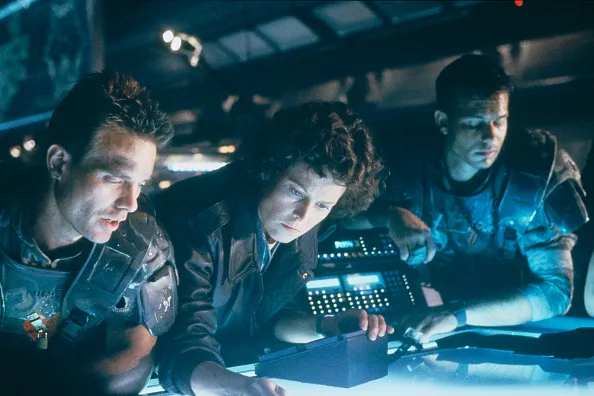
“My mommy always said there were no monsters… but there are.” “Game over, man.” “Get away from her, you bitch!”
Released on July 18, 1986, James Cameron’s Aliens remains a cultural touchstone four decades later, celebrated for iconic, much-memed quotes, intense action, Oscar-winning effects, and Sigourney Weaver‘s indelible performance as the ass-kicking Ellen Ripley.
“I know it’s been 40 years, but to be honest with you, it doesn’t feel like it,” star Michael Biehn, who memorably portrayed Cpl. Dwayne Hicks, tells Gold Derby. “It seems like yesterday,”
The film’s acclaimed producer Gale Anne Hurd agrees that unlike many of the relics of 1980s cinema, Aliens remains fresh. “I’ve seen it multiple times in movie theaters in the past couple of years and it really holds up,” she says. “Even the visual effects hold up, which is remarkable considering the technology back then.”

Here, the producer and star share their favorite memories making the movie, what it was like working with Cameron and Weaver, the poignant scene that didn’t make the cut, and how it felt staring down those very real Xenomorphs on set.

Chaos behind the scenes
Biehn’s role almost didn’t happen. Production was already underway in London when the original Hicks suddenly exited the shoot.
“I was cast in Aliens was because James Remar, the actor who was originally cast as Hicks, had a drug problem, which he’s been very open about,” Biehn explained. “I think he’s been sober now ever since then. But they had to let him go.”
Having already built a strong shorthand with Cameron and Hurd on The Terminator, Biehn was thrilled to step in despite the incredibly tight turnaround.
“On a Thursday, I get a call from Gale asking if I could play Hicks. Of course, that was just a no-brainer, and I said yes immediately. Monday morning I was on the set dressed in Hicks’ outfit,” Biehn recounts. “Jim knew what to expect from me and I knew what to expect from him and Gale. Both of them are just dynamos and I loved working for them.”

That mutual trust proved vital as they navigated a rigorous shoot in the U.K. — a setting Hurd described as a “big culture shock.” As the producer explains, the decision to fire Remar and bring Biehn aboard was one of many major on-the-fly changes.
“Two weeks in, we had to fire our cinematographer,” Hurd explains. They tapped Adrian Biddle, who was working as a commercial director at the time and proved up for the challenge. Biddle, who would go on to shoot The Princess Bride and earn an Oscar nomination for Thelma and Louise, was, Hurt says in retrospect, “a perfect, perfect hire. He was fantastic.”
The showdown to secure Sigourney
But the biggest challenge to getting the film off the ground was getting Sigourney Weaver onboard. Hurd recalls how Weaver held out for a bigger paycheck to reprise her role as Ripley from the 1979 Ridley Scott original.
“I’m so proud of her for insisting on more money than I believe any woman had ever made to star in a film before to be in this sequel,” Hurd says. “But you’ve got to remember that back then, sequels were not common. It wasn’t expected that a sequel would make more money than the first movie, and Fox didn’t want to establish a precedent. But she stood firm, and Jim refused to write a script without her in it. Ultimately, we all agreed and moved forward. But can you imagine the film without Sigourney? Nope. I don’t know what movie it would’ve been.

Weaver would go on to earn a Best Actress Oscar nomination for Aliens, a groundbreaking nod for a sci-fi movie. However, for Hurd, true impact of Weaver’s performance reached far beyond box-office receipts and Hollywood accolades.
“I got a letter from a domestic abuse shelter, and they said they used this movie to empower women who are in abusive relationships to leave,” Hurd shares. “There is no more powerful statement to me than that.”

A tragedy left on the cutting-room floor
While the conflict between the overmatched space marines and the terrifying alien horde drive the film’s edge-of-your-seat action — the bond between Ripley and young survivor Newt, played by child actress Carrie Henn, forms the emotional core. Hurd points to one heartbreaking scene as a favorite.
“Ripley and Newt have both been traumatized obviously and Ripley’s trying to put her to bed and Newt says, ‘You’ll never leave me, will you? ‘ And Ripley knows how big this promise is,” Hurd recalls. “Sigourney says, ‘Cross my heart and hope to die,’ that makes me tear up right now.”

But Hurd reveals that particular moment carried even more weight due to a poignant backstory that didn’t make the theatrical release. In the original script, later restored in the director’s cut, Ripley discovers that the daughter she left behind on Earth had died of cancer during Ripley’s 57-year hypersleep.
“She always had the personal trauma of promising to come home,” Hurd explains, adding that another cut sequence showcased the happier, early days of Newt and her family in the colony before the alien infestation.
“When you have contractual running time limits, that was one argument trying to get the longer running time that we lost,” Hurd says. “However, you’ve got to remember back then there weren’t multiplexes; there were individual theaters. By having a movie over two hours long, you lost a screening per day. And it’s not like you could offset times in another theater in the same complex, so it was a big deal.”
No CGI? No problem
With zero CGI available at the time, the production relied entirely on full-body stunt performers in latex suits, animatronic heads, and intricate rod puppets to bring the terrifying Xenomorphs to life. The Alien Queen was a massive, 14-foot practical rig operated by a synchronized team of puppeteers, hydraulic cables, and technicians hidden inside the suit.
When it came time for the frightening aliens to descend on set, one primary concern for Hurd and Cameron was protecting the 9-year-old Henn from being genuinely freaked out by the monsters surrounding her.
“Jim and I were terrified that we would give her nightmares for life that perhaps she’d be traumatized,” Hurd admits. “And I remember the iconic scene when the alien warrior rises up behind her and she turns around and she screams. We were so terrified and had child psychologist discussions, all of that to make sure that we were not going to ruin the life of this wonderful young woman. And she looked at us both and she said, ‘It’s just a man in a suit,'” Hurd recalls with laugh. “We were the ones with the problem.”

That undeniable physical presence on set is exactly why Hurd believes the 1986 film continues to outshine modern green-screen blockbusters.
“The actors are actually interacting with the creatures, whether it’s the Alien Queen or the Terminator. They’re there on set. And they have done studies to show that the human pupil, if there’s nothing there, doesn’t react in the same way. So however great someone’s performance is, it’s never going to be the same as if there was something there for the actor to respond to,” she says.
The Motion Picture Academy agreed. The aliens-making team of Robert Skotak, Stan Winston,
John Richardson, and Suzanne M. Benson won the Oscar for Best Visual Effects. (The film, which had a total of seven nods, also won for the now-defunct Sound Effect Editing.)

Witnessing a ‘goddamn roller-coaster’ in theaters
The true magnitude of the team’s accomplishment wasn’t truly known until the early screenings. For Biehn and the late Bill Paxton, the realization came by sneaking into the projection booth at a New York City cinema.
“Bill and I watched the movie for the first time through the projectionist little square,” Biehn said. “When that movie ended, both of us just were jumping for joy and high-fiving each other and screaming. I can remember Bill Paxton saying, ‘It’s a roller-coaster, Michael. It’s a goddamn roller-coaster!'”
Hurd experienced the same visceral energy while watching the movie with an audience on Hollywood Boulevard.
“There was one woman who was so into the film. She managed to pull the arm off of her seat and she was slamming it on her partner’s leg,” Hurd remembers. “And honestly, at that point, Jim and I weren’t watching the movie, we were watching the audience react to the movie. Every film I’ve done since, there have been some terrific reactions, but nothing that matched that.”
Biehn agrees there’s something undeniable about Aliens.
“I believe it’s the best movie that I’ve ever made,” says Biehn, who also starred in Cameron’s Terminator and The Abyss. “I believe you could put in theaters now and nobody would know that it was made 40 years ago. And that’s just a testament to Jim Cameron’s brilliance.”
