
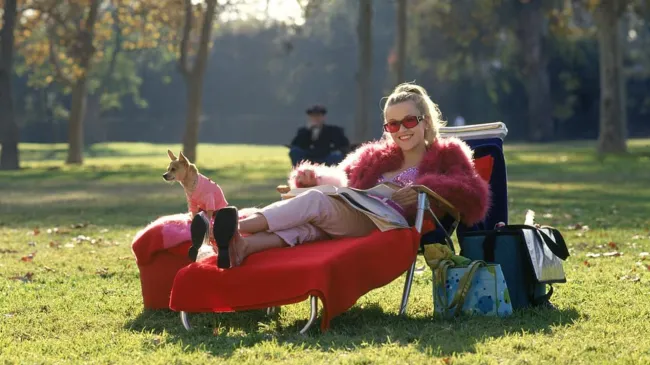
It’s hard to believe that Hollywood didn’t see Legally Blonde coming. Much like Reese Witherspoon‘s iconic Elle Woods herself, the movie was an underdog. Made for $18 million, the sleeper hit grossed approximately $141.8 million at the worldwide box office. Now, as the comedy celebrates its 25th anniversary, it is considered a classic.
“It was not on the radar of a lot of people when we made it,” explains Kirsten “Kiwi” Smith, who co-wrote the film with Karen McCullah Lutz, as the pair chat with Gold Derby. “It didn’t have a ton of cooks in the kitchen monitoring it.”
“Legally Blonde was made with the leadership of Mark Platt, our producer; we were never replaced as writers, and we had first-time Australian filmmaker Robert Luketic directing. For the very early stages, we got to make the movie we all wanted to make, and we became an unexpected sensation.” Before Legally Blonde, Platt had only produced Josie and the Pussycats and Campus Man. Still, over the last quarter century, he’s also given audiences the Oscar-winning La La Land and both Wicked movies among countless other crowd-pleasers.

Legally Blonde sees Witherspoon play Woods, a fashion-obsessed sorority queen who follows her ex-boyfriend, Warner (Matthew Davis), to Harvard Law School. Once there, she discovers that there is so much more to her than just her looks. As well as Witherspoon, who already had Election, Cruel Intentions, Pleasantville, and American Psycho under her belt, the film boasts an ensemble cast that includes Luke Wilson, Selma Blair, Victor Garber, Jennifer Coolidge, Holland Taylor, and Ali Larter. It also features a cameo by future Longlegs filmmaker Osgood Perkins as Dorky David.
Legally Blonde was inspired by Amanda Brown’s then-unpublished novel of the same name, which was based on her real-life experiences as a blonde attending Stanford Law School. Just like Witherspoon’s Elle, Brown was obsessed with fashion and beauty. The adaptation came about after the author met with Platt, who helped Brown restructure her work into a manuscript. That’s where Smith and Lutz came in.
When you think about Legally Blonde, what is the first thing that comes to mind?
Karen McCullah Lutz: The first thing that comes to mind for me is joy because it was a joy to make, it’s still a joy to watch, and it brings us a lot of joy that so many people still love it after all these years. It also felt a little bit like summer camp. We were on set every day; we were all very young at the time, and the studio left us alone. It was almost like, “Do you think they remember we’re making this movie?” We all just showed up every day and had a blast, so it was a very unique experience that way.
That’s something a lot of people in the industry don’t get these days.
Kirsten Smith: It was an extremely charmed experience in that regard. We were really lucky. We were quite innocent, and we’ve come to realize how rare that is as the years have gone by. We’ve come to appreciate how special it was to make that film.
Lutz: I think it was because the studio trusted Mark so much, and Mark trusted our script so much, that it was just like, “Let’s go. Make a movie and have fun, ladies.” It was a blessing.
Smith: We adore Mark so deeply. He got the rights to that book; we were the writers he brought into the studio; we were the sole writers on the project, and we were always invited and treated as partners. He’s an amazing leader; he trusted us, and we trust him with anything and everything.
It was a sleeper hit. Reese was well-known and already acclaimed, but even then, Legally Blonde was not expected to be the massive hit it became. What do you recall about the theatrical release?
Smith: There was like an amazing marketing and publicity team at MGM, led by and publicity team led by Eric Kops and Adam Keen. They were so creative and out-of-the-box when it came to promoting the film. They had floats in the Pride parade, and Regis Philbin dyed his hair blonde. They wrote the playbook. These are now common, but they were so original at the time, and the spend was super strategic. When we’d be like, “Where are all the billboards?” Mark would say, “Billboards don’t matter. We’re spending the money on TV spots and on these other strategic things,” so there was a lot of smarts involved. I was personally shocked that we opened at No. 1, but Karen was manifesting it.
Lutz: I’m ridiculously optimistic, so for the whole week before it opened, I was like, “We’re going to be No. 1,” and everyone was like, “Oh, sweetheart, don’t get your hopes up,” but I did.
Smith: The movie’s premiere happened maybe a week or two before, and they really went crazy. They rented the Hammer Museum. We screened the movie at the Mann Village Theatre (now known as the Regency Village Theatre) in Westwood. It was an extremely large premiere with Chihuahua rescues, blonde wigs, and mani-pedi stations, so that was probably a clue as well. There was a lot of goodwill from MGM and a desire to launch the movie properly. That was a very fun premiere, and they took it really seriously. For opening night, we went to a movie theater with our friends for a group screening. We rented the Beauty Bar on Cahuenga and had a party with maybe 7,500 people, or however many could fit in that club. We had Phantom Planet play a set, and by midnight, we knew we were No. 1. It was a very thrilling night we’ll never forget.
And come Monday?
Lutz: Mark Platt called us at like 6:15 in the morning. It had been tracking to open at $12 million, and I kept saying, “No, it’s going to open at $20 million,” and he was like, “Honey, the tracking’s right. It’s going to be $12 million.” So, he called me up and was like, “Remember how you said it was going to open at $20 million? Well, you were wrong. It opened at $20.4 million.” I was so excited.
Let’s talk about the evolution of the script. First of all, was Legally Blonde always going to remain the title?
Lutz: Yes. That was the title of Amanda Brown’s manuscript, and we loved it. They had to change the title in Europe because “legally blind” isn’t a phrase in most European countries, and Legally Blonde is obviously a riff on that phrase, so in many countries it was called Revenge of the Blonde. For instance, in Italy it was La rivincita delle bionde.
Is it true that you only did 10 drafts of the script? That’s not many.
Lutz: Not many at all. I believe we completed five or six drafts on our own, then gave a few to Mark, and completed two for the studio.
Smith: I think one of the reasons we give Mark his flowers is because he’s very good at developing scripts, he’s really surgical, and you never felt this fear of thinking, “Oh no, we’re just going to be developing with this producer for draft after draft.” He was really a great guide.
Lutz: He would say things like “We need a scene where we see that Elle’s smart before she gets to Harvard,” so that’s where the dress shop scene came in, where she puts the saleswoman in her place.
Smith: The bend-and-snap sequence was something that came about later in the process. Mark had us meet with Reese when she was cast to really go through it and make sure we’re getting her ideas and vision for the character baked in. He was never trying to keep us from any part of the process. Also, when the director, Robert, was hired, he had a great idea for the opening sequence, which is still in the movie, that would bring us into Elle’s world.
Lutz: We went with Robert to all the different sororities at USC and UCLA because they don’t have sororities in Australia, so we toured that world for him. We drove past Aaron Spelling’s house so he could picture the neighborhood where Elle grew up. I think Kirsten was mugging for the security cameras, and we heard, “We see you,” or something from their security over the intercom.
Smith: Other than those research trips with him, which were pretty informal, he trusted the writing in the script.
Lutz: I lived in a sorority house, and mine was not nearly as ornate as the one in the movie. Now, of course, you go to colleges in the South, and they live in giant mansions that look like the Four Seasons, so Robert was ahead of his time on that one.
Smith: The movie was this magic mix of the right director and the right screenplay, because he wasn’t trying to make it something it wasn’t. He was leaning into what made it what it was. It was the same with Mark. He was always on set, and he fought for it to be its own unique creation.
So, what was it that Reese brought?
Lutz: First of all, she was the perfect person for the role.
Smith: As we all know, she has incredible comedic timing and so much vulnerability and humanity in what she does as an actor. She has so much bounce, sparkle, and intelligence that can’t be faked. Reese was able to bring fierceness and determination while remaining deeply endearing and vulnerable. Her toolkit is so vast that we still feel like the luckiest writers alive that she wanted to make it. Reese also had some really cool ideas about the sorority sisters and about making sure that those two characters, even though they weren’t roles she was meant to play, were super differentiated and specific. I remember that being a part of our conversation, making sure Margo (Jessica Cauffiel) and Serena (Alanna Ubach) were very different from each other.
What was the toughest thing to crack with the script?
Lutz: Making law school look interesting. The whole murder trial was a lot of legalese and jargon that we had to get totally 1,000% right. Mark insisted that any legal statute cited, and anything in the law classes, had to be real, so we were combing through law books and trying to figure out how to make the law classes sound exciting. That’s when we came up with the whole sperm defense from the sperm donor. We were like, “OK, let’s give that law class a little flavor.”
Smith: Our favorite parts to write were the relationship. The set pieces, like the bend and snap, and that whole arc with Jennifer Coolidge’s character, Paulette, and the UPS guy, came later in the script. There were a couple of weeks where we knew we had to create this B-plot, and it wasn’t going great. We rejected a lot of ideas. We were like, “OK, what happens if the nail salon gets burgled? What are we going to do?” but we actually came back to asking ourselves, “What is our superpower?” and that is romance and character dynamics, so we took it from there. We thought, “What if Paulette is interested in someone and Elle can help her with that? What if she’s got a bad relationship with an ex that she can solve with her legalese?” so we returned to our North Star.
The bend-and-snap sequence in the salon is a fan favorite. Toni Basil choreographed a whole dance sequence for that scene. Was it shot in its entirety?
Smith: I don’t know if that was in the original cut, but it was a much longer sequence. There was an early version where it felt like the movie fully stopped, and there was a proscenium musical number. In the edit, everything got tightened and smoothed, as always happens in movies, and it became the perfect length. It’s a little bit of a musical number, but it’s not the full five- or however-many-minute version it was in an earlier cut.
How much did the casting influence the script? Were there moments that came organically once they formed their chemistry?
Smith: We were invited into the rehearsal process, which was another really cool, empowering thing for writers to be included in, and is not normal in features. Alanna Ubach speaking Vietnamese in the nail salon, being fluent in that language, and little touches like that were coming up in rehearsal. We were in the room when that happened, so we’re able to capture those details. Alanna is a comic genius, so that was really very cool. This movie got greenlit because the script was ready and right. It wasn’t a thing where the movie got greenlit before there was a script. That sometimes leads to chaotic, quick decisions and rewriting on set. We had a screenplay that we all knew worked, so I feel like that is the benefit of doing it that way, as opposed to having a start date and an actor-available project that’s not ready.
Lutz: I remember one ad lib during shooting that made the movie. It was the scene in the courtroom where Enrique’s boyfriend stands up and says, “You bitch.” We had a bunch of alternatives for that line. We were like sitting there with the extras, and we’re all weighing in on like what line should this be, and Jason Christopher, the actor playing Chuck, said, “What if I just stand up and say, ‘You bitch?'” and I was like, “Yes, please! That’s the one.” Every time I saw it in a theater, that line got the biggest laugh of the movie. When he came to our party at the Beauty Bar, I was like, “Dude, thank you!”
There are so many fan-favorite quotes. Do you have your own?
Lutz: Oh, my favorite is, “If you’re going to let one stupid prick ruin your life … you’re not the girl I thought you were.” That’s Professor Stromwell’s line. A lot of people love Enrique saying his whole little “Don’t you stomp your little last-season Prada shoes at me, honey” line.
Smith: I like that we invoked Coppola directing her Harvard admissions video. I like “I object,” which isn’t a great standalone line, but in that moment, it’s very funny. There was a crazy Madonna joke in the beginning where Elle says, “I love that restaurant! I heard Madonna went into labor there,” that I heard for the first time in a long time at a screening at Cinespia in L.A. recently. I was like, “Why did I not remember this in there?” It really made me laugh.
Elle has become an iconic character, and Legally Blonde continues to inspire and influence so many.
Lutz: I meet a lot of lawyers who say they went to law school because of Legally Blonde. I meet a lot of young female screenwriting teams and film students who say the movie is referenced in different classes and books. Also, so many young female screenwriters came of age watching this movie and feel really inspired by it. It’s very cool that we’ve given that to a generation of filmmakers and screenwriters.

Do you still have the original scripts?
Lutz: Our agent at the time had them bound for us with this lovely leather cover.
Smith: I have all of the drafts in my garage. I would say there are more than ten, because we would do a lot of internal drafts among ourselves. I probably have 25 versions of the script.
Lutz: In some of those drafts, we might have just changed one line or punctuation and stuff like that, so we didn’t present those. I auctioned off a page of one of those old drafts for charity, and it went for quite a bit of money. I also still have the yellow plastic Delta Nu cup from the sorority party in the beginning. That’s the only thing I took from the set, unfortunately.
Smith: I have a couple of cute photos, but I don’t think I have anything else from the set. I wish I had some of those clothes. My gosh, where are they all?
Lutz: They’re probably in Reese’s Closet. She kept them all. It was in her contract to keep all the clothes.
Smith: That’s right because she has an archive. That’s so cool. We should give a shout-out to Sophie De Rakoff Carbonnell, our incredible costume designer. We love her and what she did.
