
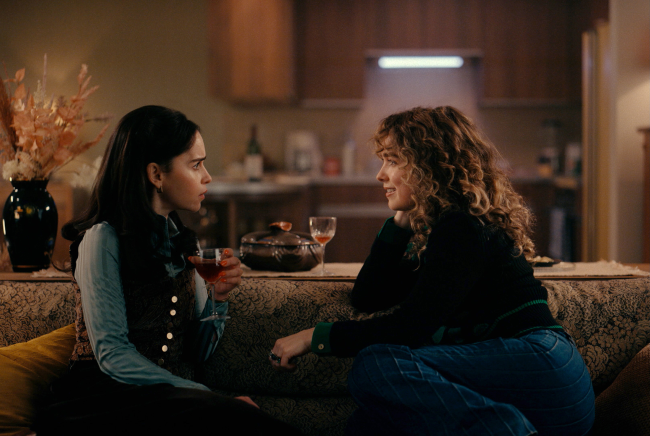
There’s a reason you don’t see television series set in the past all that often. When it comes to filling the frame with era-accurate details, everything needs to be from a different time. With Peacock’s spy thriller, Ponies starring Emilia Clarke and Haley Lu Richardson, production designer Sara K White had some additional challenges.
First, everybody knows what the ’70s looked like — or, more specifically, they have a conception of what the decade was. And secondly, Ponies doesn’t limit its setting to just one country during the era, but two. White had to recreate both the U.S. and the USSR during the Cold War while shooting in Budapest, which made the domestic antiques ironically harder to find.

White spoke with Gold Derby during our Emmys production design panel and shared some of the rich history she found in prep.
Gold Derby: What are the challenges that come with doing a period show? Is everything more designed when you’re talking about 1977 versus 2026?
Sara K White: There are so many opportunities to work with an incredibly rich design history, but you are working from a template. I had done very deep period and very shallow period. Those each come with their own opportunities and drawbacks, but this is a time period that is very indelible and revered. There’s so much history, and so many people know that history and are fans of that history in the design world, so there is a lot of pressure in doing it right — for America and for Russia.
How did you end up striking a balance between what you were seeing within research and what you found visually interesting for yourself?
It was a lot of just finding and also what was available to us. We shot in Budapest, and it’s not a tremendously large city. It’s a city with great history, and there’s a lot of analogous architecture because it was part of the Eastern Bloc and part of the Soviet Union, so a lot of the aesthetics were very similar. But we didn’t have a tremendous amount of prep, and I didn’t know the city going in. I’d spent all of my time researching, just understanding what made Russia tick at the time. Then it was just a matter of driving around the city and being like, “Wait a minute, that’s interesting. Wait a minute, this looks like one of my references,” and trying to pull all of those things together.
Where did you turn when you started looking for period details?
When it finally started to gear up and get close to a green light, I started going to the New York Public Library’s Art and Architecture room, digging in super, super deep. I had a joyful summer before I went to Budapest, spending three or four hours a day for weeks at a time, going through all of the books about Russian art and architectural history and Russian folk art and the history of the architecture and the way that the socioeconomic forces were driving the building of housing stock that looks like the thing that you think of when you think of a Russian apartment in that era. It was a lot of time there actually and working to dig through real tangible resources and trying to find like the obscure Russian fashion magazines at the time, which there were very, very few of, and I only caught glimpses of them because of the state control of the output of media.
Were the 1970s as brown and orange as people imagine?
There were a lot of primary colors actually. I watched a lot of Russian movies that were certainly propagandist movies telling the story of people who are having a good time in the Soviet Union. But they also really showed, if not the actual fashions, the aspirational fashions of the time, and there was a lot of color, a lot of red but also like a lot of blues, a lot of yellows, a lot of pattern. Pattern on pattern was as ubiquitous there as it was here, so it was something that we just really fell in love with and wanted to exploit.
With some of these sets and locations and building out the details of them, how much were you able to source and how much needed to be fabricated?
It was very easy to source anything that was from the Soviet world in Budapest. Building out any of those sets was just second nature to our team. A lot of the people who were working on the show were like, “We’re just building my grandma’s house.” Some of our actors came in and would show me pictures of them sitting at their aunt, uncle, or grandparents’ house and be like, “Look, it’s the same.” But the American stuff was really hard. We didn’t have an ability to shop in the States and bring anything over. We mostly shopped from the continent, so we did bring stuff in from London. We got one container from Universal, who sent some stuff over from New York, but we actually fabricated so much stuff.
This interview has been edited for length and clarity.
This article and video are presented by Peacock.
