
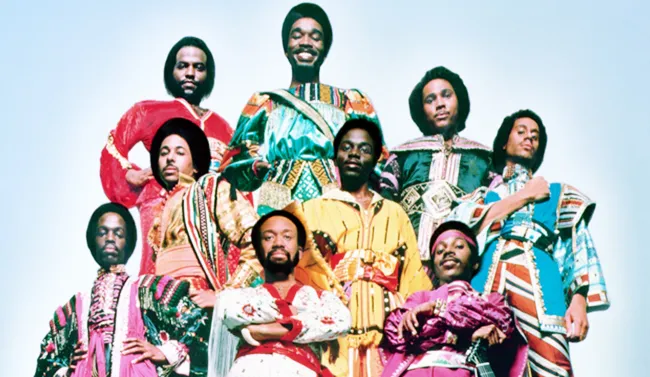
The first voice you hear in Earth, Wind & Fire (To Be Celestial vs. That’s the Weight of the World) belongs to Barack Obama. It’s a deliberate choice by director Questlove — and when you ask Philip Bailey about what it felt like to see that for the first time, the singer’s answer is heartfelt: “I wish my mom was still here so she could relish in it.”
The HBO original documentary — which opens the 25th Tribeca Festival on June 3 before debuting June 7 on HBO — is Questlove’s third consecutive master class in Black music history, following his Oscar-winning Summer of Soul and 2025’s acclaimed Sly Lives!
The film’s connection to the Obama White House runs deeper than that opening moment. When Barack Obama was inaugurated, Earth, Wind & Fire was the first group he called to perform at the Governor’s Ball. “It was surreal,” says Verdine White. “He took the paradigm off the paradigm and he took us with him.” For three men who grew up in an America that couldn’t have imagined a Black president, the full circle of that moment — from Chicago’s South Side to the White House to the opening frame of their own documentary — is not lost on any of them.

Surviving band members Philip Bailey, Verdine White, and Ralph Johnson sat down with Gold Derby to talk about the film, the legacy of late founder Maurice White, and what they hope audiences carry with them when the credits roll.

Gold Derby: The first voice we hear in this documentary is Barack Obama’s. What did it mean to you to see that?
Philip Bailey, vocalist: As African American men who couldn’t have dreamt that we would even have a Black president — for him to be connected with us in that way, and to contribute, is humbling and gratifying. I always say, “I wish my mom was still here so she could relish in it.”
Ralph Johnson, drummer: It’s very cool to see Barack Obama in the documentary, because when he first took office, we were the first group he called to play for one of his affairs at the White House. The Governor’s Ball.
What was it like being invited into the White House in that historic moment?
Verdine White, bassist: It was surreal. Life-shattering, historic. He took the paradigm off the paradigm and he took us with him — and he’s from Chicago, so that had a big place in my heart. It was beautiful.
Johnson: It was super special. The White House is something you see on the news all the time, but you don’t ever expect to be there one day. And we made it.
Questlove has now made three extraordinary music documentaries in a row. What were those early conversations like, and why was he the right person for this?
Bailey: Kahbran White — Maurice’s son, who owns the trademark — made that decision after talking to several directors and looking at what Questlove had done with Summer of Soul. Just the whole rhythm of that piece, how you were entertained and informed at the same time. We were very happy that he chose Questlove, and we knew he would knock it out of the park. He has.
After decades together, you’d think there are no more surprises. But Questlove spent years in those archives. Did the film teach you anything new about each other — or even about yourselves? What was it like to watch it?
Bailey: I didn’t necessarily learn anything new — I think I actually learned more listening to Ralph’s book (Rhythm & Fire: A Life in Harmony With Earth, Wind & Fire). But the film was very entertaining.
Johnson: I’m with Phil on that. I didn’t learn anything new, but it’s so interesting to take this retrospective look back. We’re 50-plus years into this, and when you look back at all that you’ve done, you kind of lose track of all the work.
White: Seeing your life in front of you — things were refreshed in my memory. And Ralph’s got a great book, by the way. Not to just chime in and give him a plug, but it’s a great book.
Johnson: [Laughs] Thank you, thank you, thank you.
The film tells Maurice’s story — including parts that were difficult and less than flattering. How do you feel about telling his story on his behalf, showing all sides of him?
Bailey: I’m glad we’re doing it now, at this part of our maturity — with grace and mercy in our hearts and minds. Maybe earlier it could have become something different than what it is. Now it’s just part of life, part of life’s learning experiences. I think Maurice would be very pleased with the way his story has been told.
Does time make it easier to look back at those harder chapters with more understanding?
Bailey: I think we’re able to see it from a different perspective now. We’ve been touring 30 years longer than when we toured with Maurice — and knowing the ins and outs, the good and the ugly about touring, there’s a lot more grace and understanding now than there would have been before.
The film traces your influence on Prince, Stevie Wonder, and a whole new generation through hip-hop sampling. What is it like having the music take on that kind of life?
Bailey: A lot of people know the music through films they watched as kids, or through songs that have sampled us. It’s a very positive thing — the music has been able to take on a life of its own.
“September” is its own cultural phenomenon at this point. When a song is so popular, do you ever get tired of playing it?
Johnson: Every night we hit the stage, each of us tries to give a personal best. We’re never just slacking — we’re coming to get it every night. We’re probably one of the most consistent bands on the planet.
Stevie Wonder, Lionel Richie, the Obamas, H.E.R., Flea — the range of people in this film is extraordinary. Was there anyone whose participation surprised you?
Bailey: Everyone, honestly — because we weren’t expecting any of it. All of those artists were so gracious. They’re icons in their own right, and for them to talk about the influence our music had on them was very humbling.
White: When we first started, we had no idea. We admired so many people coming up — we had no idea that one day other people would give us our flowers. We’re jumping in and enjoying every moment of it.
The music industry has changed enormously. Could a band like Earth, Wind & Fire be built today?
Bailey: Well, we’re still playing to sellout crowds — large halls, small halls — and still having a lot of fun. We’re getting ready to start our third tour with Lionel Richie, which always sells out. Judging by the crowds, the music is still very much in style.
I interviewed Dionne Warwick recently, and I asked her which artist she never got to record with but always wished she had. She said Earth, Wind & Fire. So I have to flip that — who is the one artist you never got to record with and wish you had?
Bailey: [immediately] We love Dionne, by the way.
No one actually comes to mind just like that — but whenever we’re asked, it’s a great honor.
[Dionne, the door is open.]
What do you hope people feel when they walk away from this film? Not what they learn, but what they feel?
White: Joy.
Bailey: And hopefully it whets their appetite to go deeper — find out more about the catalog, and maybe come out and see us live.
Johnson: You’d hope they come away with a broader understanding of what we did back in the day, and everything we’ve done since.
This interview has been edited for length and clarity. Earth, Wind & Fire (To Be Celestial vs. That’s the Weight of the World) debuts June 7 at 9 p.m. ET/PT on HBO and is available to stream on HBO Max.
