
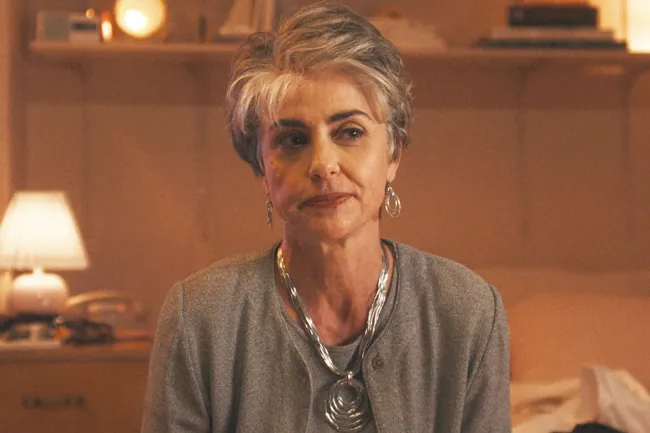
When FX‘s Love Story: John F. Kennedy Jr. & Carolyn Bessette drew to its devastating close, the final moments belonged not to the doomed couple at the center of the story, but to the woman who saw it coming all along. Constance Zimmer plays Ann Messina Freeman — the mother of Carolyn Bessette-Kennedy and her sister Lauren, both of whom died in the 1999 plane crash alongside JFK Jr. A woman who wasn’t famous, wasn’t a Kennedy, and wasn’t on any tabloid cover, but who saw what this relationship was doing to her daughter, and wasn’t afraid to say it. It’s her voice, reading a poem at the funeral of both her girls, that carries viewers out of the series.

Zimmer had no idea that’s how it would end. Not until she watched it.
“In the script, it wasn’t me in the entire voiceover,” she tells Gold Derby. (Read our full Q&A below, or watch the video above.) “I was in a section of it, but I wasn’t in all of it. So it was actually a surprise to me.” The discovery came in stages. After production wrapped, she asked Ryan Murphy directly which speech he’d used in the funeral scene. “He said, ‘Oh, we used the poem,'” she recalls. “And I was like, ‘Oh, OK, that’s cool’ — because I was so partial to what she actually read.” What she didn’t realize was that the final cut wove both together and let her voice run all the way to the end. “I still didn’t know it was going to be me the whole time.”
Shooting those scenes had been grueling. Zimmer filmed two versions — “Death Is Nothing at All,” the poem Messina Freeman actually read at the funeral, and another selection, “Do Not Stand at My Grave and Weep” — in front of a church packed with extras. “It was incredibly hard,” she says. “Very hard to live in those emotions for half a day.” So when she finally saw the finished episode and heard herself carry the whole thing, the reaction was equal parts surprise and gratitude. “I was actually really moved and also very humbled. I found it incredibly powerful and I was like, ‘Wow, that’s really cool.'”

Gold Derby: Ann Messina Freeman isn’t a household name, but she carries one of the heaviest losses in this story. What was your process of learning about her and preparing for the role?
Constance Zimmer: The first thing I did was look up what she looked like — to see if I could believe I could look enough like her. And when I thought, “We kind of have the same mouth and eyes, and with a wig, maybe it’ll work,” I felt like I could clear that hurdle. Even though people didn’t really know her well enough to scrutinize the resemblance, obviously more photos of her came to light after the tragedy — because that’s part of the story, right? Nobody really cared about the people in Carolyn’s life who weren’t famous.
I read the book the show is based on (Once Upon a Time: The Captivating Life of Carolyn Bessette-Kennedy by Elizabeth Beller), and I looked up anything anyone had ever said about her. Finding out she was an elementary school teacher told me a lot. She had this fiery wit, a real strength, and above all a deep, passionate love for her children — especially when she felt her daughter was being pulled away from where she thought she should be going. All of that was a very good base for me to work from. And since she and Lauren — played by Sydney Lemmon — weren’t people the audience knew well, we had a little more freedom to put our own stamp on who these women were.
What was it like when you first put the wig and costume on and looked in the mirror?
It was a trip. The first time I just put the wig on in my own clothes, I was like, “Wow, she’s kind of cool.” But when I put the actual costume on and looked in the mirror, I was like, “Oh, that’s her. That’s it.” It was really wonderful to look in the mirror and not see myself, but to see her. And then you step into the shoes and the clothing, and it’s a whole other level of stepping into the character.
She didn’t just lose Carolyn — she lost Lauren, too. Two daughters in one crash. How do you find the emotional truth in something that immense?
The hardest thing was not to play the emotion of it, but to not let the ending be in the beginning. We all know the story. I knew what was coming, but I couldn’t play those early scenes knowing they were going to die. Having to gather all that information and then throw it away — that was the hardest part. Because you watch those scenes back and they feel so much sadder when you know that in just a few years they’ll be gone. The mom was right. And that makes it even more heartbreaking.
But I’ll tell you — we have so much grief in our lives that I don’t think we allow ourselves to feel very often. So having a character where that’s all she was feeling allowed me to just let it be there. I didn’t have to think about anything else. I just had to think about what that must feel like. And I don’t ever want to know what that feels like. I think what I was going to need to do was give people a space to grieve.
Was any of it fun? Because you’re also the spark of the show — whenever you were on screen, something was going to go down.
Oh yes, a lot of it was fun! All of it was fun except the last episode — that’s the only one that wasn’t. I love being the woman in the room who is unfiltered, not afraid to say what everybody else might be thinking. I was excited knowing she had this really sharp wit too. That scene with Paul Anthony Kelly at the top of the stairs, where she says, “Yeah, I know you believe that” — I was like, “Yeah, that feels real.” It’s not that I don’t like any of you. I’m just calling it like it is. And a lot of times when women are honest like that, they’re looked at differently.
The wedding episode was so fun to film, because I grew up with that story and all we ever wanted to know was what the wedding was like. They did such a good job of keeping it so secret. To get to live in that and elaborate on something that happened in secret — “Can you imagine if they really did put guests in the backs of trucks?” — that was just cool. They were so cool. We had a lot of fun.
The finale ended in a way I didn’t expect — with Ann’s voice, Ann’s eulogy. It really ends on her terms. What was it like reading that script?
That was something that changed in the edit. In the script, it wasn’t me for the entire voiceover — I was in a section of it, but not all of it. So it was actually a surprise to me. When we shot those scenes, I had to do two versions: [“Death Is Nothing at All,” the poem that Ann actually read at the funeral, and another poem — “Do Not Stand at My Grave and Weep.”] It was incredibly hard. Very hard to live in those emotions for half a day in front of however many extras were in that church.
I was really moved and humbled that they used my readings all the way to the end. I didn’t know until I saw it. I even asked Ryan Murphy which speech he used in the funeral scene, and he said, “Oh, we used the poem.” And I said, “OK, cool,” thinking it was just one piece. It’s actually a combination of both — I think they did such a beautiful job with it. But I still didn’t know it was going to be me the whole time. So that was pretty cool.
What is it like being in the Ryan Murphy universe? Do you hope to stay?
I’m waiting by the phone. Just waiting — let’s go. It’s incredible, it’s a machine. So many of the cast and crew have worked together before, so there’s this very easy way of being on set. I worked on a Ryan Murphy show a long time ago — The New Normal — but I was in one scene and it was so fast. So I was just really excited to be back in the Murphy-verse. I would like to live there. It’s a nice place to be.
Take us back to 2016, when you got your first Emmy nomination for UnReal. What did that mean to you then, and what does it mean now?
That was a big deal. It was July, so I was in France on vacation — not thinking about it at all. My friend called me and said, “Oh my God, you got nominated for an Emmy!” And then my team called, and they were so mad that my friend had gotten to me first.
It was more surreal because UnReal was a show that not everybody was watching — versus something like Love Story, which has taken on a world of its own. There are still people today who say, “UnReal? What’s that?” But then it became a phenomenon, and now that it’s on Netflix it has this whole new fanbase, which is very exciting.
Being recognized for your work — whether it’s a nomination or a win — that feeling never goes away. Everyone’s biggest thing in life is just to be seen in whatever they do, not just as an actor. When people talk about something you’ve done, it’s like: people saw me and I did something that meant something to them. The nomination is just as huge as the win. When I won the Critics Choice Award for UnReal, I laugh at pictures of myself — I’ve never seen someone so shocked. Maybe after you’ve been nominated 20 times and never won, you’d be over it. But I find it all just so exciting.
Any final thoughts heading into Emmy season?
I feel very fortunate and grateful to be a part of this cast. This is stuff you don’t ever imagine happening when you get a role. You’re just excited to get the role. So all of this is bonus material.
This interview has been edited for length and clarity. Clips in the video above are courtesy of FX Networks and Hulu. Love Story is currently streaming on Hulu and Disney+.
