
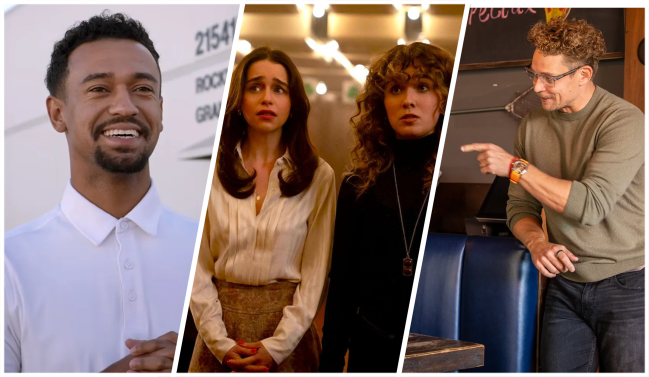
The job of a production designer is to make all of the hard work that they do disappear. The viewer isn’t supposed to wonder how the filmmakers managed to recreate the Soviet Union in 1977, subbed in Vancouver for Silicon Valley, or filmed an entire company outing without the central figure knowing.
Gold Derby spoke with the production designers from some of this year’s most lauded shows, including Sara K White from Ponies, Joe Warson from Jury Duty Presents Company Retreat, and Mark White from The Audacity, about how they managed to create worlds that were instantly believable without drawing too much attention to themselves. Click each name above to watch an individual chat with that person.

Gold Derby: When you are trying to explain your job to somebody outside of the industry, what do you say that you do?
Sara K White: I say that everything the light touches is our responsibility. It really is taking care of the storytelling and taking care of the vision of the show with all of the elements — if they’re not the actor or not worn by the actor, but sometimes that they are. It’s my responsibility to tell the best story and to make a visually cohesive project with all of the tools that come with that.
Mark White: It’s the visual storytelling. It’s giving life to the worlds that these actors or characters live in and explaining who they are. It’s the look of the show. It’s the colors of the show. That’s ultimately, for me, what I think about when I think about what I do.
Joe Warson: I’m just trying not to get caught.
You all have had great, varied careers. What are some of the biggest ways that your job has changed over the course of your career?
Sara K White: The first projects I worked on were music videos for tiny indie bands that nobody knew of, directed by my friends who had just graduated from film school. I was in the art department of one, and sometimes also the costume department, and bizarrely also hair and makeup, because I was the only girl on set. So shouldn’t I do that too? It was a very long process of building both my knowledge of the film world — because I came from interior design and architecture — and learning what a set was, which I did boots-on-the-ground, like driving a truck on these small films because I didn’t have anyone else to drive the truck.
Mark White: My start was also in the New York indie world in the ’90s. Everybody’s doing everything. We’re all painting. We’re all driving trucks. It’s a really, really great way to learn the business. I don’t think it happens as much as people are coming up now as it used to. I just know for me, I couldn’t have gotten to where I am now without that sort of hands-on experience early on.
How would you describe the perfect relationship between production designer and showrunner?
Warson: It’s just building up to the trust, right? For instance, on Jury Duty, it was about letting us go into a room and ask, “Where do you want that?” And then letting us decide what that’s going to look like, how that’s going to work, how [the camera is] going to disappear. It’s about trusting that and knowing that we’ll always get it done under budget for the most part and be able to do it.
Sara K White: With Ponies, I had a relationship already with co-creator Susanna Fogel. It was my fourth project with her and her partner, David Iserson, which is invaluable to be able to come into an experience, especially when the prep time is always so truncated in any of these shows that we’re doing now, to not have to go through the awkward feeling-it-out period, but to be able to step immediately into conversations where you don’t have to be worried about what somebody might be reading off of some of the comments that you have or some of your ideas. You’re able to just bring out all the ideas, no matter how bad, no matter how crazy, and feel like you’re heard and understood and everyone’s along for the ride of figuring out what sticks and what doesn’t.
Before we wrap up, do any of you have questions for each other?
Mark White: I’m really curious, Sara, about the whole idea of shooting in Budapest and sourcing vintage American materials. I had to do something like that once, but not on the scale that you had to, so I’m fascinated with that challenge.
Sara K White: I know!
Mark White: I mean, even the electrical outlets.
Sara K White: That’s actually an amazing comment because my set decorator became obsessed with outlets because in the embassy [on Ponies], they generate their own power. So it’s all American power with American appliances, and they plug in American lamps. And obviously the plugs are different. So we 3D printed fake plugs and put them over the cords so that we could pretend things were plugged in and then they go through that outlet and then plug it into the real power source behind the wall.
Mark White: That’s cool!
Sara K White: You guys both have so much glass in your sets. I feel like you’re both using and fighting reflections at the same time. Joe, did you end up like using the reflections to help you to obfuscate what cameras were hiding behind?
Warson: Well, sometimes just to camo if I have a long lens camera out in the field, especially when they’re doing that hiking stuff, we would just take a piece of two-way mirror and tilt it down so it blends with the grass. I’d also have it cut with a water jet, so that it looks not so squared-off. Those are the best hides.
This article and video are presented by AMC, Prime Video, and Peacock.
