
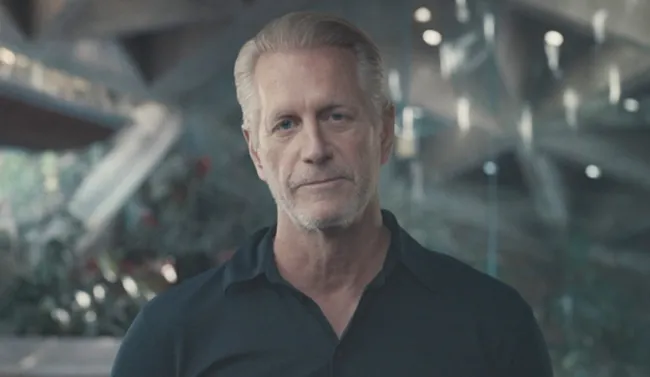
When director Chris Smith first heard Hoyt Richards tell his story, he almost couldn’t believe what he was hearing.
“The mix of this world of fashion and modeling, and this other life that he was leading — it seemed hard to believe that they could coexist in the way that they did,” Smith tells Gold Derby.
Richards was one of the first male supermodels, a fixture of the glossy 1980s fashion world. At the same time, he was sleeping on a mat in a Manhattan apartment, funding a New Age cult, and believing — sincerely — that he was the luckiest man alive.
That story is now the HBO docuseries Bring Me the Beauties: A Model Cult, premiering June 1. But the more remarkable thing is that Richards is the one who wanted to tell it.

“I’ve watched a lot of survivor stories,” he says. “It just feels like that information — that’s a duty to share. Because why else did I go through it?”
The Promise
It started on a Nantucket beach in 1978. Richards was 16 years old when he met Frederick von Mierers, a self-described Manhattan socialite who preached a mix of astrology, Eastern philosophy, and self-realization. The group von Mierers ran was called Eternal Values, and it would consume the next two decades of Richards’ life.

The seduction was gradual. Richards says von Mierers encouraged members to immerse themselves in glamour and luxury while remaining emotionally detached from it.
They would go to Studio 54 — but they would not drink or do drugs.
“We were just dancing,” Richards says. “The idea was just see it for what it is, experience it, laugh, dance, have fun. But ultimately you should be able to walk away from it because that’s not ultimately what’s real.”
Richards now sees von Mierers as a narcissist who surrounded himself with ambitious, attractive, well-connected young people. “He would always over-inflate people in a sense,” Richards says. “And yet I never really inquired about him and his life.”

The Cash Cow
After college, Richards moved in. He slept on a mat, attended spiritual sessions until dawn, and as his modeling career exploded, he wrote check after check to keep the operation running.
“He played me so well,” Richards says. “As long as I keep giving the cash, I’ll be OK. And it worked like a charm on me.”
The more money he gave away, the more his career flourished — and he credited the group.
“I’m thinking it’s because of Eternal Values,” he says. “The more money I’m giving away, the more money I’m making. I’m like, ‘Oh, this is how it works. This is awesome.'”

At the time, Richards didn’t see himself being exploited. He saw himself helping. Visitors would come to the apartment for life readings, pay hundreds of dollars, then emerge looking emotionally wrecked. Von Mierers would tell Richards the person had fallen on hard times — and Richards would hand over more money.
“I can look back at it and say, ‘Duh, how could you not see it?’ But I didn’t want to see it,” he says. “You really become your own worst enemy in these situations.”
The Turn
For years, the group preached celibacy. Then, gradually, it didn’t. “Celibacy was enforced because that was spiritual life,” Richards says. “But then we’re all in our 20s and attractive — things were just getting too tense. And so then his rationale was, ‘Don’t get involved with other people (outside of Eternal Values), just do it with each other. And be unattached.’ That’s just not the way people are wired. And so that’s where the abuse happened.”
Smith watched this evolution in the archival footage and through hours of interviews. “I think they did start in a very altruistic place,” he says carefully, “in terms of trying to be a group that worked on becoming the best version of yourself, self-realization. And through things that transpired, I think it evolved into a place that was very far from where it started.”
When von Mierers died, Richards expected things to collapse. Instead, they got worse. A new leader rose — someone who had always resented the special treatment Richards received as the group’s most famous and most financially valuable member.
“Freddie really did treat me with kid gloves because I was the golden goose,” Richards explains. “Because of that favoritism, there was a lot of resentment that built up within the group. And so after Freddie died, we went through the power struggles and this other guy rose into the position of power — he had a deep, deep resentment for the way I’d been treated. And so I was treated much more harshly and abusively in that next 10-year period than I was with Freddie.”
The leader told him, repeatedly: “I just wish you weren’t such a pussy so you’d kill yourself. Put me out of my misery having to deal with you.”
“And I would think about ways to kill myself,” Richards says. “And I was like, ‘Yeah, at the end of the day, I just don’t think I can do it.’ And thankfully.”
“I’m Going to Give Hoyt Sanctuary”
His exit, when it finally came, arrived in the form of a man with a mane of flowing hair who apparently cooked great pasta.
Fabio Lanzoni — yes, that Fabio — had been one of the first models Richards ever met. “It’s like meeting Thor,” Richards says, laughing. “He’s just kind of bigger than life, but he’s so down to earth. And he’s from a very wealthy family, so he’s very polite and elegant.”
They were friends — gym buddies, club companions — but Richards had never brought Fabio anywhere near Eternal Values. When Richards finally hit bottom, with no money, a shaved head, and an excuse he’d invented about some “extreme modeling job,” he showed up on Fabio’s doorstep in Los Angeles.
“He just let me come in. He said, ‘Let’s go to the gym’ and let me incubate for a year. And we’ve talked about it since. He’s like, ‘I just knew when you were ready, you would come talk to me, but I was not going to probe you.'”
“And no questions asked — that was the beauty. Because I couldn’t answer those questions. But the last thing I wanted to do was be asked them either.”
Smith, who interviewed Fabio for the series, was struck by what his instincts had been. “Interviewing Fabio was amazing because he just had such wisdom about him in the way that he understood — without knowing anything — how he was there for Hoyt in the best way possible.” Smith continues. “When I would tell people this story, it was like, ‘Interesting, interesting, interesting, interesting.’ And then when he finally escapes, he goes to live with Fabio for a year and a half — it was the thing that just made everybody say, ‘OK, I have to see this.'”

The Recovery
It took Richards nearly 18 months after leaving Fabio’s house before he fully understood what had happened to him. That it had been a cult. That what he’d experienced had a name.
Today he works with families trying to reach loved ones still inside groups like Eternal Values. The advice he gives them is counterintuitive but hard-won. “The last thing you want to do is confront the person,” he says. “You want to build bridges rather than confront.”
The cult’s pitch to members, he explains, was precisely designed to make outside intervention backfire. “They were telling me, ‘The brainwashing all happened before you met us. Your parents, although they completely mean well, brainwashed you. Now you’re finding out the truth. So we’ve pulled you out of the matrix. They’re still in the matrix. They don’t even know the matrix exists. Unconsciously, they’re going to try to pull you back in. You have to have the strength to isolate from them.'”
So instead of confronting, he tells families to ask questions. “‘This seems really important to you. I want to understand why it’s so important. Are there things I can read?’ Try to infiltrate into their world so you can understand — and maybe meet other people so you have more credibility later when you can have a more open conversation, because you’re not seen as adversarial.”
Smith believes the film matters precisely because Richards is not who we imagine when we imagine cult members. “Hoyt is somebody that I think many people will be able to relate to, and not understand how that person could have ended up in this situation,” he says. “You have somebody from such a great background — educated, smart, articulate — and that he ended up in this situation made me realize that this is something that could happen to anyone in the right circumstances.”
Richards agrees — and he extends the lesson. “Many of us may be in cultic relationships without even realizing it,” he says. “Whether it’s political parties, religions — there are elements of cultic relationships that exist all around us that we may not even be aware of.”
He’s still reaching out to people he knew during those years. Some hang up. Some don’t. Recently he reconnected with someone he hadn’t spoken to in nearly 40 years.
“Not talking about it really does not serve you very well,” he says. “I’m hopeful that when this thing comes out, maybe more people will reach out.”
