
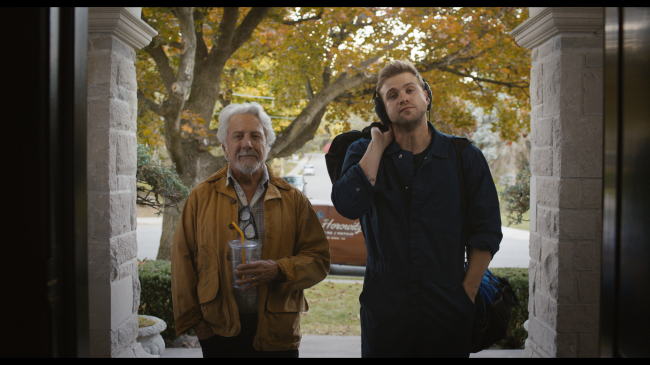
Having broken through with The White Lotus, Leo Woodall has stolen scenes from the likes of Renee Zelleweger (Bridget Jones: Mad About the Boy) and Rami Malek (Nuremberg). But here comes Daniel Roher’s new film Tuner, where the actor finds himself improvising with legendary Hollywood icon Dustin Hoffman.
The thriller casts Woodall as Niki, a musical prodigy-turned-piano tuner with hyperacusis, a rare hearing condition that leaves him sensitive to loud noises. As it turns out, that’s a skill that’s helpful for cracking safes. When his mentor, Harry Horowitz (Hoffman) suffers a medical crisis and looming bills, Niki gets recruited by a gang of thieves eager to make use of his talents.

Tuner marks Roher’s first narrative feature — his documentary Navalny won the Oscar in 2023 — which makes it even more remarkable that he lets the two actors have so much freedom in their scenes together. Speaking with Gold Derby, Woodall shares with his experience working with Hoffman, which he describes as “the most fun I’ve ever had acting.”
Gold Derby: What’s harder — piano playing or safe cracking?
Leo Woodall: Oh, definitely piano, though neither of which I’ve mastered in any way, shape, or form! The piano is a fascinating and challenging and very beautiful instrument, and I have so much respect for the people who can do it at the level that our characters do it.
How much training did you have to do for the role?
It was hours every day for months. I didn’t really know exactly what level I needed to be at to play Niki, but it was clear very quickly that if we didn’t put in the work to really understand this instrument as much as we could, then the movie would start to fall apart.
Take me back to the beginning. What was it about Niki that drew you to the role?
There were many different reasons. I felt like I grew close to him and was drawn to him when realizing how lonely he is. In my ordinary life I always want to look after people who have any kind of loneliness. It just kind of f–ks me up. And with Niki, he really is that. He’s this 26-year-old guy who could have been living his best life, and instead he’s got Harry and [his wife] Marla [played by Tovah Feldshuh], who he loves, but he hasn’t really got anyone else. He doesn’t have any friends, he doesn’t have a girlfriend, he can’t go on dates, he can’t go to parties, he can’t live a life that I was fortunate to live in my 20s. It made me realize how much I take for granted.
Was Dustin Hoffman already attached when you signed on?
I don’t know if it was definite, but it was very close, and that obviously was something that I never thought I would get the opportunity to do, so this film felt like a gift.
What did that mean to you to work with Dustin?
It’s hard to really put it into words. All I can say is that his career, his body of work, all the films that he has given to cinema, and been in my experience have affected me at all the sort of different points in my life. I was a young kid growing up watching Hook at least once a year, and then as a young actor learning about acting and learning about film. Watching All the President’s Men and Kramer vs. Kramer, I already loved him, and it would have been totally OK if I didn’t also then get the chance to work with him and hang out with him. That was a gift in itself to get to just converse with him and hear all his stories. He’s got a million stories. He’s magic.
I would imagine those scenes between the two of you were heavily improvised.
Oh, yeah.
What was that like? How did you even begin to keep up with him?
I don’t know, man. I did my best.
You did a great job.
I think if I had known how much improvising we were going to be doing, I would have maybe gotten so much anxiety about it that I would have gotten cold feet. But Dustin just lives his character, and I don’t mean in like a method way. He’s just so present and he’s so alive, and there’s something new every time. I’d never experienced that before; it was just the most fun I’ve ever had acting.
Did you take away anything from the experience of filming those scenes with him?
A lot. He didn’t do this actively, but his level of care and love and passion for making movies is so built in him. Regardless of how anyone else looks up to him or counts [the statuettes in] his awards cabinet, or just talks about his legacy, you can just feel that it’s because he cares about the work. And that inspired me. He treats every take like a rehearsal, so that was that was one of the main things I learned from him, too.
I’m curious about the experience of making the film, because there’s so much joy and pace and humor that comes across in the edit. How much were you able to capture that in the experience of making the film, and how much did you know was going to come through when you saw the final product?
Just by chatting with Daniel every day, his vision for the edit [came across]. I didn’t really mind being a part of the editing process, even on set, because he never wanted it to compromise performance or anything like that, which I appreciated. There are some sequences in the final cut that were in the original script; the needle drop of Nina Simone’s “Sinnerman” was always there, and I loved it. I remember reading that, putting the script down, getting up Spotify, and playing the song, because I thought it was really cool, and I wanted live it as soon as possible.
What moment are you proudest of from the film?
That opening scene is still pretty surreal for me. I’ve seen the film twice now, and that opening scene — just seeing me in a scene with Dustin — you can’t help but feel pride.
This interview has been edited and condensed.
