
“I love you. Thank you. I forgive you. Please forgive me.”
A few weeks ago, I was sitting by my dying mother’s bed, searching for ways to say goodbye to her, when a scene from the first season of The Pitt popped into my head.
It’s an occupational hazard — as a longtime entertainment journalist, I’m so immersed in movies and television that it’s often hard to separate my personal life from my professional one.
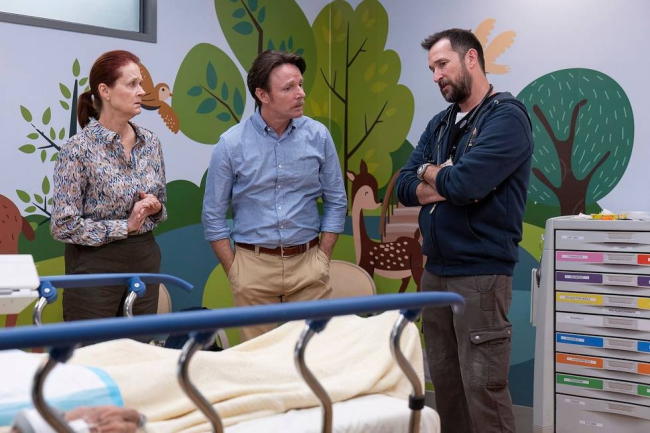
As I held her hand, I remembered Dr. Robby (Noah Wyle) helping two adult siblings come to terms with their elderly father’s DNR (do not resuscitate) order. He shared with them a ritual he’d learned that he hoped would bring them comfort. “I had a teacher, mentor, who told me about a Hawaiian ritual called ho’oponopono, or ‘the four things that matter most,’” he said. “It’s basically just a few key things that we can say when we’re saying goodbye to a loved one that can really help at the early stages of loss.”

And so I found myself telling my 88-year-old mother: “I love you, thank you, I forgive you, please forgive me.”
It’s what my sister and I had been saying for the past hours at her bedside, but giving our thoughts and feelings that structure gave me a sense of purpose and focus — and ultimately relief. Over and over again, we told her how we felt. We recounted stories from our childhood, laughing and crying, and though she was mostly unresponsive, I do believe she heard us. Her breaths rose and fell with our own. I’ve got a famously loud laugh, and when I burst out cackling at one memory, I felt her gaze lock on me.
“You’re not the first person who’s told me that that helped them,” Wyle told me later, when I was back at work. “The fact that we got that messaging onto the show and have helped people in that incredibly difficult time, gives me a lot of — I don’t know what the right word is — well, it makes me feel wonderful.”
Wyle said he’d met Dr. Ira Byock, the author of The Four Things That Matter Most, during the show’s first season. “He saw it more than anecdotally be proven time and time again to have a really tangible effect,” Wyle said. “So I’m thrilled that you found it to be true, too.” When the subject came up in the writers’ room, he raised his hand to fold it into the episode, “10:00 AM,” which bears his writing credit.
That’s one of his goals with the series, Wyle said. “We’re trying to build bridges, we’re trying to connect hearts,” he said. “It’s trying to be an empathy generator.”
We may complain about the character flaws and cast changes, but just two seasons in, The Pitt has changed the way we think about healthcare. Call it The Pitt Effect: Like CSI and Law & Order: SVU, the series has made an impact beyond the screen into our hearts and minds along with our politics. According to a study by the University of Southern California’s Norman Lear Center, a third of viewers of the end-of-life storyline — count me among them — sought more information about end-of-life planning after watch the show; 1-in-4 did the same for organ donation.
Supriya Ganesh (Dr. Samira Mohan) told me she’s often approached by women who’ve found their voice to advocate for their own healthcare — women with chronic disease who haven’t been believed. “I hear from a lot of people with chronic disease, chronic pain conditions where they weren’t believed, especially women of color, who really want this doctor,” she said. “I think someone like Dr. Mohan really represents the doctor that’s like, ‘No, I am going to listen to you, and I am going to take what you’re saying seriously, and even though other people are calling you crazy.’”
Taylor Dearden (Dr. Mel King) and Tal Anderson (Becca King) talked to Gold Derby about how the show changed how people think about autism and neurodivergence. “What the writers are getting right is that they show the diversity of autism in an authentic way, by introducing each neurodivergent character in their everyday lives,” said Anderson. “They don’t focus on the stereotypes, and disability isn’t the story.” Dearden reflected on how much that meant to both of them, especially in having a character who’s autistic not rock back and forth stereotypically. “To have something where you can, as Tal has pitched to writers going, here’s what I personally do when I’m reacting to heavy stress, and the writers being like, please do what you know… it’s pretty cool,” she said.
The impact of the show’s production in L.A. has been well-documented — so much so that Wyle testified before Congress about the impact of tax incentives on the state. “It’s really hard to shoot a TV show in L.A. and it’s really expensive, prohibitively so — unless you adopt an economic model which takes full advantage of the California tax incentive,” he told Congress.
And of course there’s the ICE episode, which triggered a social media firestorm. “It was something that was happening in the country and happening at hospitals,” Gemmill explained to Gold Derby. “We basically try and portray the reality of what’s happening in healthcare today, and that seemed to be part of it.”
And for me, it changed the way I approached my mother’s deathbed. I didn’t get to say goodbye to my father, who’d died suddenly in his sleep over a decade ago. I’d often thought about what I wanted to say to him if given the chance — but when it came to it when it was my mother’s turn, it was harder than I thought to put words to it. Thinking about that Pitt scene made me feel a little less tongue-tied.
I love (and miss) you, Mom. Thank you for making the woman I am. I forgive you — and I hope you’ll forgive me for sharing this story.
