
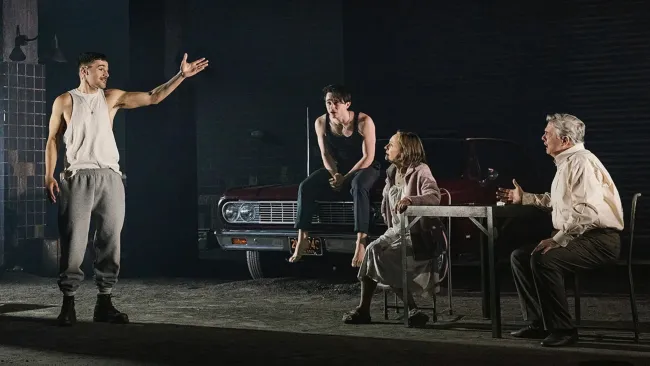
Believe it or not, prior to landing her Tony-nominated role in Death of a Salesman as Linda Loman, Laurie Metcalf had never seen a production of Arthur Miller’s classic American tragedy. In fact, as she tells Gold Derby, she had deliberately steered clear of all prior stagings of the 1949 drama.
“I thought, ‘Who knows? Maybe down the line, I’ll be able to play Linda,'” the actress says of that decision. “I really do mean it when I say that if I have seen somebody’s performance, it’s going to stick with me no matter when I saw it or where or who it was. I wanted to go in fresh, and not influenced by anybody.”
The fact that director Joe Mantello selected her for the Tony-contending revival — which he has been developing for the better part of three with star Nathan Lane as Willy Loman — turned out to be what the actress characterizes as “a lucky turn of events.”


Though Metcalf had never seen Salesman and says she hadn’t cracked the spine of the play in decades, she’s not unfamiliar with Miller’s plays. Two decades ago, she starred in a 2006 production of All My Sons at the Geffen Playhouse opposite Len Cariou and Neil Patrick Harris. Asked what makes Miller’s writing so unique, she answers with a knowing smile: “Great storytelling, great characters, and a hell of an ending.”
In taking on the mantle of Linda, Metcalf says she’s had to “remind” herself about “how shocking Death of a Salesman was” when it was first staged in 1949. “The way the boys talked to each other about women, the things Willy is teaching his sons, him even just being caught in the hotel room [with another woman] — these things packed a bigger wallop back then,” she notes.”
Of course, Metcalf is also part of a moment that packs a wallop — one that has come to be known as the “Attention Must Be Paid” scene. That’s when Linda confesses to her sons Biff (Christopher Abbott) and Happy (Ben Ahlers) that their father has made multiple suicide attempts. In her version of the scene, Metcalf brings a ferocity of emotion to the dialogue, especially the sound she makes as she struggles to tell her two boys the truth of their family situation.
“It was only a few weeks ago that I stumbled upon having a hard time saying, ‘This is really hard to say,’” reveals the actress of how her performance of the scene has evolved. “It’s a long-ish scene, so we get a lot of good traction going, but the climax to it for me now is [saying], ‘I don’t know what to do.’”
Metcalf also attributes the “traction” of that scene to the way Abbott and Ahlers play their respective roles. “The boys are very protective of her,” she shares. “That’s on the page, but those actors are so open, they’re so physical, they hug me, they hold my hand. None of this is planned out; they just sell it. It’s not an easy play to do, but I enjoy doing that part of the play with them.”
Salesman‘s climactic confrontation between Biff and Willy also demonstrates the quartet’s innate chemistry. “I have the ringside seat,” says Metcalf as she reflects on watching Lane and Abbott’s wrenching work. “Linda Loman forced it, and I never put that together. She’s kicking the golden boy out, and telling him I made my choice. Happy and I are watching him leave for the very last time, and things will never be the same again. In my mind, it’s a really striking picture.”
Metcalf also does unexpected and moving work in her final lines of text, as Linda takes the family’s recently paid-off mortgage deed from her pocket and buries it beneath the dirt adjacent to Willy’s grave. “I never know if it’s too anticlimactic,” confesses the star, adding that “a lot of performances have been a lot of sobbing.” Instead, what Metcalf sought to tap into for those final moments is “truly not understanding, ‘Why at this time? Why did you do it?'”
“I can’t figure it out,” she says of Linda’s mindset in those closing moments. “We were almost there. It’s like a betrayal. I’ve lost the teammate, the partner in the end.”

As if starring in Death of a Salesman wasn’t enough for one season, Metcalf also spent the fall headlining the Broadway production of Samuel D. Hunter’s Little Bear Ridge Road, which earned a Tony nod for Best Play. “I am so happy for him,” she says of Hunter. “I can’t believe he wrote that part for me. The thing that was spot-on was the sense of humor in it — so dry, so Midwest. I loved doing that play. He’s going to have a long career, and I hope I’m able to do a lot more Sam Hunter plays.”
Asked why she continues make the stage a priority while also juggling television and film roles, Metcalf jokingly chalks it up to “selfishness.”
“I came up doing the theatre, it’s where I feel the most comfortable,” she continues. “I just keep gravitating back to it. I like the storytelling, I like the immediate, instant gratification of having an audience in the room with you. I find it’s where I’m most creative; I get a lot of rehearsal… so I get to really dig around and figure out the most exciting way to tell the story through my piece of the puzzle as one actor in a show.”
