
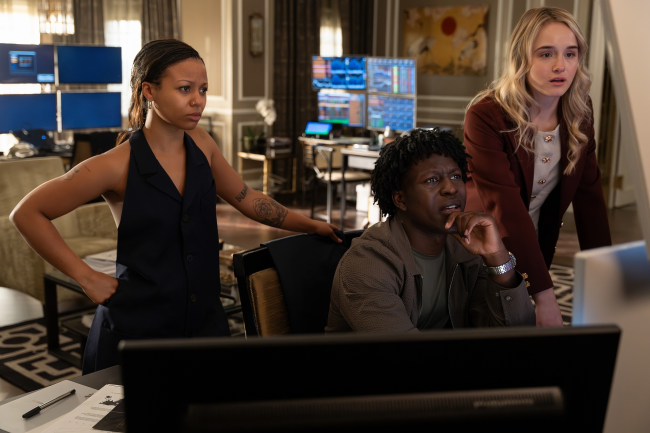
Industry co-creators Mickey Down and Konrad Kay have never played it safe, but the latest season of their critically acclaimed HBO series represents their biggest creative gamble yet. The just-concluded fourth edition transformed the show into a high-stakes financial thriller that saw Harper Stern (Myha’la) take down a fraudulent fintech startup.
While Harper scored a massive career win, her relationship with Yasmin (Marisa Abela) was left hanging by a thread, and her mentor, Eric Tao (Ken Leung), terminated their business partnership amid a sex scandal involving underage girls. The season finale culminated with Harper sitting on a private jet, contemplating whether she’s finished with finance. Given the recently announced fifth and final season, it’s safe to say that she’s not quite ready to retire.

Gold Derby caught up with Down and Kay — who are currently writing Season 5 — to delve into some of Season 4’s biggest moments, including Rishi (Sagar Radia) hitting rock bottom, Max Minghella singing Whitney Houston, and how Harper and Yasmin’s journeys have mirrored each other. The showrunners also teased how Industry’s swan song will feel both “surprising and inevitable.”
Gold Derby: Season 4 was a soft reboot of the series. How did you both want the show to evolve after we leave Pierpoint?
Mickey Down: That’s a good question, considering the show feels so different in Season 4. The bones of it are pretty much the same; me and Konrad can’t write away from what our sensibilities are. We like writing provocation, and we like writing about the world in which we live. This season was exciting to us because we were evolving to something that feels a little bit more genre-led. It’s a conspiracy thriller, it’s a comment about the political ecosystem in the U.K, and it has action sequences in some respect. But it’s still really about the characters we grew up with at Pierpoint — that’s why I hope it was a successful soft reboot.
If the first season of the show was Season 4, it might feel a little like it was leaning on tropes. But because we had the buy-in of the audience having watched the two female leads grow from grads to where they are now — occupying positions of quite significant power — that’s why it was exciting. The show has always been concerned with watching competent people f–k up quite often, and how you bury your vulnerability in pursuit of the profit motive. That was as true when Yasmin was going on a salad run in Season 1 as it is in Season 4 when she’s playing with statecraft and Russian espionage.
The idea of yearning has also always been important to Industry. The show is always dismissed as this cold, calculating depiction of late-stage capitalism, but I do think it’s about people who are broken. They work in a transactional world, but they’re people who just want to be held and loved and form relationships. That’s what the show has always been about, and it’s turned up to 11 in Season 4.
The show is definitely more sentimental than you guys get credit for.
Konrad Kay: The show is fundamentally about me and Mickey trying to find a way to tell each other we love each other. [Laughs]

Harper becomes a “world killer” in Season 4, and also has some major emotional breakthroughs. Why was it the right time for her to start letting some walls down?
Kay: I guess because we’re four seasons in! There’s a version of this show that runs for 20 seasons where moves through the world and is pretty much the same person. We felt that it would be an interesting character journey for the shark of the first few seasons to butt up against her own sense of ambition and morality, stuff that wouldn’t be in Harper’s peripheral vision when she was so focused. As she ascends the mountain, she starts to enjoy the view, and gets this more existential feeling of like, what kind of life am I living? Who am I living it for? What sort of person do I want to be?
These are very big questions, obviously, but as we were getting into Season 4, we knew she was going to have this historic career win. What does it mean for someone like her to achieve this stuff? Mickey made the point that these people are trying to fill a hole in themselves. Once you’ve tried to fill that hole with material stuff, then where does it lead you? As we write the fifth season, we keep talking about this, particularly as it pertains to these two women. It’s always been an ensemble show, but the axis of Harper and Yasmin has carried us through the first four seasons.
Down: In the first season, Eric is telling Harper to be a world killer in the first episode, and to be a world killer, you have to be on top of every transaction. Every single conversation in the first two seasons is a transaction. Even in Season 3 when she’s outside Pierpoint, she’s still reacting to Pierpoint. Now that Pierpoint no longer exists, we wanted to ask: “Was it Pierpoint driving this self-serving attitude she had? And without Pierpont, who is she?”
By the end of Season 4, Harper is — for all intents and purposes — incredibly successful. But then she looks around and sees the consequences of her success, and she thinks, “Maybe I’ve been pursuing the wrong priorities.” She has a reckoning at the end of Season 4 that we’re going to take into Season 5 about her morality and what it means for her ambition. That’s not to say that she won’t return to the default like everyone else in the show, but there needs to be a next leg of her emotional journey that isn’t just picking up a phone, making a trade, and being successful.
Kay: We want to be surprised by the characters as we write them. That’s by far the best thing about narrative TV, being able to live with characters for years of your life and taking them on these spectacular journeys that you could never accomplish in a two-hour movie. We know how the show ends, but being able to surprise ourselves with those images when we’re in the writers room is the joy of television.
Just when we thought things couldn’t get worse for Rishi (Sagar Radia), his arc comes to a brutal conclusion midway through Season 4. Why was it important to have him reach rock bottom?
Down: The decision to bring Rishi back has always been driven by our love for Sagar and his performance as much as anything else. In Season 1, he was a secondary actor who came to life via ADR that we did after we shot. We wanted the trading floor to feel experiential, so we wanted to hear this quite funny trader that’s shouting obscenities in the background, and Sagar was really good at doing that. In Season 2, we gave him his own storyline, and in Season 3, we gave him his own episode to see if he could carry it — and he could. He’s a fantastic presence, one that felt very organic, but also quite novel for television in that it’s a brown man who acts depraved.

In Season 4, he was out of the finance game. We made that huge decision at the end of Season 3 — quite honestly, because we didn’t think we were going to come back [for another season] — and we didn’t want to walk it back. So we couldn’t have him just working with Harper as a trader again, so we used it as an opportunity to explore what happens to someone if they’re pushed out into the real economy. You’re still ambitious and avaricious, but now you don’t have the money or the career to back it up.
What does a person like that do to make quick money? Probably sell drugs. Would he have a bit of self-reckoning about his wife? Probably not, given who he is. People always joke about the characters having sociopathic tendencies, but I think Rishi is a character who leans into that mold. He hasn’t really had a reckoning about who he is. Even in the face of his wife being shot, he’s behaving the way that he was in the first few seasons.
Down: His conversation with Jim Dycker (Charlie Heaton) is a reflection of modern masculinity. It’s the worst kind of conversation you can have with the worst kind of person at the worst possible time. HBO said to us that it was incredibly unpleasant to watch — even more so in the director’s cut version that was 15 minutes long. It was an endurance test.
Kay: They kept trying to get us to take time out, and we kept trimming two frames out of it and saying, “There you go!”
Ken Leung told us he shot some material that was left on the cutting room floor. We also see a flash frame of Whitney (Max Minghella) in the credits of the season finale. Might we revisit any of those threads in Season 5?
Down: You’re beholden to runtime when you write TV. HBO is very hot on that, as they should be. There’s discipline in telling an hour’s worth of story. We write long scripts, and we shoot long episodes. The cutting process of getting them down to 58 to 63 minutes means that we have very tight, fast-paced episodes, which I think serves the atmosphere of the show well. Obviously, you’re going to lose stuff that you really like. There are versions of the thing that became the post-credits scene at the end of the finale that maybe one day might be leaked, because they were really atmospheric, sentimental, and so well-acted. But you’ve just gotta lose stuff for runtime. That was a casualty, unfortunately.

We have to talk about Harper and Yasmin. They go out partying in Episode 7 and relive their youth, but everything comes crashing down in the finale. Where do they go from here?
Kay: There’s a yin and yang to their relationship that we’ve always leaned into. It’s a bit like sports — how quickly can we give Marisa and Myha’la the ball again? Especially if you’re shooting nine pages a day sometimes, you want to know that when you give someone a hyper-emotional scene, they can deliver. The show has been an ensemble show, but Marisa and Myha’la are so energetic and charismatic. We just love writing for them, to be honest. As the seasons went on, their journeys began to mirror each other in this really interesting way and now it feels like whatever the final statement of the show is will ultimately be a statement about their relationship.
How have current events influenced the types of stories you want to tell?
Down: It’s very hard to write a contemporaneous show set in London without writing about what’s happening in the world, especially when its through the prism of business. Otherwise it becomes a hermetically sealed show within a workplace that doesn’t seem to vibrate against anything that is happening in the real world. We’re interested in the rise of autocracy and right-wing politics around the world, as well as state interference in different countries. Because the show has been allowed to evolve — and credit to HBO for allowing us to do that — we try and write about everything we’re interested in. Even though we don’t sit in the writers room and say, “OK, this season is going to be about the rise of autocracy,” it’s also impossible to ignore.

You co-directed “The Commander and the Gray Lady,” which is almost entirely focused on Sir Henry Muck (Kit Harrington). Clearly standalone episodes are special in the Industry universe — what excites you about telling self-contained stories?
Kay: The whole season is really Henry’s tragedy and his relationship to his identity, and then his willingness to be deceived. I don’t think the season works as well if you’re not totally underneath his internal psychodrama. Spending all that time in his psyche makes what happens to him more tragic and nuanced. A lesser show would go potentially from, “I need to find a new CEO” to “Henry’s the new CEO.” The show is really about how people define themselves through their professional lives, so from a narrative point of view, as well as a kind of cinematic experience, it really earned its place for us.
Music is such a crucial part of the show. Do you have a favorite needle drop from Season 4?
Kay: I could give you 15 answers, but the one that just popped into my head is the Trance song at the glory hole — “Silence” (DJ Tiesto’s in Search of Sunrise Remix). And also the song that plays when Rishi finds Dycker dead, “Set You Free” by N-Trance.
Down: I love “Where the Streets Have No Name (I Can’t Take My Eyes Off You)” by the Pet Shop Boys at the end of Episode 2. It feels glorious and romantic. It’s one of those things that Industry always does — there’s a moment of triumph before everything goes to s–t. [Laughs]
This interview has been edited and condensed.
