
By the end of the 1970s, Garry Trudeau was riding high. Doonesbury, the quintessential political comic strip of the 20th century, had just earned him an historic Pulitzer Prize for its dissection of the Nixon administration and Watergate. He soon found himself accompanying the White House House press corps during the Carter administration and befriending the likes of ABC News’ Sam Donaldson, who would become the inspiration for Doonesbury’s Roland Hedley.
With a culture-defining comic and unfettered access, it was inevitable that Trudeau would set his sights on Hollywood. He drafted a screenplay for a film called The Zoo Plane that combined his political insight and signature wit. What should have been a slam-dunk, was anything but, however. The Zoo Plane failed to lift off, as A-list director after A-list director passed.

Trudeau’s ill-fated dalliance with Hollywood — which also included a follow-up project that attracted the interest of Jennifer Aniston and Jeff Daniels — is chronicled in the new book Trudeau & Doonesbury: A Biography. In the following exclusive excerpt, author Joshua Kendall draws on original interviews with Trudeau and previously untapped archival material to explain how it all went wrong.
I had a lot of near misses. — Garry Trudeau
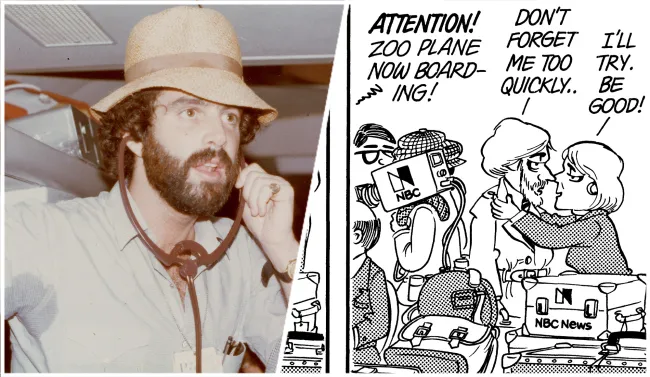
In 1979, Trudeau began turning his experiences traveling with the White House press corps into a filmscript. In those days, the media entourage trailing the president on overseas trips filled two charter planes. The fancier one flew the first group, which consisted of network stars like Sam Donaldson along with the leading reporters from the major newspapers. In contrast, the so-called Zoo Plane, as Trudeau noted a few decades later, “carried those further down the pecking order — reporters from less exalted publications, field producers, cameramen, White House staffers, and assorted riffraff like me.” As Rick complains to Joanie in a 1978 strip, behavior on the Zoo Plane was typically wild and crazy:

But for Trudeau, still less than a decade removed from his Davenport College days, hanging out with colleagues who drank too much and tended to gyrate widely in the aisles turned out to be loads of fun. The cabin, the cartoonist noted, “had the look and feel of a frat house during pledge week.”
Trudeau’s treatment for a film he called The Zoo Plane, which he completed in 1979, features the fictional adventures of a New York Times White House correspondent, Alan, who follows President Carter around the world — to Poland, Iran, India, and France. Much of the drama stems from Alan’s complicated personal life; though he is married, he is sleeping with Liz, a beautiful network TV correspondent, while he is on the road. Though the proposed film has humorous moments, it has a sad ending. During the course of the trip, Alan’s relationships with both his paper and his girlfriend fall apart.

As Trudeau puts it in the synopsis, the film highlights “what the extraordinary pressures and unrealities of covering a moving president do to human behavior and (the quality of the coverage).” These pressures are exactly what the cartoonist himself bore witness to during his own stint on the Zoo Plane. Soon after registering his screenplay with the Writers Guild of America, he sold it to Mike Medavoy of Orion Pictures. “I had high hopes,” Trudeau tells me. George Roy Hill, who had done huge films like The Sting (1973), was originally supposed to direct it, but he backed out when he became ill.
Unfortunately, in 1982, Orion, which had planned to devote more than $7 million to shooting the picture over eighty-three days, suddenly dropped the project. Then 20th Century Fox took a bite at the apple and over the next few years shopped it to some of the most prominent filmmakers of the day — including Richard Lester, the director of A Hard Day’s Night (1964), whom Trudeau met in London, and Alan J. Pakula, director of All the President’s Men (1976). In 1986, the renowned producer Scott Rudin, then the president of 20th Century Fox, personally sent the script to Mike Nichols, director of The Graduate (1967). In his response to Trudeau, Nichols described the offer as “tempting, since it is one of the few literate and funny scripts around,” but felt compelled to decline due to various other commitments.
After nearly a decade, Trudeau finally gave up on The Zoo Plane. But he would remain a wannabe screenwriter who continued to dream up various new ideas for Hollywood heavyweights. In the mid-1990s, Trudeau reconnected with Alan J. Pakula, who expressed an interest in ETC, a black comedy he had written about biomedical research. “We even had a table read with some wonderful actors, such as Jennifer Aniston and Jeff Daniels,” Trudeau says. But after Pakula was killed in an auto accident in 1998, the project died. “Despite my grad school education in film production, I had a lot of near misses,” he adds. Summing up his inability to get any of his carefully crafted screenplays produced in Hollywood, Trudeau reports what the late director Sidney Lumet once told him: “Trudeau, you write soufflés. I make bagels.”
Excerpted from TRUDEAU & DOONESBURY: A BIOGRAPHY (Abrams Press) by Joshua Kendall, available May 26.
Doonesbury strip by G.B. Trudeau. Reprinted with permission from Andrews McMeel Syndication.
Photo courtesy of Garry Trudeau Papers. Yale Collection of American Literature, Beinecke Rare Book and Manuscript Library.

