
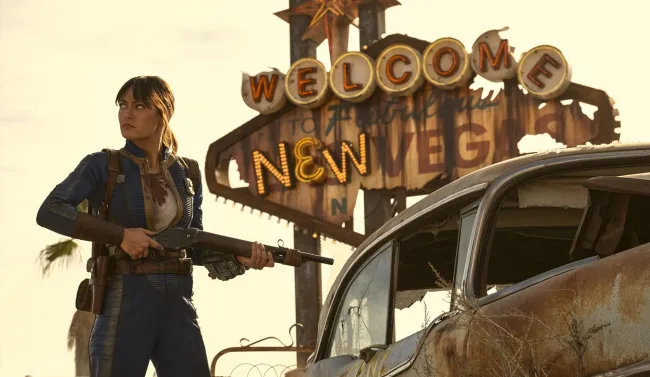
In Fallout, a familiar song rarely lands the way you expect it to. The music is steeped in mid-century Americana, yet it carries an entirely different emotional charge once it enters the show’s broken landscape. For Emmy-winning music supervisor Trygge Toven, that tension is the point. The music becomes part of the storytelling fabric, where lyrics, tone, and placement work together to reveal something deeper beneath the surface. What begins as nostalgia often opens into something more complicated, with songs pulling double duty as emotional anchors and narrative devices. That layered approach sits at the heart of Toven’s work on the series, where a carefully chosen track can shift how a scene is understood in real time.

Fallout, created by Geneva Robertson-Dworet and Graham Wagner and executive-produced by Jonathan Nolan and Lisa Joy, adapts the iconic video game franchise into a sprawling post-apocalyptic drama set centuries after nuclear war reshapes the world. The series centers on characters like Lucy (Ella Purnell), a vault-raised optimist thrown into the chaos of the wasteland, and the Ghoul (Emmy nominee Walton Goggins), a hardened survivor with a long and painful history. The music operates as connective tissue across these worlds, working alongside Emmy-winning composer Ramin Djawadi to define tone, character and perspective. Toven’s role places him directly in the creative conversation with showrunners, editors, and composers, shaping how songs are deployed, when they should lead and when they should yield to score.

Season 2 pushes that further. The move toward New Vegas brings a slightly different energy, something Toven describes as leaning more into outlaw textures and a rougher, Western-inflected sound. The shift is subtle. Rockabilly tones, a hint of Johnny Cash grit and a looser, scrappier feel emerge as the characters move deeper into the wasteland.
In a conversation with Gold Derby, Toven speaks about using songs from another era to carry emotional and thematic weight in a post-apocalyptic world, leaning into the shifting sonic identity of Season 2 as the story moves toward New Vegas, and navigating the constant push and pull between score and song as part of a deeply collaborative creative process.
Gold Derby: The music in Fallout feels like cultural residue from a lost America, carrying memory and identity into a broken world, while placing nostalgia against something more existential, where lyrics do a lot of the storytelling through irony. How conscious are you of that tension when you’re choosing tracks?
Trygge Toven: The gift of the show is that you’re going with the music from this post-war era, where they still have love songs and sound like they would be on the radio, and they are heartwarming songs, they’re beautiful, and they bring this nostalgic feel to a sort of a begotten era. And especially for the characters down in the vault, it’s basically that they’re living in this forever land of the way things used to be.
But what I love about that era in our timeline is that they’re post-war, and they may be love songs, but they have so much deeper meaning and a deeper message with all the turmoil that they were dealing with in that era. So it fits the show really well.
How did the move to New Vegas in Season 2 change your musical approach?
It’s not a big change, but it’s trying to lean in to that outlaw sound, a little bit of rockabilly, a little bit more of the Western feel. We have it in Season 1, but we went a little bit further with the rockabilly style in this one, which I think is really fun because it’s much more of a road trip season. They’re on this journey and you feel, because you know the destination the whole time, where they’re trying to get to. That type of music plays that really well, I think. And what I love about the different worlds of the show is you’ve got the Vault dwellers and then the Wasteland, and the Wasteland has always had this much more, well I don’t know the word for it, but it’s obviously the wasteland. It’s not going to be all cheeky and nice, so that Johnny Cash feel really spoke to that better.
When you’re looking at a scene for the first time, what are you actually listening for that tells you that it is a needle‑drop moment, not a score moment?
It changes. We try it out. There’s certain scenes where we need to get that emotion. It really depends on what we’re trying to tell with the scene. So, where a lot of Ramin’s score is playing up the drama, a lot of the songs are playing up the irony. We have moments where you may have a big, long section, like a big action sequence, and half of it is score, half of it is song, and you find that moment where you want to shift it on its head. You might start to go a little more introspective when you go with the song, whereas the score may be playing up the action and the mystery of everything. So I think it’s always a question mark. We have amazing showrunners, amazing editors. They’re always looking for the moments to make music shine, so my job is incredibly lucky in that way, because you don’t always get the opportunities that this show gives to highlight music and really use it. It may be in the background and fighting with dialogue and it’s a cool song, but it’s not taking over any of the moments. There’s an incredible canvas to be able to do that on this show. It’s pretty amazing.
I think that’s the journey, right? You try a bunch of things. I’ll be sending ideas, and they might be telling slightly different stories, because sometimes we’ll have a moment where we’re like, oh, this is perfect, but let’s save that song for when we get to this part. That’s when I want that payoff of that story to happen, so it’ll be a lot of that, where emotionally it may make sense, but then it doesn’t necessarily, have all the different levels of are we setting up the next episode, or the next scene, or are we foreshadowing what’s going to happen a few episodes later? And so if it doesn’t have those qualities, even though it emotionally does the trick, you want to work on all the different levels.
When you’re working this closely with creators and showrunners, how collaborative is the process on song selection? Are you pitching heavily, or are they coming in with references and instincts that you’re responding to?
I’m pitching ideas that I think match the season and different specific episodes. The editors are really doing the heavy lifting of finding the way to make them work early on, and then working with the showrunners and seeing how they work, and then it becomes a really collaborative idea of how do we want to address this? A lot of stuff comes directly from the editors, it’s coming from me, it kind of comes from all over, which is great, because luckily, there’s a lot of canvas. It’s not like there’s four songs in the season, you know what I mean?
Let’s talk about curation versus discovery. Fallout uses iconic tracks, but also a lot of deeper cuts. How do you balance the power of recognition with the thrill of surprising the audience?
That’s a good question. I think that the really fun part is, for me on this one, because it’s such an iconic era, I do pull in things that no one’s ever found before, and they maybe not even have been on the radio at the time, which is really fun, especially when it’s so fitting to the show. It’s just all about supporting the storytelling and trying to connect the emotions in any way possible. So I think the recognizability is really good.
In comedy, we call it paying for the joke, because a lot of times you’ll have a really big song, and then it makes the big moment that much more nostalgic, because you get the nostalgia, the comedy plays, and everything’s there. So I think in the big moments, it works really well to have something recognizable.
The Ghoul is such a specific tonal presence. Part Western gunslinger, part tragic relic. Did you find yourself gravitating towards a certain musical aesthetic for him, or resisting that instinct?
Ramin did the most amazing theme for the Ghoul, so I love when that hits, and then when I get a chance to do something with the songs. We had “Big Iron” [1959 country ballad by Marty Robbins] this season, which is a really fun straight-up gunslinger, and really famous from the games.
What’s amazing is every character’s on such a long journey in these shows, with so much growth and change. It’s almost like Lucy’s becoming more human in a growth sort of way from being very childlike, and then on the other hand the Ghoul is trying to get back to being a human. This season, they’re converging, which is cool.
Talk us through collaborating with composer Ramin Djawadi. How do you collectively decide when to lean into score versus stepping outside of it with a curated song?
We spot with the showrunners, the producers, the editors and everybody involved. We spot together, so we’re talking about what we should do with score here, we’re talking whether this a song moment, all in the room together. And what I love about this team is that we still get together in person and watch it in a room and talk it through, and I think it makes an interesting difference.
There’s such a trust with our incredible music editor Chris Kaller. He’s kind of the glue between everything, because he knows it so well that he’s putting in a lot of past ideas. We’re trying to figure out, are we going to maybe go to a game Fallout theme here to call out for the fans. There’s a lot of those moments, and then Ramin will rescore that and integrate that into his piece. It’s always an emotional decision on how to address it, but, yeah, it’s just a big collaborative group.
Do you find yourself building a kind of internal “library” of songs for years before they actually find a home, and did Fallout give you a chance to finally use things you’d been saving?
Of course. It’s interesting because it’s changed mediums, right? So I had a bunch of huge hard drives full of stuff from iTunes, and then now it’s kind of basically all on Spotify, and then I’ve got a bunch of stuff that’s not even on Apple Music or Spotify, and I have to go back to the hard drive to find it. My entire life I’ve been building a catalog of fun stuff. I think that’s always the thing where you think this song’s going to be so cool, but five years go by, and trying to find it again is the crazy part. But I think Nat King Cole was probably my favorite to really find moments for, and I was able to bookend the first season that way.
Working with labels and publishers, that’s where a lot of it comes from. It’s not going to come perfectly out of my brain in a perfect system. You can start with an emotion and then go out to so many other people and see what they have, and dive in that way too, so it’s a kind of industry-wide collaboration, which is fun.
You won the Emmy for Season 1. It’s a category that’s still relatively young and still defining itself. What did that moment actually mean to you, both personally and in terms of how you think about your role on a show like Fallout?
It’s crazy. The opportunity to be able to control how music’s used, I feel very blessed to do a show like this. It has to be a good show, it has to use music well, have all those opportunities to where I can be able to shine in that way. And then, people have to actually see it. It has to be pretty popular to get even the noticed. It’s a perfect storm. It’s not something that I thought would ever be possible, because to your point, it had only been six years. When I won, it was the sixth year. I’ve been doing it for probably close to 20 years now. It wasn’t even something you thought possible, so it’s pretty incredible.
You’ve now gone from landing Fallout Season 1 and winning an Emmy to expanding that world in Season 2. How has this experience helped you evolve creatively?
Not settling is a good place to start. When it’s all married together in the right way, you see what that can do. I think it really opens up the possibilities to make sure that I’m taking it as far as it can on any project. Obviously just diving into an era where I’m sure I knew some of this music, but it’s not like I was a 1940s or 1950s expert, by any means. So that’s made me grow, which is amazing.
