
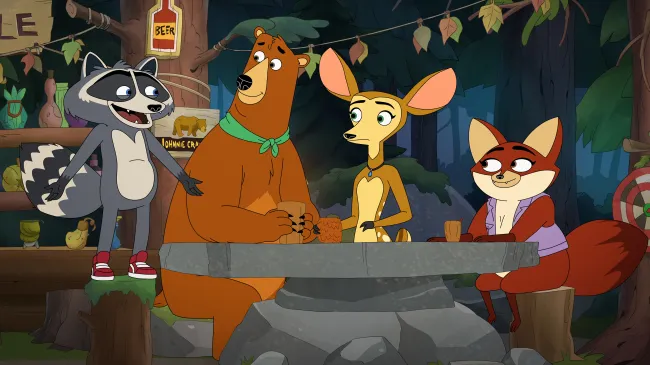
Gird your loins, because it’s Mating Season at Netflix. The streamer’s latest animated series is a raunch comedy set in the animal kingdom that hails from actor-comedian Nick Kroll and the creative team behind Big Mouth, which wrapped up its eight-season run last year and with a career total of 10 Emmy nomination and four wins.
Kroll & Co.’s new show follows four lovable critters — a raccoon named Ray (Nick Kroll), a deer named Fawn (June Diane Raphael), a bear named Josh (Zach Woods), and a fox named Penelope (Sabrina Jalees) — as they navigate the wild, wild world of sex and dating.
Gold Derby spoke with Kroll about voicing a “rakish” raccoon, creating a unique animal world, and what he loves about working in animation.

Gold Derby: What did you take from eight seasons of Big Mouth and apply to Mating Season?
Big Mouth was a show that — when we were doing it well — was all about big laughs and big emotions. What you earn from a really honest, emotional scene is some pretty big swing jokes, oftentimes of a sexual nature. I think we brought that to Mating Season.
Walk us through the casting process. You’ve worked with a lot of these performers before — how did you find the right balance for this core friend group?
Zach, June, and Sabrina are all people who I’ve known forever. Zach was a part of Big Mouth; he was originally supposed to play Andrew, but he was on Silicon Valley, and HBO wouldn’t let him out, so we got stuck with f–king John “Nobody” Mulaney. [Laughs] But we used Zach a few different times, eventually as a rival to Andrew, so we knew he was someone who we were going to want to go to for this part.
June was also a big part of Big Mouth; she played a number of different characters throughout the run of the show. And Sabrina was a writer on Big Mouth who also did voices on Human Resources. So they were all familiar, and they all have extraordinary voices. They’re also brilliant actors and writers in their own right, so you just have three very strong comedic voices to partner with.

You play a raccoon named Ray who’s got some mommy issues. What’s your favorite part about voicing him?
Ray is a real rascal. I have a lifelong fascination with raccoons, so it felt very obvious that I would end up playing one! They’re rakish, and they get after it. It’s fun to play that kind of character in a show set amongst a group of friends, like Joey in Friends or Neil Patrick Harris in How I Met Your Mother, whose name on the show I definitely remember just now at the end of this sentence — Barney.
How much research does it take to write jokes about the animal kingdom? Did you watch a lot of nature documentaries?
We definitely watched a ton of nature documentaries early on, and throughout the process were were sort of checking in on what funny stories were coming out of the animal world. Simultaneously, we thought about diving into dating stories and falling in love stories — and then matching those with an animal analogy was very fun.
In the first episode, my character gets stuck in a copulatory tie, which I’ve always found funny among animals — how they have sex and then can’t separate and are stuck together. So that became a story of what it’s like if you have a one night stand and the person doesn’t leave the next day. It’s a fun way to do a dating story like that.

Can you talk about how you and your co-creators fleshed out the tone of this world? We hear references to Bambi, Garfield, and Mickey Mouse in addition to animal versions of humans like Ronan Sparrow.
Whenever you start a world, you have to figure out the rules. Do we see people? No, we don’t. Do they wear clothes? Yeah, they wear enough clothes if we decide eventually to differentiate them from other animals of their species, etc. We were riffing about that first episode where we’re at Fawn’s mother’s funeral, and we just start talking about Bambi and what a trauma it is to see your parent die in front of your face. But what he did after that was not OK — Bambi is a fun version of Michael Jackson. Then we start talking about Garfield losing a ton of weight. Treating all the animals that we understand from pop culture as reference points in their world, where appropriate, was very fun to play with.
What does animation let you explore creatively that you can’t do in live-action?
The beauty of animation — at least in terms of our process — is that you really get a number of chances to fine-tune it over a long period of time. There’s the rough draft, the animatics, the colorizing process, and all of those moments are places that you can rewrite and find the best version of the joke or the best version of the story. That leads to a quality product that is really thought-out and dense in the most gratifying way.
This interview has been edited and condensed.
