
“This is a big deal,” a visibly moved Lucinda Williams declared Friday evening at the Beverly Hilton Hotel, as Car Wheels on a Gravel Road — her landmark 1998 album that “obsessed” Williams fan and gala host Anthony Mason said “literally created its own category of music”— was inducted into the Grammy Museum’s Grammy Hall of Fame. “I want to thank the people who supported me all those years when they said my music fell in the cracks between country and rock, which later became known as Americana. Don’t give up if your music falls on the cracks. That’s where it’s supposed to be. That’s a good place. … You don’t know how good it feels to be recognized and supported in the music business. It feels really good to be recognized for what you do, and not how many records you sell.”

 Grammy Hall of Fame Gala 2026: Lucinda WilliamsEmma McIntyre/Getty Images for The Recording Academy
Williams’s heartfelt statement, which elicited roaring applause from the ballroom’s all-star attendees, summed up the spirit of the night, as 14 seminal recordings entered the Grammy Hall of Fame — ranging from Sam Cooke and the Soul Stirrers’ 1950 gospel classic “Jesus Gave the Water” (which was performed at the gala by Take 6); to chamber-folk cult hero Nick Drake’s Pink Moon (fêted with a lovely acoustic performance by Taylor Hanson); to “First Lady of children’s music” Ella Jenkins’s 1966 album You’ll Sing a Song and I’ll Sing a Song (adorably honored with a spunky, funky performance by 8-year-year-old Aura V, the youngest Grammy-winner ever, and her father Fyütch); to the 1971 avant-garde jazz opus Journey in Satchidananda by Alice Coltrane (whose award was accepted by her daughter, jazz vocalist/composer Michelle Coltrane); to vaudeville blues singer Bertha “Chippie” Hill’s 1926 anthem “Trouble in Mind” and the Rouse Brothers’ oft-covered 1938 fiddle classic “Orange Blossom Special.”
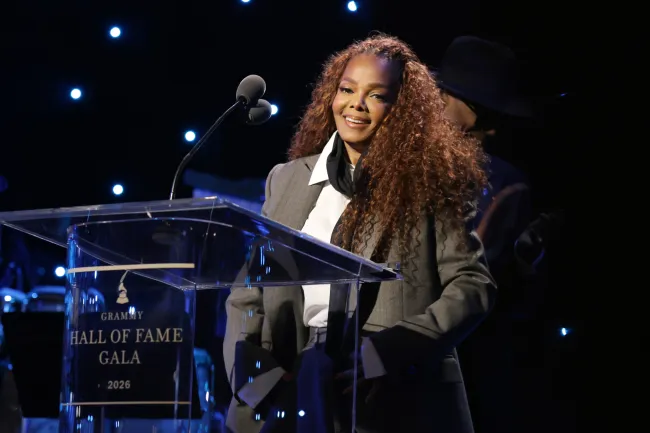
Some commercially colossal recordings were also inducted at Friday’s ceremony, of course, and perhaps the most colossal was Janet Jackson’s Rhythm Nation 1814 — with Jackson herself making a rare public appearance to personally accept the honor from Recording Academy CEO Harvey Mason Jr. and her longtime mentor and co-producer, Recording Academy chairman emeritus Jimmy Jam.
“The album explored themes of racism and poverty inequities, violence, themes that inspired Janet and what she was seeing as it unfolded in communities all across America, including the tragic Cleveland Elementary School shooting at that time. But what’s truly special, and what artists do, is they reflect the world around them. They also challenge us to think deeper, feel more, and sometimes even make change,” Mason Jr. stated. “More than three decades later, Rhythm Nation still resonates, because the message still resonates. It’s a masterwork of artistry, vision, courage, and cultural impact, an album that made musical history while delivering a powerful statement. And that statement is still relevant today.”
“When my partner Terry Lewis and I started working on Rhythm Nation with Janet, we weren’t trying to make a political statement,” Jam added. “We were simply responding to a world around us. We were watching the news and seeing all the pain, the injustice, and the tragedy, and we asked ourselves: ‘What could we do?’ We felt a responsibility to use our voices. So, this album, it was a big commercial success, but even better than that, it changed lives. And so did Janet. So much of what we see in music today, especially when it comes to female empowerment, traces back to her influence. … I’ve heard stories of young people actually going back to school because of that album. And nearly 40 years later, the message still resonates. It’s a reminder that music can heal, unite, and inspire us to change. But also, unfortunately, there’s still a lot of work to still be done. I want to say thank you to the Recording Academy for this award, but I really want to say thank you to Janet for trusting us. Thank you, Janet, for trusting us to bring your vision to life.”
As Jackson humbly took the stage and embraced Jam at the podium, she received a standing ovation, in what was the biggest audience reaction of the evening. “I’m so grateful and honored that Rhythm Nation is being recognized tonight in this wonderful, wonderful way,” she said softly. “It’s beautiful to relive the memories attached to this project that’s so precious to me. Tonight, though, I don’t see Rhythm as a phenomenon that lives in the past; I believe it’s alive and well in 2026. Rhythm still resonates on a deep and profound level. It’s an ongoing force that fights bigotry and promotes understanding. It cannot be stopped. It’s simply too strong and too positive. Rhythm Nation is a movement of people, of all ages and backgrounds, seeking to give and receive love, free of judgment. As we celebrate tonight, let’s remember that it transcends all borders, nationalities, and faiths. I hope you hear my heart’s desire when we first created this suite of songs. More than ever, my hope is that we might live in a world free of fear and despair. The prayer driving this remains the same, exactly the same: that peace prevail. Peace the world over, peace among nations, peace in our neighborhoods, peace in our homes. May the music of Rhythm Nation continue to bring us together in peace, and may that peace allow us to celebrate this precious gift of life that God has given us.”
Women had a big night at Friday’s gala. Along with the inductions for Jackson, Williams, Jenkins, Hill, and Coltrane, Heart’s 1975 debut album Dreamboat Annie was honored, with trailblazing rock ‘n’ roll sisters Ann and Nancy Wilson introduced by Anthony Mason as “the first female-fronted hard rock band to achieve major commercial success … As Ann Wilson put it, Heart has always been sort of like a cockroach: You can set up a bomb, and it’ll still be alive underneath. Well, they’re not only alive and well, they’re here tonight!”

The Wilsons then tore through fiery renditions of “Magic Man,” “Crazy on You,” and Dreamboat Annie’s title track. Ann, who was diagnosed with cancer in 2024 and at Heart’s 2025 concerts performed in a wheelchair due to a broken elbow sustained in a fall, triumphantly stood throughout Heart’s performance, and the gala guests were on their feet as well. The sisters thanked guitarist/producer Howard Leese and founding Heart guitarist Roger Fisher, who were in attendance, and Roger’s brother and Heart’s late manager, “original Magic Man” Michael Fisher, with Nancy saying: “These are the original gypsy tribe that started the whole thing. … We thank you for your great energy, your resilience, your humor, and your camaraderie. We did this together, and the beautiful poetry and music that we made together still resonates to this day.”
Late Latin superstar Selena’s 1994 breakthrough crossover album, Amor Prohibido, featuring her signature song “Bidi Bidi Bom Bom,” was also honored with a musical salute by Tejano singer Isabel Marie, a protégé mentored, produced, and signed by Selena’s father, Abraham Quintanilla. Selena’s sister, Suzette Quintanilla, accepted the award, stating, “I want to show love to what Selena represents still to this day, so many years later, even though she’s physically gone. Shout-out to my sister, Selena, who will forever be around.” Selena’s longtime collaborator Pete Astudillo added, “Selena would have been freaking out to know that she’s part of the club of 2026!”

Another diva, 10-time Grammy-winner Norah Jones, was presented with a special honor named after her “hero,” the Ray Charles Architect of Sound Award. After performing Charles’s “Seven Spanish Angels” and “Hallelujah, I Love Him So,” she gushed, “When I met Ray the first time, I burst into tears. We have a picture of it; it’s pretty funny! This means so much. … My mom listened to Ray Charles in high school. She went to see him in a high school gymnasium. I still have her vinyl of ‘What’d I Say,’ and she has her notes written after every song from when she was in high school, like: ‘This one’s great to dance to.’ And so, it has a very special place in my heart. His music is everything to me, and I wouldn’t be anything without listening to it my whole life.”

Guest star Erykah Badu also mentioned her mother’s influence when she joined George Clinton onstage for a bonkers tribute to Funkadelic’s Maggot Brain, the most roof-raising musical number of the night. “I was in my living room and I saw my mother go crazy, just losing her mind. I had to be 5 or 6, and a song came on the radio called ‘Flashlight.’ I saw my mother and I watched her lips. I knew it to be something special,” Badu told Clinton (as an instantly recognizable holler of “Yeaaaaah, boyyyy!” erupted from the audience, and Clinton responded with “Fla-vor Flav!”) Badu continued, “It is a thing that cannot be described. Millions and millions of memories of those atoms makes me what I am.”

This year’s other Grammy Hall of Fame inductees were Radiohead’s boundary-breaking art-rock classic OK Computer; Tupac Shakur’s All Eyez on Me (the final album released during the rapper’s brief lifetime); and Paid in Full, the debut album by East Coast hip-hop icons Eric B. & Rakim. Shakur’s award was accepted by his childhood friend and Outlawz bandmate E.D.I. Mean, who said, “I’m sure Tupac is smiling real big and saying, ‘I told you I was a legend!’ He would tell us that. He would look at us in the eye and tell us that every day: ‘I know I’m a living legend.’ And we’d be like, “OK, all right!’ But Tupac was more than an artist. He was a poet, a revolutionary spirit, and one of the most fearless voices of his generation. He spoke the pain, struggle, love, and the ability to overcome in spite of what you’ve been doing, what you went through.”
Eric B. & Rakim accepted their award in person, giving the most charming speeches of the night. “We started 40 years ago in [Rakim’s] mother’s basement. I remember like it was yesterday,” Eric grinned. “Rakim was down there drinking Ballantine Ale — but he don’t drink no more, don’t worry about that. I remember him saying, ‘Yo, bro, I got a great idea, man. We’re going to use James Brown [samples]. We’re going to do this, we’re going to do that.” Rakim’s laughing… and I said, ‘Rah, I want to see you laugh like that when we get paid in full!’” Rakim said, “Thank you to everybody that supported me and Eric B. throughout our career. This hip-hop journey has been crazy, but I’d do it again. It’s been a blessing thus far, and hopefully a lot more to come.”

The event ended spectacularly with Teddy Swims and Josh Groban’s salute to 2026 Visionary of Music recipient Warner Records, introduced in a rare onstage appearance by the gala’s executive producer Ken Ehrlich, who famously produced the Grammy Awards telecasts for CBS from 1980 to 2020. “I can’t believe that I actually put myself out of here after George Clinton! Whoever said I was a producer?” Ehrlich self-deprecatingly quipped. But Ehrlich, along with producers Ron Basile, Chantel Sausedo, Lindsay Saunders Carl, and Lynne Sheridan, obviously did a wonderful job, giving all 14 inductees the celebration they deserved as they joined the other 1,165 recordings that have entered the Hall since 1973.

The Grammy Hall of Fame Gala annually recognizes musical works that exhibit “qualitative or historical significance.” Mason Jr. said in a statement, “It’s a privilege to recognize these influential recordings. … Each selection reflects the creativity, craft, and cultural impact that recorded music can carry across decades. We’re honored to help preserve these works and celebrate the artists and communities behind them, so their legacies continue to inspire generations to come.”
