
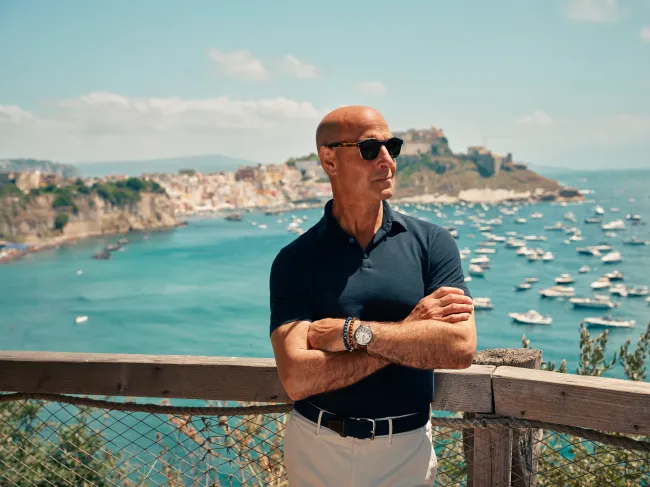
“I’m Stanley Tucci, and I’m exploring the complex connections between the lands, the people, and the food they eat in order to discover the essence of each region of the country I love. Italy.”
That’s how Stanley Tucci opens Season 2 of Tucci in Italy, which premieres May 11 on National Geographic before streaming the next day on Disney+ and Hulu.
This season, Tucci travels through regions including Naples, Sicily, Le Marche, and Sardinia while exploring the relationship among food, culture, geography, and identity. During a conversation with Gold Derby, the Emmy-winning actor opened up about how the series changed him personally, what Americans are getting wrong about food, the connection between diet and longevity, and why all six of his Emmys are scattered between offices and bathrooms.

Read our full conversation and watch an exclusive clip from Episode 4, titled “Sardinia,” below.
Gold Derby: You kick things off this season in Naples. What makes that city such a powerful entry point for the season?
Stanley Tucci: Because it’s mayhem. It’s madness. Look, it’s an amazing city. I can take it for about two days and then I’m like, “Oh my God, I can’t.” The food is fantastic. It’s just fantastic. The people are fantastic. It’s funny. It’s raucous. It’s dangerous. You have to be careful. But it is, in some ways, the pinnacle of what we know as Italian-ness.
This project goes so far beyond food. How has spending this much time in Italy changed your understanding of your own identity? How much has this changed you?
It changed me a lot. Simply doing the series has changed the way I look at myself in the sense that I never thought I would be comfortable as myself on camera. Now I’m much more comfortable with myself on camera and therefore more comfortable as myself in real life.
Before, I always wanted to disappear into somebody else’s mind, body, whatever. I don’t feel the need to do that as much anymore. I’m more interested in seeing the world through my eyes now, I think.
So you were comfortable as an actor on camera, but not necessarily as yourself?
Yeah. When I first started doing this series six or seven years ago, I really didn’t know what I was doing. I was quite nervous. Eventually, you start to figure out what you need to do and the best way to do it. As you do that, you just become more comfortable.
One of my favorite episodes was “Sardinia.” Can you talk about exploring the connection there between food and longevity?
Well, I love that whole idea of the Blue Zones. I’d read about them before, and there was that documentary made about them. Some people say it’s not true. Some people say, “Yes, it is true, that all the factors there in those Blue Zones are the reasons people live so long.”
Look, I think the thing is that diet — if you go to lots of different parts of Italy, you’ll find similar diets, but that one is very particular — is very similar to what I grew up eating. That minestrone soup is a version of what I make every week. It’s a version of what I grew up with. There are so many different iterations of it.
But I really do believe that diet, if you look at the components and it’s everything in moderation, there is no question that it is a factor in longevity.
Watch an exclusive clip:
What was it like sitting down with the elders there and experiencing that culture of caring for older generations?
It was great, except my parents are even older, so that was interesting. I thought, “Well, I could have just done this at home.”
How old are your parents?
My dad’s going to be 96 and my mom is about to turn 90.
So you have some of this longevity in your genes.
There’s no question that we do. There has to be some genetic predisposition to Southern Italians in particular that they have this longevity. I think part of it is diet and part of it has to be genetic.
In Sardinia, you also met up with a couple of guys making pasta with cannabis and hemp seeds. People often think of Italian cuisine as tradition and centuries-old recipes, but they’re still innovating. But no THC here, you weren’t getting high.
Sadly there was no THC in there. They were very strict about that. But those guys were so interesting and really funny. It was a great day working with them, and the food was really, really interesting. It has a very particular taste. There’s a grassiness to it, but it was fascinating.
What’s one thing you think America could learn from Italy when it comes to food and diet?
Farm to table. Farm to fork. We have huge conglomerates buying up farms and only producing monocrops, and that’s not good for anyone. It’s not good for the soil, so the soil gets filled with chemicals and everything becomes the complete opposite of what farming traditionally came from.
That’s one of the reasons people are sick, people are overweight and food doesn’t taste like food. It tastes like nothing. A tomato doesn’t taste like anything. A cucumber is water. Think about it. So much of the food we eat in America today has no flavor, and that’s one of the reasons people are eating so much processed food.
People are also not really learning how to cook, and they have to learn how to cook. It should be part of the curriculum in every single school. Children should be taught how to cook. It’s an invaluable skill. Why don’t we teach it? It’s weird.
Cooking embraces everything — your mathematics skills, your physical skills, your fine motor skills, your creative self — and it’s about connection. Connecting to people and understanding where something comes from and where it ends up.
People say, “Oh, I have a pet rabbit. How could you eat a rabbit? They’re so cute.” You’re like, “Well, that cow is actually kind of cute, too, but you just ate it. You forgot it was a cow because it came in a package.”
If people had to hunt for their own food, there’d probably be a lot more vegetarians.
There’d be a lot more vegetarians. Or people would just figure out what meat you’re supposed to eat and when.
What do you hope audiences take away from this show?
I hope it makes people happy. I hope it’s a diversion from a lot that’s going on in the world today. And I hope it’s educational in the sense that people see how complex Italy is — that it isn’t just sunny and everybody’s playing mandolins and eating pizza. There’s a heck of a lot more going on there.
You balance this passion project with a very active acting career. You’re also starring in The Devil Wears Prada 2, one of the biggest movies in theaters right now. How do you balance everything?
I don’t know. I must admit it is tiring, and I am getting to the age where I have to pull back a little bit. There’s no question about that.
If you had to take Miranda Priestly to one place in Italy, where are you taking her to eat?
I’d take her to Milan. In fact, I did. Miranda and I ate in Milan together a few times, and it was great.
Tucci in Italy earned two Emmy nominations last year, but you’ve won six yourself. I was actually just rewatching your first win for Winchell — Dennis Franz presented the award and you were up against Don Cheadle, Ian Holm, Jack Lemmon, and Sam Shepard. That’s quite a lineup. What do you remember about that first Emmy win, and where do you keep all your trophies?
Oh my God. Was that for Winchell? I was so incredibly flattered. I loved doing that. HBO sort of changed movies by making actual movies and putting them on television, and it was a great experience for me.
My Emmys are in an office at the back of my garden. It’s like a painting studio and office, and they’re in the bathroom in there. Some are in my regular office near my house, too. But where am I going to put them? It would be weird to put them on a mantle or something. I can’t do that. I just keep them in the bathroom.
This interview has been edited for length and clarity.
