
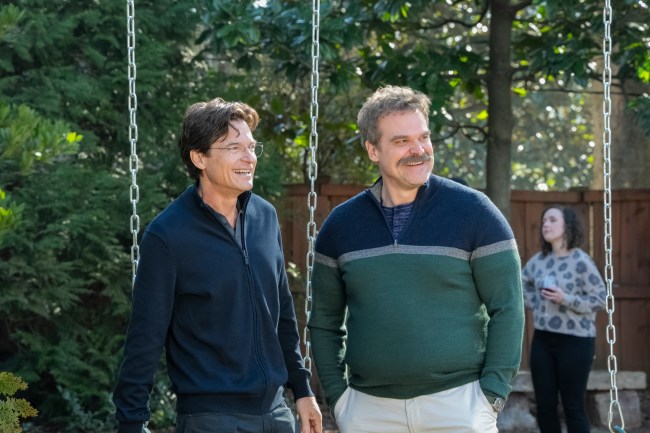
DTF: St. Louis unfolded across just seven episodes, but they were packed episodes. From introducing a murder mystery revolving around a dating app and suburban ennui in the premiere to doling out a season-long whodunit, the HBO dark comedy was deft with drama (including some downright heartbreaking moments) and plenty of laugh-out-loud laughs.
Bringing it to our screens were showrunner Steve Conrad and a stellar cast led by stars and executive producers David Harbour and Jason Bateman, along with Linda Cardellini, Richard Jenkins, Joy Sunday, and Arlan Ruf, along with standout guest performances by Chris Perfetti and Peter Sarsgaard (who delivered the most memorable monologue about secret love and Mail Boxes Etc.).

Sunday’s finale brought the fun and friskiness to a likely end, given the series’ framing as a miniseries, though HBO has made no official announcement about DTF’s future. In the meantime, writer-director-producer Conrad dives deep into the season’s final chapter, including why Floyd’s (Harbour) death wasn’t meant to keep audiences guessing indefinitely, why the show kept us guessing all season about Floyd’s unfortunate penis problem, and how Floyd was hardly the only victim of his demise.
Gold Derby: I want to touch first on the unforgettable scenes that people are going to want to know more about, beginning with Floyd (Harbour) and Clark’s (Bateman) dance at the park pool house. What were your directions to Bateman and Harbour?
Steve Conrad: They love each other so much, the two characters. Love, it’s a phenomenon, because it’s never a single thing. It explains this need to be with somebody, to share something with somebody. The dance for the three of us, and I mean Jason and David and me when we were trying to figure out what these two guys [are], I felt like they understood very clearly that this is obviously what these two guys do next. Like, they did paintball, they did the gym … what else can they do? There’s a line that David has in the midst of the dance, and it’s hard to hear, because the song is loud, but he’s in the throes of the feeling of the dance, and he just yells out, ‘Having fun in the fort!’ That’s their little fort, and they’re gonna have fun in the fort, and that is what fun meant that night.
The scene made sense as a viewer watching it unfold, that the joy they had was because it was as Clark said, he felt safe with Floyd. Do you think that is why it worked so well, because we’re left with the image of them being in their fort, where they can just be who they are, as two friends who truly appreciate and can trust each other?
Floyd had a real tough Episode 6. He was rejected by his wife. I think their sex life is, I think she discovered that it was gone, and she tried. [She] had to be honest that she didn’t have the feeling, and she needs to have the feeling. And she was frank about it. Floyd recognizes that it’s extinguished, and this idea of Tiger Tiger being interested in him, that also got blown apart because it wasn’t honest.
What Clark then knew was he could communicate honestly how he feels about Floyd. I mean, if you imagine, if this wasn’t trying to be dramatic or telling a story, if your friend had a hard day, and he just said, ‘I don’t feel good about myself,’ and you said. ‘Man, you look good,’ it isn’t enough. That’s not enough. He needed to create an event where there could be bravery. He needed to go beyond saying, ‘You look good.’ Clark needed to say, ‘This is how you make me feel. You make me feel like dancing. You make me feel like that, and I want to be with you here, and do this with you.’ It was a beautiful gift to Floyd, and if Richard [Ruf] hadn’t been there, it might have been enough to keep Floyd alive. And I don’t think Clark knew that that was what he was doing. He was responding to the need of a person he cared about. And the dance was the solution.
Going on to the payoff of the much started-and-stopped story of what happened to Floyd’s penis, it was as epic as was promised, I think, in no small part, because of how matter-of-factly it was finally delivered to Clark. Was that the only take you contemplated to reveal that information?
Yeah. And that’s pretty keen, because somebody might say, “Why are you taking this time to tell a story that has nothing to do with these other things, to arrive at such a casual throwaway? ‘Oh, this is what happened.'” It’s the way Floyd feels about it. He thinks, “Oh, that’s what Richard did. I probably deserved it. I made his mom cry. I broke her heart, and he didn’t understand any of my rationale. He just knew that he’d seen his mom hurt before, and he was watching his mom get hurt again. And he didn’t know what the consequences were going to be. And he probably didn’t even know where he was swinging the bat. But that’s what happened.” And he instantly says, “I love that kid.” And I felt like we needed all the asides of the things that didn’t hurt his penis to make the thing that did hurt his penis feel so recognizably right to Floyd that he could only take love away from it.
I also have to ask about Richard Jenkins, after getting quite an education about some of the kinkiness some of his fellow citizenry has been getting up to, Plumb (Sunday) presses him to share what turns him on, leading to the “boobs, butts and bras” conversation that was almost as shocking, in a delightful way as David Harbour in his tighty-whities getting his groove on to Barry White. Though it’s much harder to imagine Richard Jenkins being directed in his scene.
Everybody got the script to every episode before we got started, which is a real gift. So everybody knows the capacity of their character relative to the audience. So he knew what his kinks were when he started to play Homer, and there wasn’t artifice. Homer is that normal, and he is the exception. And that makes him a really strange person, to have an appetite that is that vanilla, that common. [Jenkins] just knew that’s who Homer is, elementally. And that’s what made Plumb love him so much, that he is the grandpa who doesn’t know how to turn his computer on. But he’s not faking it.
But I think their chemistry [the actors and the characters] is a really wonderful upshot of the show, because so much of what Floyd and Clark’s story is about is these two men who are mistaking this need to be close to someone with a need to be intimate with them. And it’s closeness that they need, it isn’t the intimacy. The closeness isn’t intimacy, it isn’t always sex, but the closeness provides.
And with Plumb and Homer, Homer is smart enough to allow her to come closer. He lets her in. She become part of the investigation. And (the crew) arrives at a certain instinct for blocking, where [Plumb and Homer’ just started to sit side by side sometimes, in a way that I thought just made such good sense. Like, they just start to become a team. Somehow, Homer needed this young person to delight him, and she needed someone who knows how these [investigations] get done to look at her and say, “You’re very good at this.” So their story is the same as Clark and Floyd’s, and you really wouldn’t even notice it unless you were forced to think about it.

Unspooling these characters in a murder mystery was so effective and satisfying. Do you think many viewers figured out the truth of how and why Floyd died before the final moments of the finale?
So the answer is, it’s Floyd’s ideation. It’s there from the first time we see him, which is struggling in that therapy session and struggling to get close to a stepchild, and failing. His clothes don’t fit anymore. He doesn’t fit anymore. That’s it. The answer’s there the first time we see him, and Clark almost saved him, but the fuel on a little fire that was supposed to draw him back to life, to warm him and keep him, it was too much. And the recklessness of that little promise of DTF as all the excitement none of the consequences.
Floyd, the last time he sees Richard, has to accept that this child, who is part of his responsibility … he has made this child feel lonely and strange and confused. And the thing he wants to do more than anything is to make him feel safe and protected and sure. It just shattered every instinct he had. And all he needed was to be dead. Clark didn’t see any of that coming, that out of two kids playing in a fort, something terrible could happen. The way that those two guys allow for there to be a child-like kind of innocence to their grown-up experiments is really smart, because they didn’t see these consequences the way kids don’t see consequences. They weren’t adult decisions. They were filled with naivety and a lack of wisdom, but so are all of our mistakes.
Floyd is a very complicated soul. Do think maybe he was just also too good for a world where a lot of people are too selfish or too broken to take the time to really appreciate a person like Floyd?
Yeah, I recognize that. I see that in a circle of friends we have. A couple are musicians, and they’re the sweetest guys I ever met. But neither one of them has paid their taxes in seven years. And I just go, “Hey, you have to pay taxes” “Why?” “What do you mean why? Are you gonna go to jail? No, but you’re not gonna be able to do all these things you’re gonna have to be able to do if you don’t pay your taxes.” I find myself explaining that to people in my life, and I love them the most, and like, Floyd, I’d want to say to him, “Why didn’t you pay your taxes?” and they were doing another sweet thing, like they were writing a song or playing piano, and you just go, you have to know how to try to do both.
And Carol knows how to survive, and Floyd doesn’t. They could be good partners to a point. But Floyd has to be carried through life, and he’s too big and she couldn’t carry him anymore. I love that physically Linda is small and David is very large, and you realize she’s carrying him and she can’t do it anymore. And it’s not even fair to expect that she can, so his sweetness has become a burden to Carol, even though it’s a gift to Clark.

Speaking of Carol (Cardellini) the revelation that her “big” underage crime was stealing two rolls of toilet paper because her family was unable to afford that necessity was crushing, but also illuminated a character who was being viewed as a greedy possible murder suspect, when she was really a survivor after a childhood that must have been traumatic in at least some ways.
I think that’s a super cool takeaway. And it’s Plumb who learns that fact. To her, it explains everything about Carol’s demeanor, her assertiveness, like that she’s not covering anything up, she’s just fighting. So Plumb instantly goes, “She didn’t hurt anybody, she just grew up poor and growing up poor has transformed her, it’s created her personality, and it doesn’t mean she’s bad, it means that she’s tough as nails.”
