
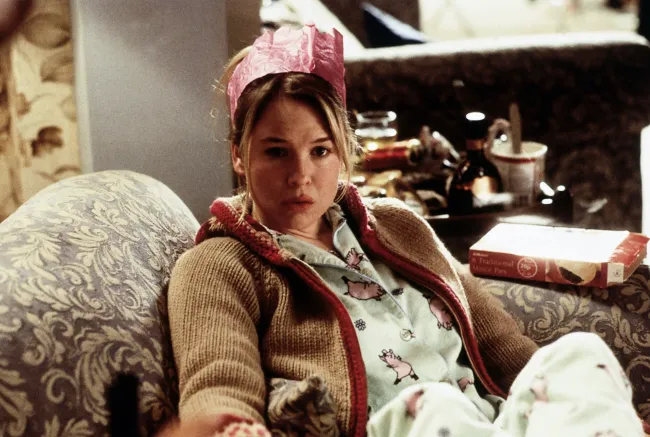
Crank up the Geri Halliwell cut of “It’s Raining Men,” because Bridget Jones’s Diary officially hits quarter-century status, having premiered in theaters on April 13, 2001. Twenty-five years and three sequels later, it’s hard to imagine anyone other than Renée Zellweger playing the titular character who originated in the pages of Helen Fielding’s 1996 bestseller. At the time, though, the Jerry Maguire star’s casting inspired shock and horror across the pond, with furious headlines bemoaning the fact that the role had gone to an American.
A loose adaptation of Jane Austen’s seminal Pride and Prejudice, Fielding’s book followed a 32-year-old lonely heart who kept a diary of her life as a single and ready to mingle Londoner. But her life changes overnight when two men — the dashing, but roguish Daniel Cleaver (Hugh Grant) and the reserved, but romantic Mark Darcy (Colin Firth) — suddenly start vying for her attention. The book already had a massive following, so director Sharon Maguire knew that if her choice for Bridget didn’t land, it would be game over.

“I still remember the first script read-through we ever had — I was absolutely petrified,” Maguire confesses to Gold Derby now. “The fear for everyone was, ‘What would Renée’s accent be like?’ No one had heard it!
“Renée had been practicing with her voice coach for about six weeks,” the director continues. “She came in, and you could have heard a pin drop before her first line was spoken. She leaned over to me and said she had a sore throat, so she whispered the entire script. Again, nobody knew what the accent was going to be like.”
Fortunately, Zellweger’s posh-totty tones were ultimately revealed to be spot-on. Still, Maguire wanted to avoid putting to much pressure on the actress on the first day of shooting, instead opting to shoot more physical moments. From then on, though, it was plain sailing. Bridget Jones’s Diary went on to become a box-office smash, grossing $282 million and earning Zellweger her first Oscar nomination for Best Actress. She was nominated in that category again the following year for Chicago, and then won a Best Supporting Actress statuette for 2003’s Cold Mountain and a companion Best Actress honor for 2019’s Judy.
Maguire — who also helmed the franchise’s third installment, Bridget Jones’ Baby, in 2016 — dishes more details about Zellweger’s controversial casting, explains the the evolution of Grant and Firth’s iconic fight scene, and reveals how George Michael almost had a song on the soundtrack.
Gold Derby: What went through your head when the film came your way?
Sharon Maguire: I knew the character, and she is very much based on Helen. We were friends, so that’s how I got the job. Working Title had had the rights to the book for a few years and approached various directors, but they either didn’t take a shine to it or had conflicts. I think they had gone to Stephen Frears, and he would have been amazing. I believe they also went to Amy Heckerling, and she would have been amazing, too. She had already made Clueless, which was a reworking of Jane Austen’s Emma.
Helen was about to go and live in America, but had been waiting around in England to see what was going to happen with the project. In the end, she said, “You should meet my friend Shaz. She’s a documentary filmmaker and a commercials director. Even though she’s not made a feature, she knows the world.” I went in to see them, and they said, “Well, obviously you get it, so that’s why we’ll give it to you. But it’s not going to be a big movie; we’re going to give you about $2 million, and it’ll be an indie-style thing.”
Was it helpful to have Helen there to bounce ideas off of?
Yes, but Helen did move to America, so she wasn’t around all the time. Funnily enough, she had met somebody, moved out there, and had kids. She was famous by then, too. I was a huge lover of the book, and there was all that gold in there. Bridget counting calories and cigarettes, measuring her thighs, worrying about getting old and being lonely, and getting half-eaten by Alsatians were really specific things that turned out to be universal. The film and the book celebrate failure, smoking, alcohol use, doomed romance, and body anxiety, and that’s why it was a success. All I had to do was bring that to the film.
Did it surprise you that people went to see Bridget Jones’s Diary multiple times? It became a global pop culture moment.
Not at all. We were originally really scared because there had been a real hoo-ha when Renée was cast. The tabloids asked why we cast this svelte Texan to play a beloved English character, and we knew we had to get that right. We weren’t sure it was going to work, and I don’t think we knew it was going to until some of the press screenings. I was still cutting it and putting the music on when one of the producers called and said, “I’ve just been to a press screening and some of them stood up.” That was when we allowed ourselves to think that it was going to be okay. Until then, we didn’t know whether the great British public would accept Renée as Bridget.
Knowing that, what were the conversations you had with her casting?
We both felt like a couple of impostors in the trenches on Bridget Jones’s Diary. By the time we got to Bridget Jones’s Baby, we were able to laugh about the fact that I was this first-time movie maker for a f–king Hollywood studio, and she was trying to be this beloved national treasure. The thing we had in common was a sense of humor about it all.
She came to meet for the role. She didn’t audition. Renée came over from L.A. to London, and she’d read the book, so she knew the character, got the film, and loved it. She also knew she had to get the accent right. She said — albeit in a very Texan accent — “If I don’t get it, we’re all busted.” It was what we were all thinking, but we knew then that she would give it her all. The whole thing depended on her. She’s in every scene.
Were many people considered for the lead roles?
Everybody was talked about and considered. When Richard Curtis joined the writing team, it stopped being a $2 million movie. We’d always wanted Colin to be Mr. Darcy because of the Pride and Prejudice TV adaptation. And thankfully, he said yes! We didn’t know if he would, because he’s a very reluctant heartthrob, and didn’t necessarily want to play that character again so soon. However, he got that when you transplant Mr. Darcy from Pride and Prejudice into a modern context, it becomes a lot funnier. He’s this emotionally constipated character in this world.
Helen had always dreamed that Hugh Grant would be Daniel Cleaver. Hugh was one of the biggest movie stars on the planet at the time, so we weren’t sure we’d get him. But with Richard and Working Title involved, Hugh was persuaded. We still hadn’t got Bridget at that point, though.
How did Renée rise to the top?
The American executives at Universal were keen on her. I also liked the idea of Renée because Jerry Maguire was one of my favorite films at the time, and she was brilliant in Nurse Betty, which I’d seen at an early screening. She’s very winning and funny. When I was talking to men about the book, they didn’t really get or like the character, so I thought we had quite a way to go on film to make this character likable to the other half of the population. We had lots of conversations about who this character was, her inner voice and her outer voice, because they were key. What Bridget is thinking and how she portrays herself to the outside world are opposites, and that’s often where lots of the humor comes from.
We didn’t really have many English comparisons to go with, so we ended up talking about Lucille Ball and Mary Tyler Moore. Bridget’s obsession with their weight was key for Renée, so she got it into her head that every time she walked across the office, she would be very conscious of her thighs rubbing together because they were too big, and that became part of her physicality. She built it into every scene she ever did.
The street fight scene between Colin and Hugh became a classic piece of British comedy cinema. Did you know that you had struck gold?
It was a risk. Richard came up with the fight idea as an emotional climax to the love triangle story. In the book, it had been about Bridget’s mum being involved in a timeshare scam, which Mr. Darcy rescues her from. That worked in the book, but it felt like a sitcom for the film and didn’t work emotionally. It missed the point of the love triangle.
We thought about why it wasn’t working for a long time, and then Richard said: “What about a good old-fashioned fight like in Western, but it’s two middle-class public school boys who have never had a fight in their lives?” Hugh loved the idea. He wanted his character to be a terrible cheat who would hit Colin with a dustbin lid. They both wanted it to be a bitch-slapping fest because they wouldn’t know how to fight. There would be kicking, screaming, and pushing, and once you start going down that route, you have to commit to it.
In rehearsals, they tried it out; it looked funny and amused me. There were probably a few people around us saying, “Are you sure we shouldn’t make it a really heroic fight?” We didn’t know whether it would work, but there were loads of scenes we shot that didn’t.
Can you give me some examples?
There was a scene where Bridget has just found out that Daniel Cleaver has broken her heart and is engaged to someone else, but she has to do a book pitch to the salespeople called Teddy Knows Best. It reads as very funny because she’s breaking her heart and keeps bringing that pain into the story, and everyone is wondering what’s going on. For whatever reason, it just didn’t work. It didn’t work when we shot it or in the cutting room. One of Bridget’s friends, played by James Callis, used to be a pop star, so when she’s sad, he sings her a song to cheer her up. There was another scene where the three friends arrive outside her flat, put on a boogie box, and sing a song. That didn’t work either.
The restaurant where the fight happened and Bridget Jones’ apartment in Borough Market have both become tourist attractions.
I feel quite triumphant that they have, because it was one thing that I was very worried about. I remember making decisions about where Bridget lived, and I deliberately didn’t choose visually beautiful locations. The film is a fairy tale, but it needed to have enough reality to ground it. She needed to live within the means of a woman who worked in publishing, so we gave her a rented apartment above a pub, with two railway lines running past the window.
I had read an interview with Alan Parker about the design and look of The Commitments, where he said it was important to be true to the environment those kids came from, because that rundown part of Dublin was very much part of the fairy tale. I felt strongly that although a Georgian stucco-fronted wedding-cake house in Notting Hill would have been much prettier on film, it wouldn’t have been true to Bridget. We would have had less sympathy for the character. Also, Borough Market was thriving, but also slightly grungy at the time, and not as bougie as it is now. That part of London hadn’t been seen much internationally, and it’s a very buzzy area with markets and restaurants, and a sense of community would give a definite feel.
The film’s soundtrack was also a huge hit. How did Geri Halliwell get involved?
The man responsible for all of that was our music supervisor, Nick Angel. He went through seven types of hell because when we put the tracks or artists he was suggesting against the scenes, they didn’t work. One day, he said, “Shall we get George Michael to do the song for it?” I was a big fan, so I said, “Oh God, yes, please.”
George came to see the movie at an early stage, and I crept into the cinema behind him. It turned out he had brought Geri Halliwell with him. He watched the movie, and I don’t think he laughed once. I was sitting behind him thinking, “This is a disaster.” He was one of my heroes! Afterward, Nick introduced us. He said hello but didn’t mention the movie, so I don’t think he liked it. However, Geri absolutely loved it. It was Richard’s idea to do a cover of “It’s Raining Men,” and then we said we should get Geri to do it.
You’ve mentioned the third film a couple of times. How different or easy was it returning to the world of Bridget Jones?
Strangely, it was very much the same. We were quite a dysfunctional family, so it was like going back to it. I had been living in America for four years, having babies, while my husband was working out there, and then we came back. I think one of the producers and the actors got to the point where they said, “We’ll come and do it if she comes back.” Meanwhile, I thought, “I’ve just come back to London. I had had enough of bringing up children, so let’s go back to work, please.”
You directed the first Bridget Jones film, you came back for the third one, so you could return for a fifth and complete that sequence if there were plans.
I think there are! I read somewhere that somebody — I believe it was one of the producers, Eric Fellner — had said that he’d love there to be a fifth one. Who knows? I would never say never. It would depend on the script. For me, it has to be funny.
This interview has been edited and condensed.
