
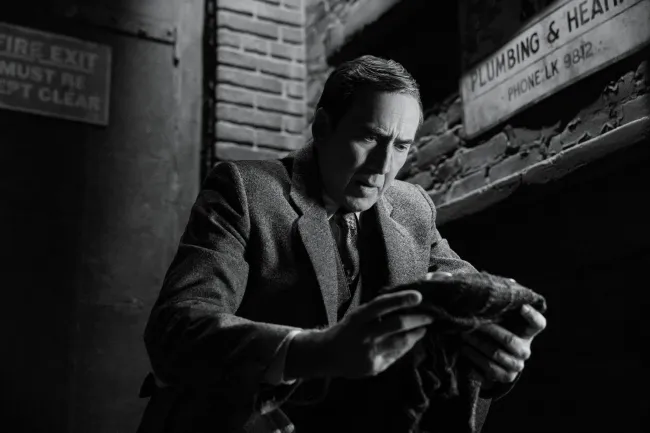
Nicolas Cage caught moviegoers just like flies when he popped up in the 2018 Oscar-winning animated hit Spider-Man: Into the Spider-Verse, voicing a multiversal variation on the wall-crawler that came directly out of vintage noir-ish pulp fiction. But that crowd-pleasing role didn’t guarantee that the noted comic book enthusiast would get to play a live-action version of the character in Prime Video’s Spider-Noir, which launches in the U.S. on MGM+ on May 25 with a Prime Video global release set for May 27.
Based on Marvel’s Spider-Man: Noir comic title, the eight-episode series isn’t part of the ongoing Spider-Verse franchise, which meant that the 62-year-old Cage wasn’t the automatic choice for the part.

“In the comics, he’s a younger character,” Spider-Noir creator and showrunner Oren Uziel tells Gold Derby. “So it wasn’t a given that he’d be older in the show.” In fact, the hero’s canonical comic book birthdate is Oct. 14, 1914, which would put him in his teenage years when the Prime Video series picks up in the 1930s. But Uziel says that “telling a story about a high school kid” was the last version of Spider-Noir that he wanted to make, and he told the show’s executive producers Phil Lord, Chris Miller, and Amy Pascal — the trio behind Spider-Verse — such in his initial pitch meeting.
“I’m fortunate that they said to me, ‘Tell us the version that excites you most,'” he recalls. “When they were fine with aging the character up, I thought, ‘Now I can relate to this.’ I related to a character that feels like they were powerful in the past, and has a few chips on their shoulder. That felt so much more rich and fun to me — and it also gave me the opportunity to cast Nic Cage!”

To further distinguish Spider-Noir from the Spider-Verse series, Cage’s out-of-costume alter ego isn’t Peter Parker, but rather Ben Reilly, the nom de clone of the Parker doppelgänger at the center of Marvel’s notorious “Clone Saga” storyline from the mid-’90s. This version of Reilly is a down and out gumshoe that’s often three sheets to the wind and has more issues than the entire run of Peter Porker, The Spectacular Spider-Ham.
Gifted — or is that cursed? — with arachnid powers via a nightmarish origin story that’s revealed midway through the series, Reilly enjoyed a career as Manhattan’s friendly neighborhood Spider until the tragic death of his fiancée drove him to hang up his webs. But just when he thought he was out, he’s pulled back into the suit when a local crime kingpin (no, not that one) Silverman, played by Brendan Gleeson, puts together a crew of super-powered toughs to cement his hold over the city’s underworld. Those toughs include Depression-era versions of classic Spidey antagonists like Sandman (Jack Huston), Tombstone (Abraham Popoola), and Megawatt (Joe Massingill).
With its gothic production design and cartoon-ish tone, Spider-Noir‘s first episode plays like the offspring of Tim Burton’s Batman and Robert Zemeckis’ Who Framed Roger Rabbit? that we never knew we needed. And Uziel confirms that both of those ’80s productions served as inspiration along with ’30s and ’40s titles like Double Indemnity, The Thin Man, and His Girl Friday.
“When Nic and I first started talking, we were feeling each other out in terms of our cinematic references,” Uziel recalls. “Both us realized that we had a deep love of film noir in addition to our love of Spider-Man. There wasn’t a reference I could make that he wouldn’t immediately understand. We always spoke about making a Humphrey Bogart movie where Bogart just happened to be Spider-Man.
“We also would never have done it as an origin story, because that just doesn’t interest him,” he continues. “What does interest him is talking about the physicality of what happens to you if your DNA is more spider than man. Over the course of the show, we realize that he’s only cosplaying as a human, which is why he goes into movie theaters and watching all these actors in order to remember how to behave like a human being. The fact that he sounds a little like Bogart, a little like James Cagney, and a little like Edward G. Robinson is because that’s his way of fitting in.”

Uziel credits Cage with coming up with Reilly’s most memorable bit of spider-like physicality. The detective routinely wakes up via a full-body spasm, his arms and legs jutting out like an arachnid desperately looking for a foothold. “That was something we talked about,” the showrunner recalls. “And his movements are almost naturally like that.”
Spider-Noir takes its time getting the Spider back into action. While we do get a recap of his crimefighting career in the premiere, the first full-on superhero vs. supervillain brawl doesn’t arrive until the fourth episode. (Look for our spoiler-filled full-season postmortem after the show’s May 27 premiere on Prime Video.)
Uziel says that gradual move back into web-spinning spotlights the fact that Reilly is, at heart, a “really avoidant” Spider. “He’s the kind of guy that knows he can spider his way up the side of a building, but he’s going to take the fire escape,” he remarks. “He’s taking to heart his motto — ‘With no power comes no ressponsibility’ — even though we know that’s not going to last.”
