
Spoiler alert: Do not read until you’ve watched the Season 2 finale of The Pitt.
Is Dr. Michael “Robby” Robinovitch (Noah Wyle) actually riding off into the sunset? After spending much of his Fourth of July shift showing strong signs of suicidal ideation, The Pitt capped off Season 2 with an exhausted and burnt-out Dr. Robby contemplating his own mortality following a successful high-stakes emergency procedure involving a pregnant woman with pre-eclampsia who chose to have a “wild” pregnancy (aka no medical intervention). It was the perfect case to remind Dr. Robby — who had pre-planned a three-month motorcycle trip sabbatical and alluded to desires of not returning — that he was very much needed.

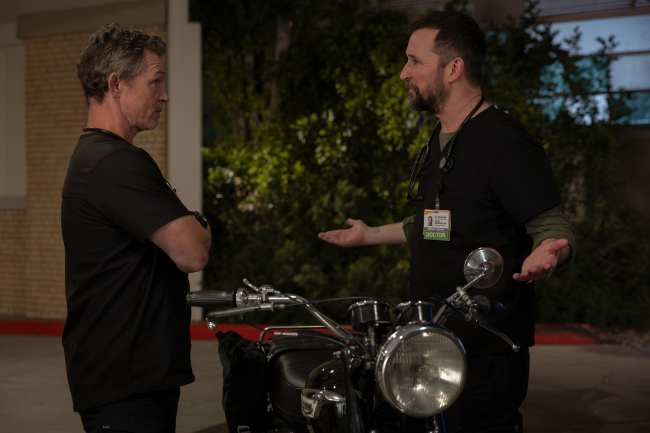
But it’s the emotional conversation between Robby and Dr. Jack Abbot (Shawn Hatosy) that may have pulled him back from the brink. After saving the pregnant woman and her baby, Abbot urges Robby not to take his own life and to promise that he would return after his trip — even looking up the destination Robby plans to riding off to and discovering it to be a known suicide spot. Death may come for them all, Abbot tells his longtime friend, but they can’t “succumb to it.”

“Yes, life can suck. It can be unbearable and brutal and ugly and heartbreaking, but it’s also beautiful and hilarious,” Abbot says. Abbot tells Robby to stop with the helmetless motorcycle riding, calling it “death wish behavior.”
Robby confesses that being in the ED “is killing me,” that he’s “tired of being a role model,” “tired of feeling like I can’t get ahead,” “tired of feeling like I’m drowning everyday” and most concerningly, “tired of all of it.” An obvious cry for help if there ever was one. Abbot advises Robby to find a way to “dance through the darkness” and more importantly, that he needs help.
Knowing there’s only so much he can say, Abbot ends their chat by telling Robby to come back “in one piece.” He reminds him gently that he’s listed as his emergency contact and that he “doesn’t want to be contacted.”

Robby’s confronted, too, by Dr. Frank Langdon (Patrick Ball) who tells Robby he desperately needs help, that he’s not perfect and that he’s not living up to his own high standards. And as his shift winds down, Robby takes over the care of baby Jane Doe, the abandoned newborn introduced earlier in the season. “I wish someone would swaddle me,” Robby says under his breath. Within the safe confines of the baby’s room, Robby promises there’s hope for the baby’s future, even if he doesn’t quite believe there’s hope for himself: “You’ve got so many wonderful things to see and so many people to love ahead of you.”
Elsewhere in the ED, changes are afoot. Dr. Baran Al-Hashimi’s (Sepideh Moafi) future as a doctor is in limbo after Robby threatens to disclose her medical condition to hospital administration. Dr. Victoria Javadi (Shabana Azeez) briefly toys with law school, but ends up finding a renewed focus on emergency psychiatry and mental health as her new calling. Dr. Samira Mohan (Supriya Ganesh), in a final (rather tense) interaction with Robby, finally airs their misunderstandings and she mentions possibly going into geriatrics. His last teaching moment with her? That life doesn’t go the way you think it will go, but it’s never too late to start over — advice he could probably use himself. Dr. Mel King (Taylor Dearden) struggles with taking the reins off her sister, Becca (Tal Anderson), and learning to live for herself. Oh, and she’s hit with another deposition.

With Season 3 set to take place four months later, The Pitt creator and showrunner R. Scott Gemmill tells Gold Derby that picking the story back up in November allows time for Robby — yes, he’s coming back — to work through what he needs to work through, or at least to start that process. “[We’re] really focusing on Robby’s journey through mental health and hopefully getting better,” Gemmill says of the new season. In a post-finale conversation with Gold Derby, Gemmill discusses where Robby goes from here; those excruciating final scenes with Abbot, the revolving door of cast departures; and what’s ahead for next season
Gold Derby: This season, Dr. Robby’s mental state really degraded over his shift. He went on his goodbye tour, dead-set on riding off into the sunset, which caused some in the ED, like Dana (Katherine LaNasa), to conclude that he wasn’t coming back and that he intended to hurt himself. Where is Robby’s mental state by the end of it all?
R. Scott Gemmill: It’s not in a good place. I think he’s very torn and that’s why we don’t see him ride away. We see him holding a baby, talking about his own childhood. Clearly he’s in a very bad place and we should be worried about him. I’m worried about him, you know? He needs to take steps to get better and he hasn’t. Until he does, things are only going to get worse.
There was that moment that Langdon has with Robby, where he tells him, “You need to do the work. You need to put in the effort to try and improve.” What does “putting in the work” mean for Robby?
It means he has to take the advice that he’s so good at giving. One of the reasons he doesn’t want to deal with Langdon, I think, is because Langdon represents what Robby should be doing. Langdon messed up, but he’s making amends, he’s doing the work, he’s doing the drug testing, he’s going to meetings. He’s sober and Robby hasn’t really done anything. He’s given lip service to therapy and that’s about it. Langdon says, “The ER only works when everybody works together.” And Robby’s not working together. He’s sort of a lone man out there trying to deal with his own demons and he needs professional help.

One of the scenes I really loved in the finale was Robby’s heated conversation with Abbot because it felt like everything was being laid out all on the line. Can you talk about that scene between those two?
Abbot knows Robby very well. Abbot’s been through his own dark s–tt and has come out on the other side because he’s put in the work. He’s not going to baby Robby. He’s going to be his friend, but Robby’s a grown man and Robby’s smart enough to know he needs help. He’s being stubborn. He’s being a little bit contrite, in terms of not putting his money where his mouth is. And I think Abbot is one person who can really talk to him on [the same] level because they’re equal. There’s no hierarchy interfering with the conversation. But he’s also of the mind that if Robby really wants to hurt himself, he’s gonna hurt himself — and there’s nothing that Abbot can do. So it’s like, you know what, you do what you have to do, but be smart about it. He wants him to come back, but he’s not gonna hold his hand. Sometimes with situations like that, you finally get to a breaking point where it’s like, “OK, fine, go do what you can do. But I’m tired of talking about it.”
The finale scene with Robby and baby Jane Doe was a mix of emotions. On the one hand, it was sweet and hopeful, but it was also incredibly sad to watch. One of the lines that really struck me was when Robby says, almost kind of like an aside, “I wish someone would swaddle me.” How significant is this scene?
I think that’s a big part of Robby’s [story] and we’ll learn more about Robby moving forward in Season 3. We’ll start to reveal what Robby’s backstory was and it wasn’t always pleasant. He has his own demons that he’s never really dealt with. We learn this in Season 1, too — he hadn’t dealt with [Dr. Montgomery] Adamson’s death and some of these other things that we don’t know about. Eventually it comes to a head and it finds a way out at the most inopportune moments, such as the mass casualty. He’s able to hold it together this season pretty much, because nothing got quite as crazy as the first season. But he’s certainly struggling and we see that in that last moment, even with the baby. It’s hopeful for the child. There’s a little bit of hope that Robby’s offering, but you can see that he’s still in a really bad place.

Was there ever a fleeting thought of killing Robby off because there had been speculation that it was leading down that road?
It was certainly an intention. We talked about, would Robby take his motorcycle and drive off a cliff? I think Robby went on his sabbatical wondering the same thing, leaving that option open. Sometimes that sort of a mindset, where knowing that you can take your own life at any moment, some people find comfort in that.
One of the side effects of working in the ED is the constant revolving door of doctors and patients. I’m sure it was difficult landing on the decision to have Supriya Ganesh and the character of Samira go. Why did you feel that this was the best course of action going into Season 3?
It’s part of the process. It is a bit of a revolving door in the hospital and in order to keep a certain amount of that feel authentic is the departure of certain individuals and the arrival of others. So we have new people coming in and we have new people leaving and old people leaving. And that helps keep the show fresh and keeps the audience on their toes. It also eliminates that sense of false jeopardy that some shows have where this isn’t going to happen because we know they’re not going to get rid of that character. When characters can leave in a moment’s notice and unexpectedly, then you don’t have that false jeopardy and you never know what can happen.

Ayesha Harris, who plays Dr. Parker Ellis, is now going to be a series regular, but she’s currently on night shift. Curious what your plans are for that character and how this potential shift up to dayside changes the dynamics of the emergency department moving forward?
Every time you have new faces come in, it changes the dynamic. Dr. Ellis has been on night shift and then we’re going to [change things up]. Not everyone works steady nights. Some people you can, but it’s not recommended. It’s hard on the doctors and so they usually swap out. It just felt like an idea to seize one of the night shift doctors working a day shift for a change just to change up the dynamic.

Shawn Hatosy has talked about the idea of a night shift spin-off. With the success of the show, offshoots and an expansion of The Pitt universe aren’t lofty ideas. How feasible is it for you, and are you interested?
I get that question or the possibility brought up constantly. I think it’s certainly something we’ve thought about. I think it was a little too early to do anything because part of what we want to do is really establish the show and make it as successful as it can be. And if the time comes when the powers that be want to explore other possibilities, we’ll be here. We’re willing to consider just about anything.

Season 3 will take place four months later, which takes us from July to November. What’s the reasoning behind the shorter timeframe? How will things look or be when we drop back in with these characters?
We didn’t want to go too far again. That’s a big jump. And four months seemed like a reasonable [amount of time], plus it would allow Robby time to come back. It also gets us into colder weather and we haven’t done a wintry autumn show, so that seemed like a nice opportunity to bring new stories into the ER. It felt like a good fit.
Anything you can tease about Season 3 to whet people’s appetite?
It’s really gonna be about peeling back more layers of the onion of all our characters, seeing where they are, seeing them in their trajectory. There will be some new faces, some people will be gone and some new people will show up. [We’re] really focusing on Robby’s journey through mental health and hopefully getting better.
