
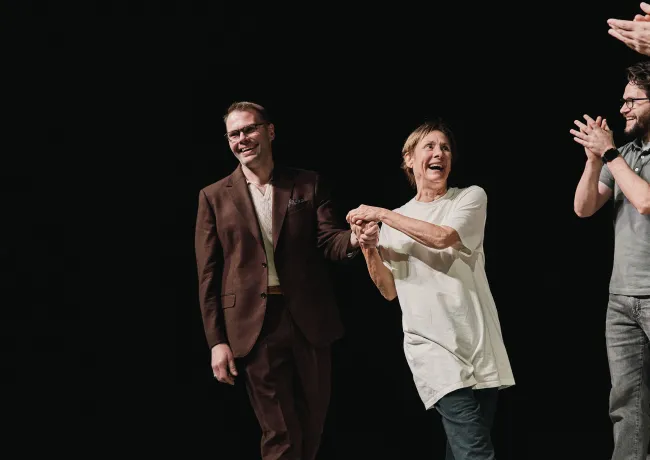
Fans of Little Bear Ridge Road might be surprised to learn that Samuel D. Hunter’s acclaimed play did not originate as the intimate family drama that audiences saw on Broadway in October.
“I started writing a completely different play that was about four custodial workers doing the night shift, and they were talking about television that they were watching,” Hunter reveals to Gold Derby. The Obie-winning author of The Whale and Lewiston/Clarkston ultimately used that notion of TV-chatting characters as the inspiration for his Broadway debut, which stars Tony-contending Laurie Metcalf as an Idaho nurse who reconnects with her nephew (Micah Stock) just as the COVID-19 pandemic sends the world into lockdown.

“[After] being a creature of off-Broadway this entire time, I feel validated that we did fill a Broadway house,” says Hunter, who also watched Brendan Fraser win a Best Actor Oscar for Darren Aronofsky 2022 film version of The Whale, which the playwright earned a BAFTA nod for adapting.
Hunter’s work on Little Bear Ridge Road began in earnest when Steppenwolf Theatre Company veterans Metcalf and director Joe Mantello commissioned a new play from him. After those initial conversation, the dramatist started work on what he describes as a “play about a mother and a son.” But like the night shift idea, he couldn’t quite get that version flowing either. “The characters were suffering from an overfamiliarity with each other,” he admits.
As a way around that obstacle, he started over with the characters of Sarah (Metcalf) and Ethan (Stock), who had a relationship that cracked the play open for its author. “[An aunt and nephew] could be very close,” he explains. “That relationship could be like brother and sister or parent and child — or it could be nothing.” Hunter’s television-related kernel remains intact in the finished version with Ethan and Sarah bonding over their shared experience of spending three years watching a prestige series about a family who may or may not be extraterrestrials.

Hunter stresses the influential contributions his collaborators made to early drafts of the play, which were refined during Zoom readings and a week-long workshop in Chicago. “Laurie is so no-nonsense about how she works,” he says of the two-time Tony winner, who is currently starring alongside Nathan Lane in a Mantello-directed revival of Death of a Salesman that’s looking to crash the Best Play Revival categories.
“She just takes it in, and makes it her own,” Hunter continues. “She delivers the text, but she finds all these nooks and crannies that you didn’t know were going to be there. In my estimation, Laurie is maybe the greatest stage actor living in America at the moment.”
Little Bear Ridge Road is a relatively lean work with only four characters and a 95-minute runtime, but Hunter meticulously crafts the complicated, ever-evolving relationship between Sarah and Ethan. “I don’t want to write plays that showcase my wit or intelligence or deep knowledge of subject matter — the stuff that’s unsaid is the most profound stuff,” he says of his process. “Seeing a character withhold something is way more interesting than some poetic monologue.”
In one especially beautiful scene, Ethan’s new boyfriend, astronomy student James, tries to help him appreciate Idaho’s starry night sky in Idaho and how many of the galaxies that we see in the heavens are actually much closer to Earth than one would suspect. “I knew that the fundamental tension needed to be this tiny couch in this void in this vastness,” Hunters says of that moment. “ the juxtaposition between the vastness [of space] and these tiny lives, these tiny televisions and these people sheltering during the pandemic.”

Much transpires during the play’s three parts. Ethan grows increasingly close to both Sarah, especially after learning that his aunt is battling metastatic cancer. He also falls hard for James, only to detonate their romance after learning his paramour may have been accepted to a Ph.D. program in Chicago. Sarah subsequently encourages him to leave the nest and, in the play’s final moments, Ethan is living alone and has finally started writing again. Our last image is of Sarah — who has started hospice care in her home — facing away from the audience while her nurse reads the closing paragraphs of something Ethan has written.
“I felt pretty strongly about [that ending] when I wrote it,” Hunter says, confessing that some audience members at Steppenwolf were frustrated by the lack of resolution. “[For me] it was so much more profound to see this nurse character, who has no relationship to anybody, read this content, not knowing at all what she’s reading. But we have the entire play behind us, so we know what it [means] — and we get to have that emotional catharsis.”
