
When Liberation is revived on Broadway in five, ten or twenty years from now, there’s a version of Bess Wohl‘s emotional memory play that could potentially contend for the Best Musical Revival statuette at those far-off Tony Awards.
In an interview with Gold Derby ahead of the 2026 ceremony, four of the show’s contenders — Best Actress nominee Susannah Flood, Best Featured Actress nominee Betsy Aidem, Best Director nominee Whitney White and Wohl, who is hoping to add a Best Play win to her Pulitzer Prize victory — reveal that a planned musical interlude was dropped from the production before it debuted off-Broadway in early 2025 and quickly transferred to Broadway months later.

“There was this protest song we learned that we thought we might use,” remembers Flood, who plays the show’s central character, Lizzie, a contemporary journalist who shifts between the present and the past while contemplating the legacy of her mother’s involvement in the 1970s feminist movement.

“We spent a good hour learning the lyrics and figuring out where we were when we were singing it,” adds Aidem, whose alter ego, Margie, quietly lived the life of a ’50s housewife until activists like Lizzie’s mother expanded her horizons. “And then we just scrapped it! It took me a really long time to realize that nobody else was singing but me, and I went ‘Oh.'”
“That’s not true,” protests Flood as the two nominees break into laughter. “I think I was still singing it way beyond anybody else,” Aidem insists with a grin. “I’ll take any chance to sing because nobody will hire me to sing!”
For the record, both performers know the song they were supposed to have sung by heart: Barbara Dane’s 1973 protest anthem, “I Hate the Capitalist System.” Just watch the clip below for visual evidence.
In a separate interview with White and Wohl, we informed the director and playwright of the private concert we experienced courtesy of the Liberation star. “Oh wow, now you have some inside baseball,” White says, laughing. “When we do our Broadway revival — or when we do the show in London — I might try and put that song back in. It’s always a question about doing the best thing for the show and the people you’re working with. If the idea isn’t quite right for the group, you have to humble yourself and lean into people’s superpowers. With that group of women, their superpower was a presence with each other and a presence in the language, so we decided to get out of the way and let them shine.”
“What I love about Whitney is that she’s still thinking about what she can do to make this a better production,” Wohl chimes in. “It’s incredible that this group is never satisfied with any version that we’ve done. Betsy called me a month ago with some notes on a scene, and I was like: ‘Betsy, notes are closed!’ Nobody ever stopped working, nobody ever settled and that’s what I loved about the process.”

Here are some other notes on key Liberation scenes as the players prepare for Tony night.
Setting the scene

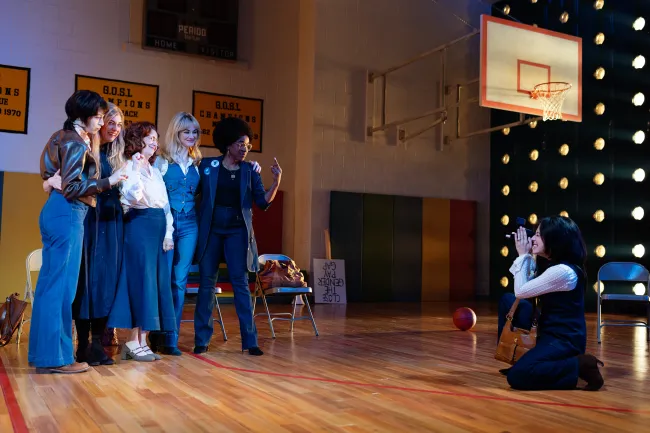
Given that Liberation is specifically described as a memory play, White and Wohl could have chosen to stage it in an amorphous setting to reflect the vagaries of how we remember the past. Think the minimal set design of Our Town instead of an ultra-specific environment seen in, say, Stereophonic. But then the production went and hired Stereophonic‘s Tony-winning scenic designer, David Zinn, to create a note-perfect replica of a rec center gym that would be right at home in any ’70s-era Midwestern town.
“There’s something so beautiful about honing in on this very specific world to release the universality of the play,” Zinn tells us. “Bess had written a play about character who are up against conflicts that are very concrete, even if the time frame is kind of slippery, and having something physical for them to bump against makes it more interesting.”
In building out the set, the designer drew on his own high school gym memories, and scouted digital platforms like Tumblr looking for period-appropriate reference images. “I found this great photo someone took of their high school gym in 1973,” he recalls. “They were getting it ready for a dance or something, and they had put up all these construction paper strips on the walls. The colors were so beautiful and evocative, so we translated that to our set with the gym mats just to soak in as much period detail as possible.”
And in case you’re wondering, yes — that basketball hoop is regulation height. “The scoreboard is also a real scoreboard from the ’70s,” Zinn reveals. “I watch a lot of basketball games from the ’60s and ’70s on YouTube!”

The specificity of Liberation‘s gym set made an immediate impression on the audience when they entered the James Earl Jones Theatre during the run of the show, and could practically smell the stale socks and flop sweat. It also impacted the actors. “I’d gaze up at the back wall sometimes, and look at all those banners announcing track championships and basketball championships,” Flood says. “All those textural details were so grounding.”
“It was a big playroom,” Aidem says. “I love it when a set has that much depth and width across the stage. It gave us permission to take up space, and not necessarily have to be in motion. There’s also a universality to that kind of space. There’s not a single person in the audience who hasn’t been in that kind of gym in grade school, high school, or summer camp. So that brought them into the play immediately.”
For Wohl, that ultra-specific setting also functioned as a potent reminder of why the ’70s feminist movement was so revolutionary. “It was a very intentional way of putting these women in a space that’s not designed for them, and where they’re not comfortable,” she observes. “And then there’s also the idea of this beautiful company of actors functioning as a basketball team. The other detail that I love so much is that the scoreboard has two big notes on it that say ‘Play fair’ and ‘Period.’ To me, that’s a little poem that’s embedded in the set.”
Dressing the part
While Zinn sadly missed out on a Best Scenic Design nomination, costume designer Qween Jean was recognized for transporting the audience back to the ’70s through clothes. It’s one of two nods that Jean received this year; she’s also nominated for Best Costume Design in a Musical for her fancy feline lewks in Cats: The Jellicle Ball. Speaking with Gold Derby earlier this year, the designer revealed that her secret to Liberation was simple — avoid ’70s kitsch.
“I don’t do kitschy,” Jean emphasized. “But I do love clothes, and with Liberation I felt called to search each and every character’s journey, and that meant creating a wardrobe for them that displayed their full arc.”
Both Flood and Aidem appreciated Jean’s careful attention to their characters’ fashion — and emotional — journeys. “We tried a lot of different versions of what Lizzie would be wearing, and they all kind of gave different things,” Flood says. “At one point, I was wearing this period-inspired sleeveless linen dress with boots that put me in touch with this kind of professionally ambitious journalist, and then we ended up with a costume that’s on the more casual side of the spectrum. It enabled me to move through space in a practical way, and that made her feel close to me.”
Aidem recalls that while Jean had a specific outfit in mind for Margie, she did give the actress the freedom to choose her alter ego’s eyewear. “I went to a flea market and I found two pairs of glasses — one for the first act and the other for the second,” she recalls. “I brought them in, and Qween said, ‘You’re right.’ I’m so grateful that she was collaborative about that.”
“I wish the world could see how many drafts of all the costumes Qween went through,” White notes. “I was looking back at some of the early photos, and thought, ‘I loved that outfit!’ She worked so arduously on the show and didn’t just go, ‘These are real-ish clothes, so we can just shop them.’ We also had to deal with nudity in one scene, and so what the women wore became more than just a wardrobe — it became armor. I can’t say enough how wonderful it was to work with Qween.”
Mother and daughter reunion

Liberation reaches its emotional climax with a moment of almost transcendent transference. Towards the end of the play, Margie removes her Act 2 pair of glasses and becomes Lizzie’s mother, freeing her daughter of having to keep both personalities in her mind’s eye. It’s a scene that both Flood and Aidem characterize as “magical,” especially considering how quickly it came together in the rehearsal room.
“We barely got the whole play staged in time,” Flood remembers. “We were racing to get to the end, and — I’m not joking — we got to that scene in the last 45 minutes. But Whitney had a clear vision for what the scene was, and had been calibrating it all the way through. We weren’t even off-book, but she orchestrated it like a conductor. We held the pages, held onto each other, and the scene just played itself.”
For her part, White says that a lot of pre-rehearsal thought went into her orchestration of that key moment. “When I hear them say, ‘Oh, it didn’t take that long,’ it felt eternal to me,” the director says, laughing. “It felt like that beat always existed, like Bess had written it in 2000 BC and we were destined to do it.”

And White took inspiration from a wide variety of sources, including Eastern European and Indonesian theater, as well as that stone-cold sci-fi classic Star Trek II: The Wrath of Khan, specifically the scene where an about-to-die Spock transfers his memories to good ol’ Bones McCoy. That’s right, everyone: the Liberation is an honest-to-Borg Trekkie — one who loves classic Trek as well as the new slew of Paramount+ shows — and the play will live long and prosper because of it.
“Cultural myths endure for a reason,” Wohl says, happily. “I don’t know as much about Star Trek as Whitney, but it speaks to people. There was something so primal in the experience of writing that scene and seeing it staged. Watching Whitney, you could really see somebody channeling a source that was coming from somewhere else, and making it manifest in front of your eyes. All of us in that rehearsal room felt like we had experienced something deeper than any of us.”
Hey Paramount, if you want to liberate Star Trek from its streaming confines again, give Star Trek: Discovery‘s Michael Burnham her own feature vehicle — and put White in the captain’s chair.
