
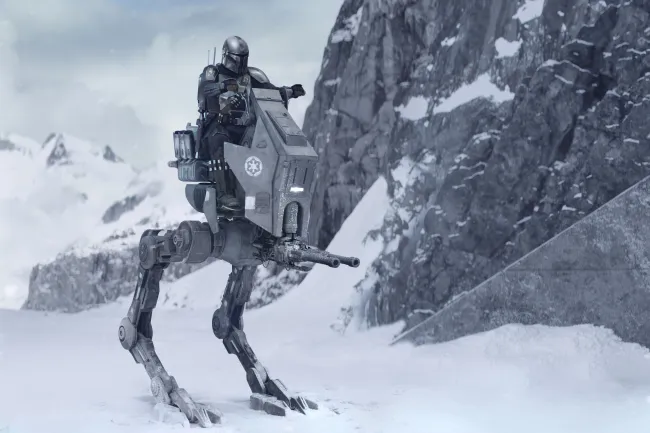
To supersize The Mandalorian Star Wars series into the Mandalorian and Grogu theatrical feature, director Jon Favreau insisted on maintaining the original trilogy’s blend of practical and digital effects. “We got to work with puppeteers, stop-motion animation, all the things I loved about Star Wars,” Favreau says. “It’s about combining new technology with the old, handcrafted stuff that’s so much of what makes Star Wars, Star Wars.” This approach ultimately resulted in bigger action set pieces (including the opening oner featuring the AT-AT walkers) and cool creatures (such as the standout dragonsnake) for the movie.

But since Favreau and team filmed for Imax, that meant more detail went into all 2,300 VFX shots created by Industrial Light & Magic. However, composing action for Imax’s two aspect ratios (1.90:1 or 1.43:1) was new a new experience.
Fortunately, ILM had a document describing proper headroom adjustment so you weren’t looking up somebody’s nose in extreme close-ups. But they needed to frame shots for both standard (2.39:1) and Imax aspect ratios at the same time.

“So we had these guides and we started to follow them, but we realized that we needed a better way of vetting this,” explains ILM Chief Creative Officer and VFX Supervisor John Knoll. “Imax was just down from the cutting room. So we would go there and take a look. But we also built a VR app for Apple Vision Pro, where we could stream both from the video taps on set into a virtual Imax theater.
“You put on the headset, you go in the [virtual] theater, you see all the seats around you, and you see this 100-foot screen,” Knoll continues. “And we could see the feed from the video tap, and we could get a hyperdrive stream from editorial, so we could play through sequences and just make sure it’s all working in Imax. I thought this was a terrific use of VR tech, and was way better than guessing at it.”
Unlike the series, which had 10 months to complete around 5,000 VFX shots, the feature had nearly two years. That enabled the team to be more deliberate and measured about how they approached the work. And also avoid the waste of completing shots they weren’t going to use by employing maximal efficiency.
“So we did a couple of measures to make use of the longer calendar time we had by letting post actually be post,” adds Knoll. “And we didn’t do big sequence turnovers until Jon had a chance for his director’s cut to coalesce. And, in the meantime, after we wrapped principal photography, we went through the whole film and picked key moments and characters and environments that were likely to survive any version of the edit. And we picked about 70 shots to get started and to keep iterating for three or four months.”

The first thing Favreau wanted to do was build bigger sets and also change up how they used the eliptical, 110-foot-wide Volume, which had become predictable by Season 3. “One of our locations is a place called the SCS Warehouse in downtown L.A.,” Knoll says. “That’s where we did the street scenes for Shakari, that sort of Blade Runner nighttime planet with shiny streets.We were meant to be looking down the main drag there, where the streeet goes way off into the distance.
“And rather than put a blue screen down there, I argued to erect LED walls on either end of it. Put the tracking cameras in so that we’re moving around through the street, tracking the perspective and making that look like it goes away for miles. I think the shiny streets reflecting the LED content really helped sell it.”
The opening walker battle

For the bravura opening, which begins with Din Djarin (Pedro Pascal) and Grogu (aka Baby Yoda) dodging Imperial walkers on their AT-RT walker, Knoll was in familiar territory from Star Wars: Rogue One. “One of the things that we discovered on Rogue One was that the speed of the walker really depends on how tight you’re framed,” Knoll recalls. “We tried to match the cycle timing of the walkers in The Empire Strikes Back, but they rendered way too fast. So we ended up at half-speed, and we went into this one figuring we’d have to use that half-speed walk. But after our shots were framed tight enough, we were still way too fast, so we ended up at a quarter-speed.”
For the high-octane oner inside the AT-AT set, where Din Djarin chases after the villain he’s trying to capture, the VFX enhancements were minimal but effective. “Apart from us painting out a couple of stunt rigs, there’s a flamethrower effect and a lot of laser blasts going back and forth,” Knoll suggests. “Most of that is practical. They had this 100-foot technocrane that they could telescope all the way down the set and back following the action. And, boy, they rehearsed that for weeks, figuring out all of this complex stunt choreography.”
Grogu

Meanwhile, the Force-wielding Grogu was still primarily an animatronic puppet built and puppeteered by Legacy Effects. However, the adorable creature has a lot more to do than in the series. Indeed, there’s an emotional 15-minute sequence midway where the child nurses his father-figure back to health by finding him medicine and building a shelter.
“The biggest difference here than in the series is that Grogu isn’t always with other actors,” says animation supervisor Hal Hickel. “And it was kind of lovely because they could really drill down on and only worry about the puppet performance. But there are little bits here and there where we do CG Grogu where it’s an action that was just impossible to do with a puppet.” For instance: when he gets swalled and spit out by a giant swamp frog.
The Dragonsnake
The appearance of the massive, pale CG dragonsnake, which Din Djarin fights beneath the Hutt palace, was a nod to both Empire and The Clone Wars animated series, where the species first appeared. This was a beautiful design by Doug Chang, Lucasfilm’s senior vice president and executive design director. “It’s tough because it’s not a real world thing,” Hickel admits.
“There’s nothing that big so we have to start using our imaginations. But the animation team did a great job, and I really like the way he looks. We did a fun thing with its snout, where we noticed that running down its nose, it almost looked like the bones in the back of your hand. And we thought maybe then the end of those teeth can actually flex and grip like prehensile teeth.”
The sentries
Finally, Din Djarin battles a pair of mercenary sentry droids, Arges and Bullethead, who protect the Hutt twins. These were detailed, old-school stop-motion models created by Tippett Studio, under the supervision of legendary animator Phil Tippett. (See Slide 13 in the gallery below for a glimpse of the sentry models.)
“The droids have three limbs and they have all sorts of moving plates on them, including a sort of skirt that’s individual pieces,” Hickel adds. “The Tippett folks said that was probably the single most complicated thing they’ve ever animated.”

Marcus Errico/Gold Derby

Marcus Errico/Gold Derby

Marcus Errico/Gold Derby

Marcus Errico/Gold Derby

Marcus Errico/Gold Derby

Marcus Errico/Gold Derby

Marcus Errico/Gold Derby

This display includes a selection of credits and currency from the film (including some beskar), as well as the deck of bounty cards featuring wanted Imperial criminals.
Marcus Errico/Gold Derby

Marcus Errico/Gold Derby

Marcus Errico/Gold Derby

Marcus Errico/Gold Derby

Marcus Errico/Gold Derby

This display contains models and props from The Mandalorian and Grogu, including the hulking droids that protect the Hutts and some of the alien species in the films.
Marcus Errico/Gold Derby

Marcus Errico/Gold Derby

Marcus Errico/Gold Derby

Marcus Errico/Gold Derby

The Mandalorian, his N-1 starfighter, and some friends in the Star Wars prop house
Marcus Errico/Gold Derby

Marcus Errico/Gold Derby

Marcus Errico/Gold Derby

Marcus Errico/Gold Derby

Marcus Errico/Gold Derby

Marcus Errico/Gold Derby

Marcus Errico/Gold Derby

Marcus Errico/Gold Derby

Marcus Errico/Gold Derby

Marcus Errico/Gold Derby

Marcus Errico/Gold Derby

Marcus Errico/Gold Derby

Marcus Errico/Gold Derby

Marcus Errico/Gold Derby

Marcus Errico/Gold Derby

Marcus Errico/Gold Derby

Marcus Errico/Gold Derby

Marcus Errico/Gold Derby

Piloted by a diminutive droidsmith, this ship transports Grogu in a key sequence. Fun fact: Favreau’s model makers repurposed Apple Watches for the rectangular cockpit monitors.
Marcus Errico/Gold Derby

Marcus Errico/Gold Derby

Marcus Errico/Gold Derby

Marcus Errico/Gold Derby

Marcus Errico/Gold Derby

Marcus Errico/Gold Derby

Marcus Errico/Gold Derby

Marcus Errico/Gold Derby
