
Jack Thorne had wanted to adapt Lord of the Flies for more than 30 years.
“I was 11 when I read this book, and I loved it from the moment I read it,” the Emmy-winning co-creator of Adolescence said about William Golding’s 1954 novel during an FYC event in Los Angeles on Sunday.
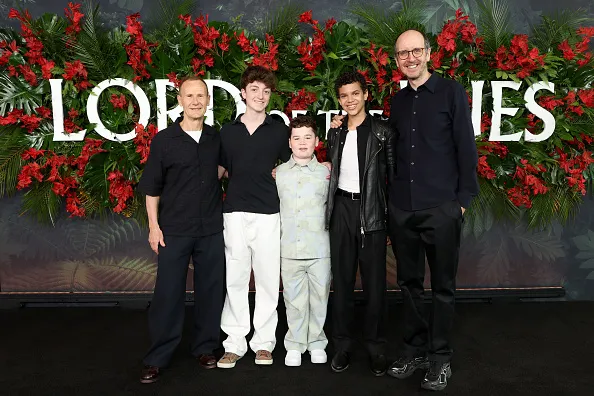
Thorne was joined by series director and executive producer Marc Munden, casting director Martin Ware, series composer Cristobal Tapia de Veer, and cast members David McKenna (Piggy), Winston Sawyers (Ralph), Lox Pratt (Jack), and Ike Talbut (Simon); de Veer and Pratt appeared virtually.
The four-episode TV adaptation of the dystopian classic, which follows a group of schoolboys stranded on an uninhabited island as they descend into violent chaos, began streaming on Netflix on May 4.

One character in particular stood out for Thorne when he first encountered Golding’s text.
“I was the lonely kid at the back of classes that didn’t really understand anyone else, that wasn’t very good at making eye contact, and I felt like Simon was me,” Thorne said of the introspective character.

The boys who play the four central roles — each of whom anchors their own point-of-view episode in Thorne’s adaptation — were relative newcomers to television. Ware said that he and casting colleague Nina Gold sifted through “7,000 to 8,000 tapes and boys” and visited “a couple hundred” schools during an exhaustive search that also extended across social media.
Sawyers, who portrays the levelheaded leader Ralph, noted he had only “done a couple episodes” of a previous show but had mostly acted in school plays. Talbut (Simon) and Pratt (the violent antagonist Jack) had similarly limited experience, coming primarily from school plays and amateur theater.
To uncover the boys’ natural personalities during auditions, Ware explained that he and Gold asked candidates what they would bring with them to a desert island, or whom they would want to be stuck there with.
“I said the West End cast of Les Mis,” quipped McKenna, who plays the sharp but bullied Piggy.
“I said that I would want a load of books because you can use them for entertainment, but then also like firewood and toilet paper and stuff,” Talbut said.
The series’ unique “relay race” structure, which centers on one character at a time, diverges from the novel’s chronological format. It was this fresh approach that ultimately persuaded Golding’s estate — and the author’s daughter, Judy, in particular — to green-light the TV adaptation.
Thorne explained that he wanted to “structure it using the vocabulary of television to really bring out the juice of the book.”
Delving deeper into Jack’s villainous perspective also added a psychological layer missing from the 1990 feature film adaptation.
“Giving Jack his own episode, I think, allowed us to expose the truth of Jack, the tenderness of Jack,” Thorne said. “And if you can understand Jack, then you can understand the tragedy of the island.”
Beyond the fictional location, Thorne emphasized that it is “important in our world currently” to be examining characters like Jack.
“In our country yesterday, there was a huge march through the center of London that was people that are very angry about immigration, very angry about what they see as their country being taken away from them,” he explained. “They have some dangerous ideas, these people, and I’m a bit scared of them, but I also want to understand them.”
For Pratt, tapping into such a brutal character proved “a little bit tricky.”
“I think as we got further into it, we started to realize that we could sort of laugh at the end of takes and sort of realize that it wasn’t what it seemed to be,” Pratt said, adding that he drew inspiration from Cillian Murphy’s Tommy Shelby in Peaky Blinders and Malcolm McDowell in If…. “And I think watching it, it kind of hits you harder than when you’re actually doing it in the moment.”
McKenna, meanwhile, felt a more direct, relatable connection to his on-screen counterpart.
“I mean, I’m the bossy one. [Piggy’s] a lot more organized than I am. And he’s a bit more pessimistic than I am,” he explained. “But I feel like, in a lot of ways, we’re pretty similar.”
Working with a young cast meant BAFTA-winning director Munden had to navigate strict labor laws while filming on location in Malaysia. Because night shoots with children were restricted, he had to get creative to simulate the dark jungle environment.
“The hallucinatory reds and pinks really is a practical thing, which is we could never film with the boys at night,” Munden revealed. “The script was set at night, so we had to find another way to connote night in some sort of way, and that was by taking out the infrared filter from the camera, which turns all the foliage to red, pink, and maroon. And we just took it from there in terms of making it more and more vivid as we went on.”
Emmy-winning composer de Veer mirrored the boys’ regression through the score, starting with classical European orchestral music that gradually distorts to reflect their savage transformation.
“The classical music starts disappearing, and we go further into chaos and, let’s say, abstract sounds and more violent aesthetics,” he said.
“I think the music still needed to represent that these are kids and it’s very vulnerable,” he added, “but it’s still kids and they’re still somehow, I don’t want to use the word victims, but it’s somehow they’re being controlled by things in a different way than if they were [adults].”
For Thorne, the project ultimately came down to maximizing the medium’s unique strengths.
“This book is beautiful and your first question always is how can I be faithful to this book?” he concluded. “But as you’re expanding out, as you’re finding different corners and nooks and spaces to live, you do see possibilities of things.”
