
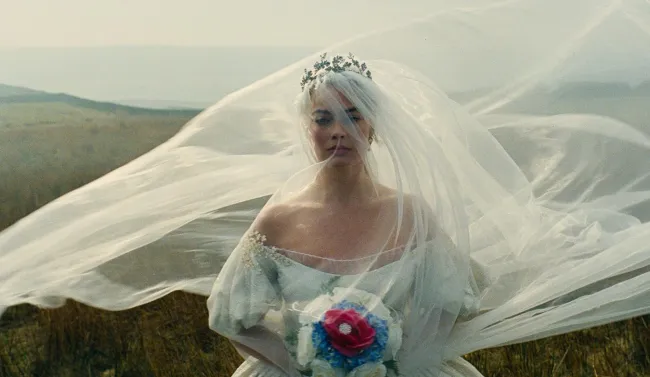
Love it or hate it, Emerald Fennell‘s provocative Wuthering Heights is an undeniable visual feast. It stirs up the passion, obsession, and inner turmoil between Margot Robbie’s Cathy and Jacob Elordi’s Heathcliff.
Indeed, Wuthering Heights is the first of two anticipated awards contenders from Oscar-winning cinematographer Linus Sandgren (La La Land); the other being Denis Villeneuve‘s Dune: Part Three (Dec. 18), which concludes the franchise as a dark thriller with a different kind of visual sweep.
Both were shot on Kodak film — Sandgren’s prefered format for its innate grain and texture, details in the highlights and shadows, and beautifully rendered shades of color. He shot 35mm for Wuthering Heights (including large format VistaVision), and mostly 65mm using Imax cameras for the Dune finale. Significantly, this marks the franchise’s first embrace of the analog format.


“The stories are different and they had a different need for the visuals, but they are really exciting,” says Sandgren, who previously worked with Fennell on Saltburn, also shot in 35mm. ”They take you on a journey and what film does is make you believe what you’re watching more than digital. There is also something to the way every image captures a unique combination of random grain. It feels alive.”
The thing about Wuthering Heights that was different for Sandgren was going on a very personal cinematic journey with Fennell. She wanted to recreate the primal experience she had when first reading the Emily Brontë classic love story as a teenager. Fennell was struck by its subversive tone, oppressive atmosphere, and shifting power struggle between Cathy and Heathcliff after he seeks revenge for her betrayal.

“Emerald had a particular take on it, including the visuals, which were going to be a mix of things,” Sandgren explains. “They were inspired specifically for costumes [Jacqueline Durran] and production design [Susie Davies], but also the mood and the light and the nature versus the humans in that environment. And she took from the films she had seen [including Gone With the Wind and Cries and Whispers] and she took from architecture she had been exposed to, so it could be a mix of Brutalism and classic Gothic stories.
“And she saw that the world was living with strange black rocks coming out of kitchens,” he continues. “Everything was allowed for us to work with because she had seen crazy visions that she expressed to us very clearly. She was always very articulate about how to explain things that were grounded in her thoughts. Whatever felt like it was right for the film emotionally. So you could stretch realism in a way to be more like romantic painters and more expressive with the light.”

Sandgren had plenty to work with in lighting the film’s principal locations: the grunge of Wuthering Heights, where Cathy and Heathcliff grew up, which is overtaken by a hostile, rocky landscape; the etheral and foggy moorlands; and the gloss of Thrushcross Grange, where Cathy lives after marrying wealthy neighbor Edgar Linton (Shazad Latif), which boasts grotesquely anatomical decorations.
They designed the world from beginning to end with set builds of the two homes constructed at Sky Elstree Studios, containing fog and torrential rain effects, surrounded by printed backdrops of the moorlands. Exteriors of the moorlands were shot at Yorkshire Dales National Park.

“On stage, we worked on making it look as realistic as possible, [with] the light being heightened but still a naturalistic,” Sandgren recalls. “We didn’t want the light, for example, the sun, to hit perfectly, we wanted it to hit more randomly, like it does in real life. We only cared about the light to follow the emotional story. And we constantly changed the look of the weather, which was basically shot on stage for those exteriors close to the houses.

“Thrushcross Grange, in that regard, was meant to feel romantic, as Cathy sees it, and it’s like the sun is setting,” he adds. “And, later in the film, when it starts to be more horrific, it’s a foggy sequence. And, later, when we follow more the sensual emotions, we go even more dramatic and blue.”
Meanwhile, Sandgren used the VistaVision process with a vintage camera for those wide exteriors of the moorlands without dialogue, along with a few interior establishing wide shots of the Thrushcross Grange set. “Emerald likes to feel the grain when you’re shooting in 35mm,” the cinematographer says. “But, sometimes, my experience is that if you go out on a wide shot, and you expect the audience to look at something very small in frame, then it’s beneficial to go to a better resolution film [with less grain] for those painterly compositions. And the larger format VistaVision, which is horizontal but still 35mm, was perfect for that.”

This is all to reaffirm Sandgren’s preference of film over digital. “When you shoot on film and you look at Margot Robbie’s skin tone on her face, and you see the variations of color from purple to red to blue, you get a much more complex palette,” he insists “What film does is this magical thing that becomes an impression of reality instead of displaying how reality looks.”
Wuthering Heights is now available on digital download, and releases May 5 on 4K UHD and Blu-ray
