
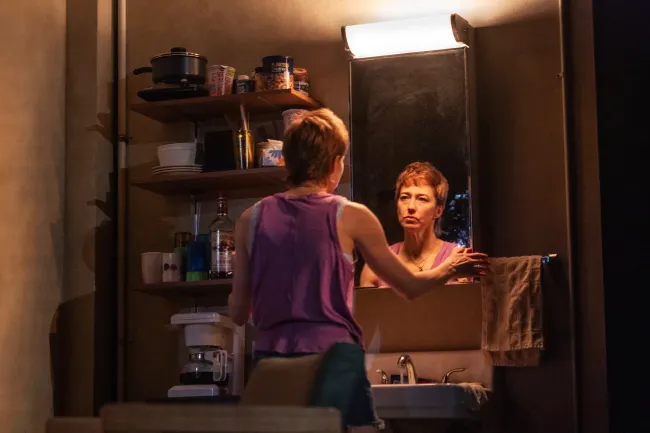
“It is so satisfying to come back to Broadway. In some ways, I’m glad it’s been a rare privilege for me, because I value it that much more,” says Carrie Coon about her homecoming to the New York stage earlier this year in the first-ever Broadway production of her partner Tracy Letts’ Bug.
The actress, who immediately leapt from Bug’s limited engagement to production on the fourth season of HBO’s The Gilded Age, starred as Agnes, an emotionally adrift woman living out of a motel room in Oklahoma who forms a fateful relationship with an unassuming stranger. The play, which Letts penned 30 years ago, feels eerily prescient as it grapples with the frightening contagiousness of conspiracy theories among isolated characters.

Coon recently sat down with Gold Derby to discuss the regional theater origins of the production, the most intimidating aspects of her character, the other Letts role she would love to tackle in the future, and the importance of her first Broadway appearance on her professional and personal lives.
Gold Derby: It has been 13 years since Who’s Afraid of Virginia Woolf, which marked both your debut and most recent appearance on Broadway. Why was Bug the perfect project with which to return?
Carrie Coon: It was mostly the perfect project because we did it in Chicago four years ago — we did it before the pandemic, we did it after the pandemic to reopen the theater — and we’ve been trying to get it to New York since then. I think it came to Broadway at a time when the play needed to be on Broadway, where people had an appetite for that kind of work.

As for me personally, it’s a hard play, so if I’m going to spend time away from my family, I want to do something that asks something of me. It’s also satisfying because Tracy’s plays are really fun to do. It’s also the kind of character I don’t think people have seen me play very often. Playing a working-class character, which is in fact a lot closer to me and my upbringing than things I usually get invited to play, it feels like me in a way.
Once you had a confirmed theater and dates for the Broadway run many years after the Steppenwolf production, was it daunting to re-submerge yourself into this incredibly challenging role?
What was most intimidating about it is that because it was considered a remount, we had one workshop week in September, and then we had one week of rehearsals, and then we were in previews. [The Chicago run] was four years ago, and I was 13 weeks postpartum with my second child when I did it, so I don’t remember anything about that time in my life. I just thought, there’s no way it’s still in there. How are we ever going to put this back up?
But in fact, I think we always discover when we go back and revisit a play that it’s actually so satisfying to realize that it has just sunk in a little bit deeper. Then in previews, we were changing staging because that’s the biggest space that play’s probably ever been in, and it’s quite challenging to stage an intimate play in a big space like that.

What was it about Agnes as a character when you met her on the page that you first latched onto and made you think you understood her?
I think at first she scared me because I wasn’t sure – even though she’s closer to me in some ways than anybody else, in terms of how I grew up and what part of the country I grew up in, and the kind of people I knew — I didn’t know if I could believably channel her.
The speech at the end is just a monster speech, and to just imaging taking on that thing. And, of course, there is a very different kind of live wire you touch when you actually have kids and you sit in contemplation of a child disappearing, being killed, being lost, whatever it is that happened. It’s a different experience, there’s something much scarier about doing it.
The nice thing that I didn’t understand when I first read it, which is why it’s so terrifying at first, is that she really goes out exhilarated. She goes out on top. She goes out having solved the mystery, gotten all the answers, and on her own terms, in love. It is a triumphant ending, even as the audience is seeing it as profoundly sad or terrifying. For her, it is an absolute triumph when she self-immolates on that stage, and that’s the energy you’re finishing your day with.
Thinking back to how you performed that gargantuan monologue, it was haunting and powerful and scary; I can still hear your guttural scream in my mind! How did you approach that monologue when you saw that amount of text and you knew you were taking Agnes on such a journey?
You memorize it. And when you memorize it, you memorize the punctuation. Tracy’s a good writer, but he’s also a good writer for actors, and if you’re getting a word wrong, you feel the hitch in the giddy-up. Rhythmically, he just understands the rhythm of speech. The way it gains steam is the way it’s written. Actors know good writing is easier to memorize than bad writing, and so if you get that engine going, it starts to take care of itself, in a way.
Every now and then, Tracy will just drop something in after he sees a preview, and he said, “Remember, remember Agnes’ rage. Remember her rage at these people.” Once he reminded me about that, then the thing really, really took off again. It’s a delight.

You and Namir Smallwood, who played Peter, shared so many powerful moments together, both understated and explosive, including one memorable scene of body horror in which his character yanks out his own tooth with pliers. The audience response to that moment was extraordinary. How did you experience the audience’s reaction every performance? Could you feel their shock and revulsion and palpable excitement?
It’s not something we typically think of as Broadway-worthy, but it’s so rare you feel that level of engagement in a room like that, in a room that size, the actual audible gasps and people covering their eyes. We could hear it and see it all. Namir loved doing it. It’s really gratifying. We had so many young people coming in those last few weeks, and they were also surprised by what was possible in a live performance.
You mentioned collaborating with Tracy as a playwright. Do you see yourself stepping into any more of his characters in the future?
I really, really would like to do Barbara in August: Osage County. I’m just about the right age, I’m a little young yet. It hasn’t been revived since 2008. I didn’t know him then; I thought he was a sweet girl from Oklahoma when that play was taking Broadway by storm. It’s overdue for a revival, and we’ve done a couple of readings of it, and it’s wild to hear it now in light of what’s happening in this country. I think there’s a line in the play that calls this a “s–thole country,” and just how prescient it is about where we were headed. It’s really a proper period piece in the way it sits inside of our nostalgia, but with this looming [sense] of how all these problems would be in the aggregate in the future.
I would love to bring that back selfishly, for Tracy’s sake, to reclaim what it was he was [doing]. It wasn’t just that it was big and dramatic; it’s been mimicked and copied and inspired other works since then. You see the influence of August: Osage County. It’s actually really, really smart and saying a lot about the country. It’s a metaphor for the country.

Otherwise, I love working on new plays. I really think it’s important to support young writers, so I’m ready to workshop something new and find out who are the next voices coming up through the theatre and how can I help support what they’re up to and maybe do something I haven’t seen before.
I couldn’t agree more. I do want to take you back in time, though, to Who’s Afraid of Virginia Woolf, and the absolutely exceptional production in which you starred and for which you earned your first Tony nomination. What did that production and the recognition mean to you and for your career?
That play literally changed the trajectory of my entire life. There was no reason to expect it was going to go beyond Chicago [or] the Arena Stage. Jeffrey Richards, our producer, came to our last show in D.C., and then he didn’t move the show for 18 months, so it could have fallen apart at any time. The fact that it made it to Broadway at all was a miracle. The fact that I had never had designs to go to New York or L.A. and suddenly found myself in the most coveted position, and because of that play, I could meet casting directors in TV and film. It was that June that I booked The Leftovers and it was that July that I booked Gone Girl. And I met my husband. Some other woman getting cast in that play might have married Tracy Letts, but it was me! It changed everything about my life.
This interview has been edited for length and clarity.
