
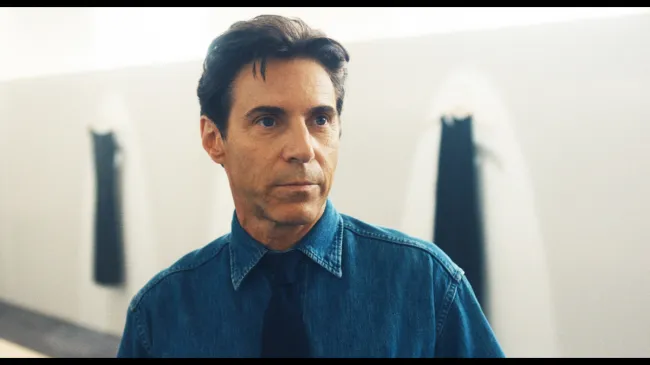
There’s a line Alessandro Nivola kept hearing, over and over, in the hundreds of hours of Calvin Klein interviews he absorbed while preparing for FX’s Love Story: John F. Kennedy Jr. & Carolyn Bessette. Klein would say it whenever he’d done something audacious or provocative: “I’m a bad boy.” To Nivola, it unlocked the whole character.
“He had this kind of powerful bearing and sort of a sense of propriety,” Nivola tells Gold Derby, “but then he also had this mischief and real naughtiness that would come through — and those things were sometimes all happening at once.”
In Love Story, the series created by Connor Hines and executive produced by Ryan Murphy chronicling the romance between JFK Jr. and Carolyn Bessette-Kennedy, Nivola plays Klein. Bessette rose from sales assistant to executive at Calvin Klein, becoming a trusted confidante of its eponymous founder — and in the show’s telling, that relationship carries the weight of a complicated love story all its own.

The man behind the brand
Nivola researched the role obsessively. He read books, talked to people who knew Klein, and people who’d worked in his offices. But mostly, he listened.
“I watched hundreds of hours of interviews with him,” he says. “I had them on repeat in my headphones as I would go to the market or walk the dog. And so by the time we started shooting, I kind of just knew all these anecdotes that he had told on certain talk shows and things — and I hadn’t tried to memorize them, I just had them in my head.”
Klein, Nivola explains, was a son of Hungarian Jewish immigrants who went to public school in the Bronx, married his high school sweetheart, then lived a kind of double life through the Studio 54 years — “coke and quaaludes and sex clubs downtown” — before getting sober and relocating from the meatpacking district to the Hamptons, horses, and galas.
“The challenge and the exciting thing was to pinpoint where exactly over this timeline we were discovering him,” Nivola says, “and trying to allow everything that had come before — all these other personas — to somehow populate his character, even though in this moment he was presenting as an establishment figure who had kind of been through his wild days and was living a more sober adult life.”

Klein’s physicality was just as specific. Nivola noticed the way he held himself “very erect” and then could “just collapse in this kind of very loose and sort of playful way — and his sense of humor was all tied up with that too.” In the office, he says, Klein was “such a powerful, almost feared figure” and then also “flirtatious and playful and mischievous — and that was in his physicality and in his kind of lexicon.” And then there was the voice. “He had such a particular accent,” Nivola says, “which was shaped by his Bronx upbringing, his sexuality, his international travels, the world of fashion — all of it mixed into this voice that he had. A wonderful sound.”
He studied the turns of phrase too — including that one: “I’m a bad boy.” In the show, when John Kennedy compliments Carolyn’s dress at a party, Klein takes credit. His wife Kelly protests. Klein shrugs: “I’m a bad boy, what do you want?”
“He just couldn’t be satisfied”
The emotional center of Nivola’s arc is Episode 6, “The Wedding” — the scene in which Carolyn tells Calvin she’s leaving the company.
It opens with Carolyn congratulating Calvin on being named to Time Magazine‘s 25 Most Influential People. His response is immediate. There’s another list, he tells her — the Most Powerful. He wasn’t on it. Influence is fleeting. Power is what matters.
“It’s not unusual for highly successful people — for the people who have achieved the greatest heights — to kind of never be satisfied,” Nivola says. “Their bad reviews are the only ones they remember. They don’t remember the good ones. As soon as they’ve reached some bar, the next goal is already in place, and complacency is just not in their DNA.” For Klein, he says, it was “a constant treadmill of needing to prove yourself over and over again, to maintain relevance and to figure out how to continually reinvent your brand, your design, your personality — and that’s all tied into power.”
Then Carolyn tells him she’s leaving.
“He didn’t expect her to tell him she was leaving,” Nivola says. “His synapses are going crazy — trying to hide his shock and embarrassment, cover it with pride and anger, convince her it didn’t cost him anything. When of course he’s just devastated.”
Nivola describes what’s underneath: “Feeling angry towards her, but also caring so much about her, and not being able to send her away without sort of letting her know that he loved her, really.”
“She’s probably the person that he let in more than anybody else — almost like she’s the person that he made himself vulnerable to in a way, and let her see a side of him that he didn’t show to other people,” Nivola says. “And then the feeling of heartbreak because of that — when you let somebody in that way, it’s that much more humiliating and painful to have them walk away.”
And he didn’t even get to make the dress.
“He had obviously been spending so much time thinking about it,” Nivola says, “and kind of fantasizing about being able to find the perfect thing for her.” In the episode, a sketch for her wedding gown sits in his desk — unseen by Carolyn. Narciso Rodriguez dressed her instead.
Easy chemistry
Nivola calls his scene partner simply “the coolest.”
Sarah Pidgeon, who plays Carolyn, was the one cast member Nivola hadn’t crossed paths with before. Nearly everyone else in the show was already in his orbit — Naomi Watts is married to his longtime pal Billy Crudup, and both Grace Gummer and Constance Zimmer worked alongside his wife, Emily Mortimer, on The Newsroom. But Pidgeon was new.
“She’s just totally free and spontaneous and not at all actory,” he says. “She’s very humble. It was just totally easy. We got along right away. The scenes were so free.”
The directors gave them room to discover. “It was never a feeling that things were already set before you arrived on set,” Nivola says. “We really were allowed to discover the scenes in the room and find the blocking in a way that felt natural and real — it wasn’t prescribed.”
“We both were aware that we were playing out this platonic romance — and that there was a whole story within the story.”
Living in the ’90s again
Nivola has a personal claim on the era. He arrived in New York in 1994, fresh from Yale, and within a year was starring on Broadway with Helen Mirren. He was 22, living on Christopher Street for $600 a month, running around the city with a pack of young actors.
“I remember feeling like the whole world was opening up to me,” he says. “All avenues, all doors seemed to be opening right and left. There was sort of no consequence to anything.”
He wasn’t part of the JFK Jr.-Carolyn Bessette world — that was gala dinners, fashion insiders, front pages of the Post. He was part of the “rowdy young actors downtown.” But stepping back into the era for Love Story felt natural. “It was easy to reminisce. It was very evocative because of the way everything looked and felt — it was pretty authentic.”
Love Story is streaming now on FX and Disney+.
