
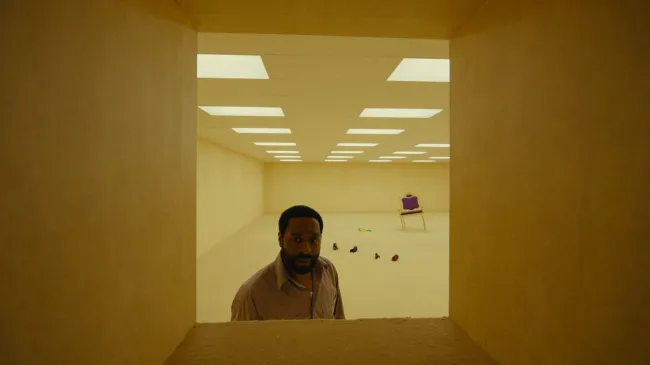
Between 2026’s breakout box office hits Iron Lung and Obsession, American horror cinema is officially entering its YouTube era. And now you can add Backrooms to that list. Directed by 20-year-old creator-turned-feature filmmaker Kane Parsons, the buzzy new freakout is poised to register a scary big opening weekend, dethroning that Star Wars duo of the Mandalorian and Grogu.
Starring a pair of Oscar nominees, Chiwetel Ejiofor and Renate Reinsve, Backrooms is adapted from a Parsons-helmed series of viral YouTube shorts that embed viewers in a florescent-lit liminal space that’s populated primarily by eerie sounds and imagery. The nominal storyline finds Ejiofor’s emotionally troubled Clark navigating this bizarre environment and steadily losing his mental marbles in the process. Meanwhile, Reinsve plays his therapist, Mary, who makes the mistake of pursuing her patient into the backrooms.


While Parsons didn’t invent the Backrooms concept, his YouTube videos — some of which have streaming numbers on par with any Hollywood-made blockbuster — caught the eye of a heavy-hitting lineup of scary movie makers, including James Wan and Osgood Perkins, both of whom are part of the movie’s producing team. (Despite internet rumors, neither of those filmmakers had a hand in directing the feature.) And the film largely retains what’s drawn people to his shorter-form excursions into these desolate environments, including low-fi ’90s camcorder aesthetics and little lore drops that point to a bigger universe.
But those looking for a fuller explanation of what these Backrooms are and how they came to be — or even a standard three-act narrative structure from Will Soodik’s screenplay — may come away from the movie disappointed. That seems to be the divide critics are experiencing as they wrestle with the latest YouTube-derived horror movie. Backrooms currently holds an 80% fresh score on Rotten Tomatoes and a 74 rating on Metacritc. Here’s a sampling of the reviews.
It’s scary good
Writing in Polygon, Tasha Robinson is ready to take up permanent residence inside the Backrooms, describing the film as “deeply unnerving,” in a good way. “The sheer illogic of the Backrooms feels threatening and alien,” she raves. “The remixing of commonplace objects and architecture into new forms feels nightmarish. The omnipresent fluorescent hum hanging over it all is oppressive enough to keep viewers’ nerves on edge.
“Parsons plays fair with the audience on the shocks, saving the jump scares for when they matter, and using the Backrooms’ mixture of bland, uniform lighting and impenetrable dark spaces to keep his audience uneasy,” Robinson adds. “When events come to a head, though, he shifts into pure terror mode.”
The Daily Beast‘s Nick Schager is also a fan, enthusing: “Backrooms is unquestionably a horror film, but at its core, it has less in common with slashers, torture porn, and haunted house chillers than with the likes of David Lynch’s Lost Highway. A descent into an uncanny-valley netherworld that’s both a warped reflection and deconstruction of the modern world… [the movie] is a waking nightmare that prioritizes atmosphere over jump scares, suggestion over explication. While it occasionally weighs itself down with excessive psychologizing, it casts a surrealistic spell that’s unlike anything else in contemporary cinema.”
Variety‘s Owen Gleiberman also references Lynch in his positive review. “As an atmospheric freakout, “Backrooms” is extraordinarily effective,” he remarks. “You sit back and settle into the enigmas and the grunge textures, knowing that the movie is going to keep raising your eyebrows. The sensation of moldering dread hinges on the prospect that something awful is lurking inside those musty yellow rooms, kind of like the monster that pops up in Lynch’s Inland Empire.
“For all the spooky vividness of its imagination, is Backrooms a good movie?” Gleiberman adds. “It may alienate anyone expecting a conventional fear ride. Parsons, for everything he shows you, leaves you with the sensation that the real horror may be just out of reach — which, in its way, is what makes the liminal-space aesthetic a form of cool.”

It’s scary bad
Count The Hollywood Reporter‘s Angie Han among those who felt alienated by a trip to the Backrooms. “Eeriness for its own sake has its limits,” she argues. “The longer we spend exploring the Backrooms, the less frightening and more random these oddities start to feel. They seem designed not according to some internal logic of this universe or psychology of these characters but simply as an attempt to keep us guessing; it works only until it becomes apparent that there are no meaningful answers forthcoming.
“Meanwhile, Clark and Mary… are painted in extremely broad strokes,” Han continues. “The choice to define each of them through a single formative trauma and nothing else renders them too flat to care about.”
Writing in the Associated Press, Jake Coyle concludes that he ultimately finds the backstory behind Backrooms more interesting than the movie itself. “While the movie finds a potentially insightful pathway to a story, it can’t bridge its very physical, wall-to-wall-carpeted labyrinth with Clark’s mental state. A movie with so many doors ultimately can’t find the right one,” he observes.
And The A.V. Club’s Jacob Oller considers Backrooms to be nothing more than overcooked creepypasta. “Though oddity abounds in the film, it’s still linked to convention,” he writes. “The lack of setup, the fringe details that only ever hint at what’s going on, is jettisoned in favor of something blunter and more explicit.
“The beauty of creepypasta is often in its shifting malleability,” Oller concludes. “It’s in trying to nail things down too tightly, in the urge to overexplain and clearly define, that weakens ideas like this. Nightmares where you run through a maze of rooms in search of an exit are scary because of the doorknob slipping ever further from your grasp, not because of what you eventually find when you open the door.”
