
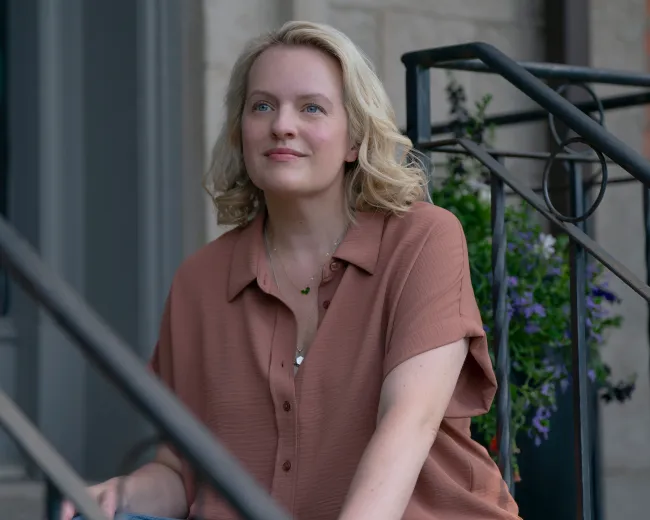
Spoiler alert: Do not read until you’ve watched the season finale of The Testaments.
The Handmaid’s Tale may have ended its run last year, but Elisabeth Moss never truly left the world of Gilead. “I feel like I never stepped out of it,” she tells Gold Derby. The Handmaid’s team started working on what would become the sequel The Testaments “whether or not there was going to be a show,” she says. Production on one series bled into the next. “I haven’t left — still here, guys!” she jokes. So while her appearance in The Testaments was kept under wraps, it was ultimately an inevitability.
June Osborne made her debut in the first episode, keeping an eye on Lucy Halliday’s Daisy — then figured heavily in the third episode, as her rescuer, saving her after her adoptive parents are murdered and ultimately transporting her to Gilead as a so-called “Pearl Girl” and undercover Mayday operative.

Moss returns again in the finale for a climactic face-off with the ever-defiant Daisy, who wants to return to Gilead to help Becka — where June learns that her daughter, Hannah, is in fact one of the Plum girls, living as Agnes Mackenzie and one of Daisy’s friends. June’s first question: “Is she happy?”
Here, in our exclusive video interview (watch above), Moss — who won Emmys as lead actress and producer of Handmaid’s and is in contention for guest actress for The Testaments — answers Gold Derby’s questions about what all this means for June — whether she’ll continue her quest to save her daughter, what she truly thinks of Aunt Lydia, and which character from Handmaid’s we’ll be seeing next season.
Gold Derby: Where is June’s mindset after Daisy’s revelation about Agnes/Hannah? Where is her head now versus where she was at the end of Handmaid’s?
Elisabeth Moss: I think that for June, not a lot has changed from those final moments of The Handmaid’s Tale, when she’s sitting in that room. I feel like in the end of Handmaid’s Tale, she becomes the person that she’s going to be for quite a while. This isn’t a sprint, this is a marathon, the overthrowing of Gilead, and she knows that. She is a mom, she’s raising her daughter, she’s also the leading resistance fighter, and I think that finding that balance between those two is probably something that she’s found in a way that she didn’t have before, being able to, I think do an incredibly difficult job while also not losing herself is something that she has found, and then of course you get that moment, which I’m so glad we got to do, where Daisy mentions Agnes. And you see June realize that her Agnes, her Hannah, is the one that she’s talking about, and that she knows Daisy. And all of that composure, all of that strength, all of that toughness, all of that coldness, that lack of emotion that she’s had to put in place in order to do her job just flies out the f–king window, and she’s just a mom who just realized where her daughter is, and that’s all she cares about. And the fact that she asks her if she’s happy, it’s just… I can barely talk about it without getting emotional. That was the question that was really important to me to ask. I wanted to ask that question. I said, can she ask her if she’s happy, because I think that’s what you would ask.
That’s why I asked the question, because the June that we knew in Handmaid’s was so motivated by getting her daughter back, and so the June in Testaments, especially in that scene then finds out where her daughter is. That’s shades of the June that we’ve known for so long.
I think it’s the number one motivation behind everything that June does. I don’t think a moment passes where she’s not thinking about Hannah, and even if she’s helping Daisy get out, or she’s helping another child, or another woman, or another person get out, or whatever she’s doing in part of taking down Gilead, Hannah’s always there, I don’t think she’s ever not thinking about her, so I think she’s just found ways to be able to do her job without letting that destroy her, but every move she makes is designed with the goal of making sure that her daughter is safe, and is going to be OK.
How is that going to change her and impact her going forward?
She’ll never give up. That’s the thing. Gilead has discovered how to hide her from June. June’s gotten a lot smarter and a lot stronger, but so have they, and I think that she is a very worthy foe in the villain of Gilead, so she’s tried, obviously, as we watched many times to get her out before, and if you don’t do it the right way. It always blew up in her face. I think she knows that, that it has to be done the right way. I think that she’ll never give up. I don’t think any parent would ever give up on trying to save their child. You just don’t. But at the same time, there’s perhaps a new element to it, which is choice, and knowing that Hannah just doesn’t even have the choice right now of where she wants to be and who she wants to be, and that is something new that June has been dealing with, and now she has Daisy.
Daisy has really transformed over the course of the season, much through June’s influence, and much through her own kind of experience in Gilead. What is that going to mean for Daisy’s future, and what is that going to mean for Agnes’s future?
I think it’s so interesting that June picked Daisy. [Showrunner] Bruce [Miller] and I have talked about this a lot, and she obviously knows vaguely where Hannah might be, even if she doesn’t know specifically, and this being the premier school, she can’t be completely unaware exactly, but did she know exactly that she was there, and did she know that Daisy knew her? No. So I think it’s so interesting that she zeroes in on this girl, Daisy, and she sees something in her. I think when she shows up on that dock and says we’re getting you out, I think that’s a test. I think that Daisy’s response could have been, thank God, get me out of here. I’m tired of this. This is way too hard, and screw my friends, and I’m going to save my own hide. I think that June’s running a test on her. This is totally my own supposition. This is nothing that was in the script, but I think that Daisy passes the test, or perhaps fails, depending on which way you look at it. But in June’s mind she passes the test by saying, “No, I’m not leaving, and this is why, because I care about my friends, and I’m going to save them. To me, that’s the final test that June runs on her. This is the one. The Agnes part of it is a blind side, I think, in that moment. I think June feels the way that we feel, hopefully, about the next generation, that they’re the most important thing. They’re everything. I believe in them. I believe that they’re going to make a better place for us, I believe in their strength and their intelligence, and June knows that that is the way to overthrow Gilead is through these women, but she needs someone who’s going to be able to go in and fight the way that she would have, and I think she sees that in Daisy. She doesn’t know yet that Hannah also might have that, that Agnes might also have that too. I don’t think Agnes even knows yet necessarily how much fight she has in her.
We see a spark of it in the beginning, even in the dollhouse scene, rebelling against her stepmother, whether it’s genetic or being a teenage girl, or all of the above, so we know that there’s fight in her. And maybe her friendship with Daisy is going to bring that out in her.
She is her mother’s daughter, absolutely, and her father’s daughter, too. In my opinion, Luke was always one of the strongest characters on the show, because the person who has to stay home sometimes has more strength than anyone. He has just as much strength as anyone out there fighting. There’s definitely so much June in Agnes, and to see Chase find that, to see Chase discover that, and not even necessarily know what it is yet, or what to do with it, but that pot just starts to boil, and then there’s this lid on it, in that scene with her and Ann Dowd where she says, I know who my mother is.
To me, both of their performances in that scene — I know it’s much more subtle than a lot of some other stuff in the show. There aren’t the tears and the drama and the incredibly emotional performances, but to me that’s one of their best scenes, the two of them, because it’s so subtle. They both are saying so much with their eyes, and they are saying so little with their mouths, and I have almost no idea what it is that they’re thinking, but you know everything that they’re thinking, and there’s just so much complexity in their performance in that scene. I think that is truly brilliance, what they’re doing there.
Agreed. How much does it take for Agnes to stand up to Aunt Lydia, and then how much on the flip side does Aunt Lydia know?
None of them are answering the question. It’s so brilliant, and the two of them are just acknowledging that there’s something that they both know, and you’re like, wait, what is it?
Do you think that Aunt Lydia knew all along who Agnes was?
Absolutely. I think Lydia knows who Agnes is, for sure. There’s a couple things early on in the season that she says that definitely point to that she knows, and I think that’s why she’s really got to keep an eye on that one. Because she knows who her mother is, so I do think she knows for sure. But when she discovers that Agnes knows, the question that I don’t think we’ve answered yet, and that I don’t have the answer to yet, is whose side is she on? Whose side is Lydia on, and whose side is Agnes on?
And did she intentionally then invite Daisy as a spy or Daisy to ignite her?
I was actually just saying this to David Shore, who’s the showrunner on my next show, Conviction, one of my favorite things, possibly my absolute favorite thing about doing a series, is I love the idea that you can ask a question in season one and then not answer it for one season, two seasons, on Mad Men three seasons. To me that is so much fun, but you’ve got to ask the question. To me the questions that are asked in this first season are so interesting.
So what are the biggest questions for you from season one that we’re going to explore in season two?
How much does Lydia know, and who is she working for? Whose side is she on? How much are her and June talking? That’s something I’d really like to know. I would love to see Agnes start asking more questions about June or trying to find out more about June. Also, her dad — I would love for Agnes to start asking those questions about who her father is. Obviously the big question for me, selfishly, is will June get to stand in front of Agnes? Will she get to see Hannah again, and what would she say to her if she did?
What will your role be next season? Obviously you’re a creative influence behind the scenes. Are you going to be directing?
Yeah, I’d love to. I wasn’t able to in season one because of Imperfect Women, we couldn’t push the show back, and because of directing the final season of Handmaid;s, I wasn’t able to do it as well, so, and it felt really weird. It was very weird to have this thing that I’m so close to, and I’m such a part of behind the scenes, to not direct on it was, was odd for me. So we’re very much talking about how that would work, and it’s very much a goal for all of us to try to make that happen in season two, because it just would feel weird to let another season go by without getting to work with those actors. I would love that as a director. I think that just be such a privilege to get to work in that way with them. I didn’t get to work with Chase, but I did get to work with Lucy, and obviously to direct Ann Dowd is one of the great privileges of any director’s life. So I’d love to get back in the ring with her. So we’re trying to make that happen. Luckily, Warren and I are both producing Conviction and The Testaments, Warren Littlefield and both have vested interest in making this work.
What would June say to Aunt Lydia? What would that conversation look like? What would you want to say to each other?
It depends on the question of how much they’ve been talking or not talking. It’s hard to say, because I feel like that is going to make a difference, how much they know what each other is doing is going to affect, obviously, what they say to each other, so it’s impossible to answer. Also, we don’t know if they have been seeing each other, we don’t know if that’s already happened, or maybe it hasn’t. I guess if it was the first time they were seeing each other. I can’t even answer that, because it’s too all up in the air right now, but probably second to seeing June and Hannah together is seeing June and Lydia together again.
It was so interesting to get to see Aunt Lydia’s backstory. What was your reaction to seeing that piece of the mystery?
When I heard that we were going to do it, I was so thrilled, because that was such an important part, and my favorite part of The Testaments, the book. And so being able to get to see Ann do that was so exciting. I think it was something that we were craving as viewers for so long to find out where we got a little bit of it in Handmaid’s. She did have a flashback episode in Handmaids, but I just wanted more. So to finally get to see more of that was so gratifying, and I’m not done, I’m not satisfied. I love going back to get to see where these characters came from. One of my favorite episodes of Handmaid’s was O-T’s backstory, when we really got to see more of Luke. I love going back and getting to see Maddie, Janine’s story. I think that’s one of the most fun things to do. Anytime on screen with Ann Dowd is time well spent.
Is there another piece of her backstory that you want to see more of?
I want to see what she’s doing now. I feel like who she is now is, though, is so interesting to me, and who she has become is so interesting to me. Standing across from her on that dirt road, in the middle of the night, shooting the Handmaid’s Finale, and watching her say her final line and walk away, and the incredible ambiguity and complexity and gravity she gave to that final line, I want to see who that person is now. That to me is the most interesting. What Ann is bringing to her character now is the most interesting to me.
Is there another character from Handmaid’s you’d want to bring forward into Testaments?
Oh, tricky question, because I do know something. I can’t answer because I’m afraid I’ll say something accidentally. Look, we have this incredible privilege of getting to continue to tell this story, and I could probably name like 10 characters who I would love to see. I wish we could bring Brad [Whitford] back, you know? That’s the only thing about killing people off. Spoiler alert! Honestly, any of them. Where do you begin?
What do you want audiences to take away from The Testaments, this new world that you’ve introduced?
I feel like the only way that we could have ever continued this story was through a new lens, and I say that as the lens that we’ve seen The Handmaid’s Tale through for nine years, and I fully believe 100% in the fact that we had to find a new way of telling the story, and there’s so much more story to tell, but I think that seeing it through Chase’s eyes, seeing it through Lucy’s eyes is to me the only reason why it would be worth telling more of it. It’s through them. They are brilliant women, off camera and on. It was like working with 65 year old veteran actresses who have been doing this for 40 years. I never remembered that they were the age that they are on paper. They’re so brilliant, and so to me they are the reason why we make this show.
