
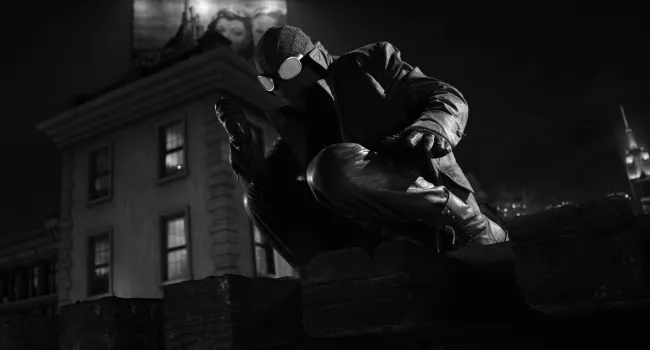
Nicolas Cage swings into action in Spider-Noir, the Oscar-winning actor’s latest foray into the superhero genre after playing Ghost Rider and Superman (kind of). It’s also Cage’s first-ever streaming series, and his second time playing a noir-ish version of your friendly neighborhood Spider-Man after appearances in the animated blockbusters Into the Spider-Verse and Across the Spider-Verse.
But this Spider-Noir isn’t the same as that Spider-Noir. Based on the Marvel Comic title, the Prime Video series spins its own web that’s separate from the Spider-Verse franchise, featuring Cage as retired hero Ben Reilly, who reluctantly suits up again to battle pulp fiction versions of such Spidey villains as the Sandman, Tombstone, and Megawatt (a lesser-known rogue from the 1990s with powers similar to Electro).

The Spider-Verse movies are adored by moviegoers, critics, and awards voters alike, and Spider-Noir is benefitting from that goodwill, particularly from those reviewers entrenched in the superhero-sphere. The series currently has a 90% fresh score on Rotten Tomatoes and a 71 rating at Metacritic. Here’s a sampling of the hot takes around Cage’s cool Spider-Man.
It’s amazing, Spider-Man
The Wrap’s Bob Strauss calls Spider-Noir “the year’s top TV treat so far” in an enthused review that indicates he’s completely trapped in Cage’s web.
“Showrunner Oren Uziel has developed an obscure Marvel property into a genre mash-up that quickly establishes its own distinct attitude, then uses it to bring new energy to worn out hardboiled detective, superhero and horror movie conventions,” Strauss continues, praising the gimmick of making the series available in both black-and-white and color versions. “Whether your thing is old, existential crime movies, four-color fantasy magazines or TV that aspires to artistry as well as entertainment, Spider-Noir has the goods. And you’ll want to delve deep to find all the goodies. These include a ton of great lines beside the anachronistic, clunky ones.”
RogerEbert.com’s Richard Roeper also likes the cut of Cage’s arachnid jib, writing: “Cage switches gears about 147 times in Spider-Noir — affecting different accents and inflections, engaging in broad physical comedy, bursting into song when it’s least expected, laughing in moments that are deadly serious, offering commentary on events as they transpire, and going FULL BORE NICOLAS CAGE throughout.
“At times, it feels as if we’re watching a particularly well-constructed Saturday Night Live sketch,” Roeper remarks. “Once in a while, we cringe at a big swing and a miss. Often, we’re reminded why Cage is one of the most electric, polarizing, and inspired actors of his generation.”
And Consequence’s Liz Shannon Miller marvels that a series this weird was allowed to exist at all. “Spider-Noir hews closely to the familiar tropes of the detective tale, but it never feels like parody,” she notes. “It just feels like the answer to the question ‘What if someone made a 1930s noir about a P.I. with spider powers?’ I cannot express how much pleasure I take in typing those words. It still makes no sense that this show exists. But it’s wonderful that it does.”
It’s not spectacular, Spider-Man
But there are also those critics who wield their reviews like cans of Raid. Take The Hollywood Reporter‘s Daniel Feinberg, who sniffs: “Spider-Noir has a great cast and some very good performances, especially Cage in the second half of the season when he’s finally allowed to start being fully weird. … But any eight-episode series in which one could easily skip three or four episodes entirely — Episodes 2 through 4, if you’re curious — isn’t telling its story optimally.
“The odd and outlandish performances in Spider-Noir offer a reminder that this is a comic book series and it ought to be fun,” Feinberg adds. “Periodically, Spider-Noir is, indeed, a hoot. It’s too bad you have to wade through so much nondescript storytelling to get there.”
Over in The A.V. Club, William Hughes singles out Cage as the show’s biggest villain. “Into this pile of comic book and private eye stock types barges Cage, giving a performance of such manifest strangeness that the show has to work in an explanation for it almost halfway through its eight-episode run. That caveat — that Reilly is so spider-brained by his imported arachnid genes that he’s essentially had to cobble together a human being impression out of old movie dialogue — could be interesting in a darker show. Here, though, it mostly just gives Cage license to completely give himself over to his most indulgent tendencies.
“In a career that’s seen the actor wrestle with any number of odd mannerisms, it’s quasi-tragic to see a few finally manage to pin him,” Hughes notes. “The result is so twitchy that you’d be forgiven for thinking Reilly hadn’t been bitten by a spider so much as a rampaging collection of tics.”
And The Playlist’s Rodrigo Perez minces no words in his pan, calling the series, “film noir for dummies.”
“Honestly, Spider-Noir might have worked as a skit or a 30-minute proof of concept,” he allows. “Stretched across eight episodes, it becomes a drag — thin, labored, and increasingly repetitive.”
