
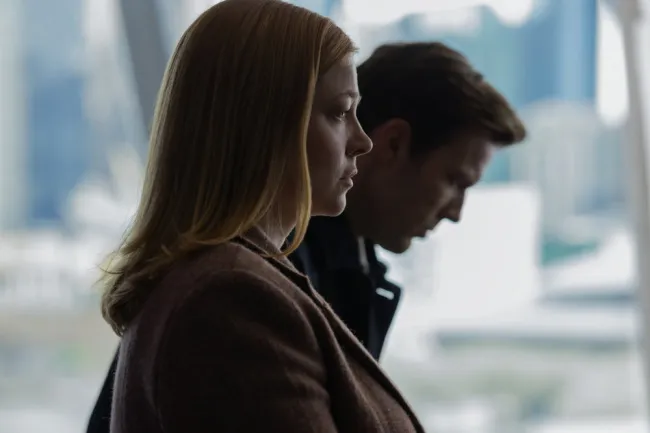
All Her Fault was built to keep viewers hooked from the very first episode.
The Peacock thriller — starring Sarah Snook as Marissa Irvine, a mother whose young son disappears after what should have been a routine playdate pickup — wastes little time throwing audiences into panic. By the end of the pilot, viewers are already deep into a twisting mystery involving lies, betrayal, class tensions, and eventually murder.
During Gold Derby’s making of All Her Fault panel, creator and showrunner Megan Gallagher, director Minkie Spiro, composer Jeff Beal, production designer Rob Harris, and editor Sam Williams broke down how they crafted one of Peacock’s most bingeable thrillers — from engineering the opening panic attack of Episode 1 to landing the jaw-dropping finale.

“You have to convey the complete devastation”
The creative team agreed the pilot had one job above all else: hook viewers immediately. But pulling that off was more complicated than it looked.
“How do we keep Marissa completely engaging over eight episodes when she’s pretty much in trauma throughout?” Spiro recalls. “You have to hit the ground running but not get to a hundred miles an hour too quickly. It’s this very delicate tightrope — because you have to convey the complete and utter devastation that any parent would have knocking on that door and their child not being there.”
Gallagher says Andrea Mara’s novel stood out on two levels. Logically — “Is there a good genre motor? Are there lots of twists and turns?” But also emotionally — it touched on themes about women, domestic labor, and working mothers that she felt hadn’t been seen on screen. “I knew as soon as I finished the book that I had to do it. If I somehow missed the opportunity, I would never forgive myself.”
Editor Sam Williams says the opening required constant fine-tuning in post. “We played around with the pace of it a lot. There was a lot that hit the floor.” Spiro agrees: “It was a lot of blood, sweat, and tears to get that opening right — and still feel propulsive.”

The bathroom scene — and “dress gate”
The team kept returning to an early bathroom scene between Marissa and Dakota Fanning’s Jenny — filmed just five days into the shoot — as the emotional heart of the pilot.
“It was the first scene that Sarah Snook and Dakota Fanning had together,” Spiro says. “It’s the scene that has the essence of the whole show.”
It also sparked what Spiro jokingly calls “Dressgate” — an extended debate over the matching dresses both characters wear. “That fabric had to say so much,” Spiro explains. “It had to feel like it works within the world of our wardrobes, but be noticeably specific so that they were both like, ‘Oh my gosh, this is really embarrassing, we’re wearing the exact same dress.’ Which is the beginning of their beautiful friendship.” For the record: three dresses were made. One was chosen.

Gallagher calls it one of her favorite scenes in the pilot. “It’s one of the few moments where you just get to breathe. No kidnapping has happened yet. Milo’s not missing. It’s the one chance these two women have to make a connection before both of their worlds completely blow open.”
Jeff Beal built the score around “the absence of Milo”

Composer Jeff Beal came on late — all eight episodes were already locked, and he’d read Mara’s novel before he’d seen a single script. His approach was less about thriller mechanics and more about raw emotion.
“I was thinking of nausea,” Beal says of the opening episode. “I’m a parent. It’s got to be just like your stomach drops and you just can’t even hardly breathe.”
The haunting “Milo’s Theme” emerged as a solution to a specific problem: how to score a character who’s barely present. “We don’t see him for four episodes. For all we know, we’re never going to see him. The absence of Milo is really what’s driving the whole story.” He describes the theme as a kind of question mark — a strange four-note motif that, once paired with real strings, had “the ache and the weird sort of uncertainty” the show needed.
The score was also deeply personal. “I lost my mother just a few months before I started working on this,” Beal says. “I was thinking a lot about this powerful, primal connection between a mother and a child. It’s beyond an emotion — it’s almost spiritual.” That feeling crested in Episode 7, as Carrie walks into the ocean while the truth about the accident unfolds in parallel. “It just summed up an emotional crescendo that we had been building to for a long time.”
The Irvine house was built to slowly turn “cold”
Production designer Rob Harris built the Irvine home to communicate comfort and security — before slowly becoming something more unsettling. Unable to secure a large soundstage in a busy Melbourne market, he constructed the entire house on a volume stage, surrounding it with moving background screens calibrated to shift with the camera. Twenty cameras were hidden inside the walls, disguised as air conditioning vents.
The result was so convincing it fooled Williams in the editing booth for weeks. “It took me about three weeks until I went, ‘Wait a minute, this is a set,'” he admits. “The image glitched — someone was standing in front of one of the cameras. I was like, ‘Oh my God. It looks absolutely real.'”
The house’s visual evolution was equally deliberate. The key was a specific wall color — dubbed “Makita Green” — chosen because it could read warm or cool depending on the lighting temperature. “In the early episodes the home felt like a cocoon,” Spiro explains. “But by the back end, the blues became greys and became colder.” Peter’s wardrobe followed the same arc. “Ultimately it went from a safe, warm family home to a very alienating, cold, dysfunctional space.”
“There was no other ending for Peter”
By the finale, All Her Fault reveals that nearly everyone has blood on their hands — culminating in Marissa deliberately killing Peter (Jake Lacey) after learning the truth about Milo.
Gallagher says she knew the ending almost from the start. “By the time I was writing Episode 2, I knew pretty much scene by scene what that final episode was going to be. When you’re writing genre, everything rests on the ending. If it falls flat, your season falls flat.” Having that North Star made it one of the easiest episodes to produce — fewest drafts, fewest cuts. “I knew exactly where Marissa ends, I know exactly where Peter ends, I know why I’m setting up the allergy stuff. It’s honestly a pleasure.”
As for Peter’s fate: “There was no other ending for him. No other option. I don’t think I’ve read a single comment from someone saying ‘I wanted Peter to live.’ Nobody said that.”

Beal praises the show’s refusal to deal in simple heroes and villains. “A lot of times we like to paint people with so much clarity about what’s black and white. I just love the fact that this series really goes into the gray area.” Gallagher agrees. “Everybody’s the hero of their own story. Very few people are just purely evil. And also, those are kind of boring.”
Gallagher closes by reflecting on the whole journey — through the scripting process, the writers’ strike, and finally production. “Everybody just brought their A-game. I’ve never been so proud of anything I’ve made.”
On the Emmy prospects? Beal, who has five of his own, put it simply: “There’s always room for one more.”
This story and video are presented by Peacock.
