
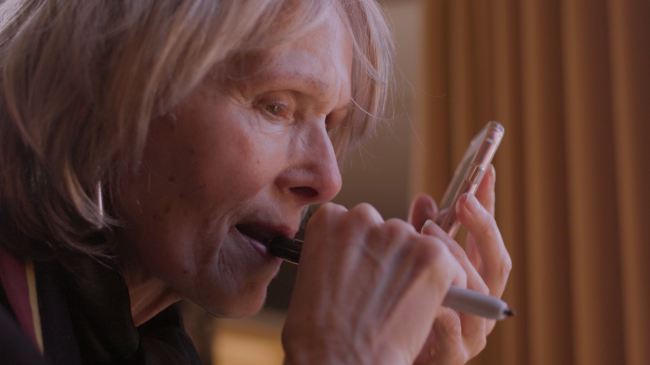
Long before she became the woman who beat Donald Trump twice in court, E. Jean Carroll was one of the most recognizable media personalities in New York.
The documentary Ask E. Jean traces Carroll’s rise from “Miss Cheerleader USA” to trailblazing journalist, television host, bestselling author, and beloved advice columnist — before chronicling how she ultimately, as the film puts it, became the only person to take Trump to court and win — twice. But director Ivy Meeropol quickly realized she wasn’t making a Trump documentary.
“This film is much bigger than Trump and much bigger than the Trump story,” Meeropol tells Gold Derby.

Instead, Ask E. Jean becomes a layered portrait of a complicated, eccentric, funny, contradictory woman reckoning publicly with a lifetime of silence — and with the cultural shifts that finally convinced her to tell the truth about what Trump did to her in a Bergdorf Goodman dressing room in the mid-1990s.
“He called me a liar”
Meeropol first encountered Carroll in 2019, when a New York Magazine cover story excerpted her book What Do We Need Men For? — in which Carroll publicly accused Trump of sexually assaulting her years earlier. No lawsuit had been filed yet. No lawyer had been retained.
“I was completely struck and riveted by the piece, by her writing style, by her honesty, by just the way she talked about what happened,” Meeropol says. “I just felt like it was really a new voice.”
That voice ultimately shaped the documentary’s opening moments, where Carroll bluntly explains the real reason she sued Trump after he publicly denied her story.
“He called me a liar,” Carroll says in the film.
For Meeropol, that line became the emotional backbone of everything that followed. “It was a very difficult edit — to get the tone right,” she says. “It had to be a lot of fun because E. Jean is a lot of fun. But then to balance that out — that was really difficult.”
She credits editors Ferne Pearlstein and Leah Goudsmit with cracking the structure. “We wanted people to fall in love with her and get to know her first before we have to talk about all the heavy stuff,” she explains. “But you also had to understand why you’re watching this film right now.”

“You were more famous than him”
One of the documentary’s most striking revelations is the celebrity power dynamic at the time of the alleged assault. In mid-1990s New York, Carroll was already a famous television personality and beloved columnist — while Trump was still largely a tabloid businessman and socialite.
Meeropol points to a moment where Carroll’s friend Lisa Birnbach tells her directly: “You were more famous than him. You’re the advice lady. He recognized you.”

“It just counters this whole dismissive, ‘Who is this woman? She’s random. I didn’t know her. I never even heard of her,'” Meeropol says. “The lies on the lies.”
The connection, she argues, ran deeper than proximity. “He was friends with Roger Ailes, who gave her that television show,” Meeropol says. “She was on the air in New York City at that time.” The more Meeropol uncovered from Carroll’s past, the more the film itself changed shape. “She is this younger woman giving advice to women that she didn’t take herself,” Meeropol says. “That’s when I realized this film is much bigger than Trump.”
“It is how she coped.”
At the same time, Ask E. Jean refuses to flatten Carroll into a perfect modern heroine. Meeropol deliberately keeps archival footage of Carroll dismissively criticizing Anita Hill and Paula Jones — moments that sit uncomfortably against everything the film is arguing.
“That was really important,” Meeropol says. “Thankfully, E. Jean recognizes how important that is too, as much as she really can’t stand watching that and feels embarrassed.”
For Meeropol, those moments reveal something specific about how women of Carroll’s generation survived. “It is how she coped,” she says. “Just be like, ‘Yeah, leave me alone,’ or accommodate bad behavior and just let it roll off.” She hopes younger viewers extend some generosity rather than simply judge. “I think all women across the generations have experienced versions of this. E. Jean being able to look at herself and reckon with her past so openly can be very empowering for younger women.”
It was the #MeToo movement that finally broke that silence. Carroll had never planned to sue Trump — she hadn’t even thought about getting a lawyer. She just wanted to tell the truth. “She was completely flooded with emotion and excitement as the #MeToo stories started coming out,” Meeropol says. “It was actually precipitating the downfall of Harvey Weinstein. And so it felt like, wow, we actually can do this when these stories come together.” At 75, Carroll’s own advice column readers were writing to her about assault and harassment in growing numbers — and she realized she had never told her own story.
“Not my type.”
One of Ask E. Jean‘s most jaw-dropping sequences involves Trump confusing Carroll for his ex-wife Marla Maples during a deposition — after previously claiming Carroll “wasn’t his type.” The footage was already part of the public record, but what makes the moment even more startling is the photo in question: Ivana Trump, his wife at the time, is also in the picture — and Trump doesn’t seem to notice her at all. Carroll’s then-husband John Johnson is there too.

Deposition videos not entered into evidence remain private, locked away unless attorneys and participants grant access. Much of the never-before-seen footage in the film came directly from Carroll and her attorney Roberta Kaplan. Trump’s footage was usable because portions were entered into evidence and became part of the public record.
“I didn’t know there were videos, that the depositions had been videotaped,” Meeropol admits. “It was a gift from God because we didn’t know how we were going to tell that part of the story in the way I wanted to.”
“Nobody seems too eager to put their name on this.”
Despite a Telluride premiere and enthusiastic festival audiences, finding distribution proved unexpectedly difficult. Strong reviews and standing ovations translated into silence from buyers — including one offer that materialized and then vanished.
“We had such an incredible response and then nothing,” Meeropol says. “No offers. Nada.”
The film eventually landed with independent distributor Abramorama. Meeropol is careful not to overstate the cause, but she doesn’t look away from it. “I absolutely think that this is a subject matter that nobody seems too eager to put their name on,” she says. It’s a climate other filmmakers know well — Oscar-winner No Other Land, a documentary with its own politically charged subject matter, similarly struggled to land a streaming deal even after winning the Academy Award last year.
Even Carroll’s $83 million verdict remains unresolved. A federal appeals court recently paused the payment pending possible Supreme Court action — extending a legal battle that has already stretched for years. Carroll had joked she wanted to buy herself a toaster with the money.
The toaster, for now, still has to wait.
“People have given her toasters,” Meeropol says with a laugh. “She was teasing me that I have to change that card at the end. I said it’s still a joke. It was true at the time.”
Ask E. Jean will be in theaters beginning May 21.
