
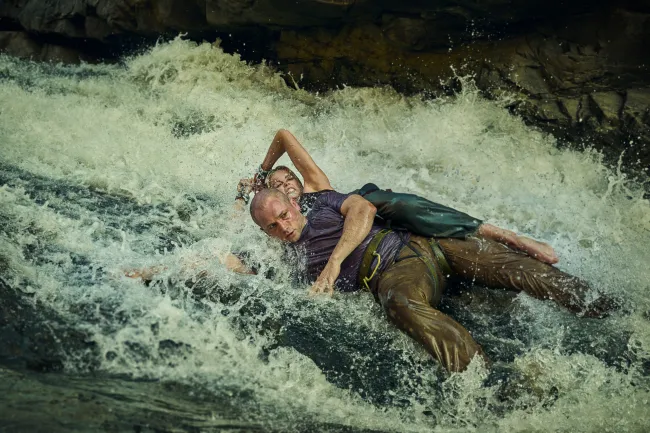
For Netflix’s survival thriller Apex, the cast and crew had to endure icy extremes of Norway to the rugged depths of Australia. Director Baltasar Kormákur welcomed the opportunity to merge exteme-location filmmaking with intense character-driven performances led by stars Charlize Theron and Taron Egerton in demanding, physical roles. Theron plays a grieving woman who embarks on a solo adventure in the Australian wild only to become hunted by a serial killer played by Egerton.
From the beginning, Kormákur was drawn to the idea of pushing into unfamiliar terrain both geographically and creatively. A filmmaker known for survival thrillers like Everest, he saw Apex as a chance to go further. “The opportunity of going to places that I haven’t visited before and going deep in and doing something raw and real was really exciting to me,” he says.


Originally set in Yosemite, logistical constraints and environmental protections forced a rethink. Instead, Kormákur expanded the geography, ultimately relocating major sequences to Australia. That decision became a creative turning point and Kormákur leaned into the environments to define the story’s texture. The result was a production that spanned extreme climates and required inventive logistics — including sequences in deep caves accessible only by helicopter drops and swimming cast and crew into set locations. “Every day was a challenge for the crew,” he said, recalling a shoot that reduced the team to around 40 people in wetsuits navigating freezing water underground.
For Theron, those conditions extended into some of the film’s most physically punishing sequences. Kormákur pointed to the climactic ascent as particularly demanding, noting the actor performed the climbing work for real. “I was amazed that she would actually do that,” he said.

But beyond endurance, Kormákur says what surprised him most about working with the Oscar-winner was not her toughness but her emotional range. “Her vulnerability, to be honest. And how her strength is built out of vulnerability,” he says. “She’s not only a badass. She is actually very vulnerable under that.”
If Theron anchored the film’s emotional gravity, Egerton brought unpredictability to his role, which evolved significantly through collaboration. Kormákur described a process that allowed the actor to build from the inside out, shaping the character’s insecurities and behavioral quirks on set. “A lot of it was Taron brought to the table and finding that,” Kormákur says.
Despite the film’s dark themes, Kormákur also sought moments of levity. He described injecting unexpected humor into scenes, often through spontaneous ideas. One sequence involved Egerton’s character swinging naked from a rope. “It has a bit of lightness to it, even though the main story of his character is very, very dark,” he says.
And Kormákur describes Theron’s journey as a kind of self-inflicted reckoning, where confronting guilt becomes the path to strength. “When she comes to terms with that,” he says. “She finds her strength.”
