
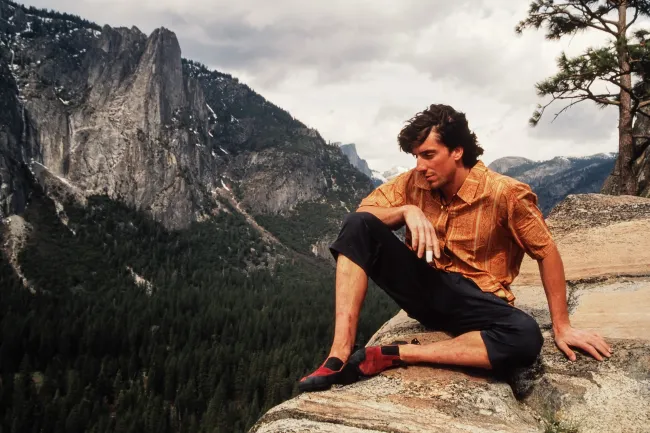
When The Dark Wizard begins, it doesn’t ease viewers into the world of extreme climbing — it drops them straight into it.
A climber falls.
There’s no immediate explanation. No context. No reassurance. For viewers unfamiliar with Dean Potter’s story, the moment plays like a question mark: Is this real? Is this the end? Is it even happening at all?
That uncertainty is exactly the point.
Premiering April 14 on HBO, the four-part documentary series traces Potter’s life, legacy, and contradictions — and that opening sequence sets the tone for everything that follows.
“We wanted to leave the viewers with some sense of ambiguity about what they just saw and where this is all going to lead,” co-director Nick Rosen told Gold Derby. “It makes for great TV, but it also represents something deeper about Dean.”

For Rosen and his filmmaking partner Peter Mortimer, that opening sequence isn’t just a hook — it’s a thesis. The fall, as it turns out, is tied to a lifelong obsession that defined Potter’s career: the tension between falling and flying.
“We were kind of trying to anchor the narrative in this dream of falling,” Rosen said, “that then evolves into this idea that it’s actually a vision of flight.”
A legend — and a contradiction
Potter wasn’t just a climber. He was a figure who loomed large within the sport — celebrated for redefining what was possible, and criticized for the risks he took getting there. That duality sits at the center of The Dark Wizard, and it becomes especially clear in the film’s portrayal of his complicated relationship with fellow climber Alex Honnold.
Honnold, best known to mainstream audiences for the Oscar-winning documentary Free Solo, once idolized Potter. But as his own abilities rapidly surpassed those of his predecessor, that admiration turned into something more fraught — at least from Potter’s perspective.
“It’s not just a younger generation coming in,” Rosen said. “This is a one-in-a-billion climber who comes along and starts eclipsing everything you’ve built.”
The tension wasn’t just professional. It was deeply personal — and, in Rosen’s view, revealing. “For Dean, it’s Alex Honnold crushing his dreams,” he said. “And I don’t really think that’s Alex’s fault. That’s kind of Dean’s problem.”
At the same time, that rivalry fueled Potter’s creativity, pushing him toward new, more dangerous pursuits — from highlining to wingsuit flying — in an effort to stay ahead. “Instead of just trying to be the best rock climber in Yosemite,” Rosen said, “he’s trying to evolve into a bird.”

Meeting Dean Potter
For Rosen, this wasn’t an outsider’s portrait.
He and Mortimer had been part of Potter’s world for years — filming him, climbing alongside him, and, at times, simply trying to keep up. One of Rosen’s earliest memories of Potter dates back nearly two decades, arriving in Yosemite Valley and immediately sensing his presence.
“At the end of this line of guys was Dean, towering over everybody,” he recalled. “He just had this oversized mystique.” That first encounter quickly turned into something more immersive.
“He was like, ‘You guys want to go up to the top of El Cap?’” Rosen said. “And suddenly I’m up there with him, and it felt like Point Break — like Johnny Utah and Bodhi.”
Over the next decade, Rosen and his collaborators filmed Potter extensively, capturing moments that would eventually make their way into the series alongside archival footage from other climbers and filmmakers.
“It’s a huge mix,” Rosen said of the material. “There were a lot of people filming Dean all the time.”

Making climbing cinematic
One of the central challenges of The Dark Wizard is also one of its most obvious: how do you make climbing compelling for viewers who have never done it? “Watching climbing in its raw form,” Rosen said, “is like watching a car rust. It’s slow.”
The solution, he explained, isn’t just technical — it’s narrative.
“You have to infuse it with story and character,” he said. “Because the stakes are dramatic, and the people involved are often larger-than-life personalities.” That approach has defined Rosen and Mortimer’s work for years, shifting climbing films away from purely technical showcases and toward character-driven storytelling.
“It really lends itself to a kind of hero’s journey,” Rosen said. “You’re watching someone confront something huge, over and over again.”
Spoiler warning: The following section discusses major events later in The Dark Wizard.
The final flight
One of the most difficult decisions the filmmakers faced was whether to include footage of Potter’s final wingsuit flight — a moment that is both central to his story and deeply unsettling to consider.
In the end, the choice came down to honesty.
“The spirit of this series is to be radically transparent and unflinching,” Rosen said. “To not shy away from hard truths or uncomfortable footage.”
After consulting with Potter’s loved ones, including his partner Jen Rapp and his sister Elizabeth, the filmmakers decided to include the footage — captured on Potter’s bodycam during the flight. Because the camera was mounted behind him, the final moments are not graphic, but they remain haunting in their implication.
Rosen pointed to one detail in particular: a raven that appears in frame during the final moments, an image that feels almost surreal in the context of what’s unfolding. “There’s this kind of haunting raven visitation at the end,” he said, underscoring the film’s broader themes of flight, fate, and finality.
But it’s Jen’s experience with the footage that ultimately shaped how the scene is presented. Weeks after Potter’s death, she watched the video for the first time — an experience Rosen described as profound and essential to understanding the story.
“Just sitting with Jen and hearing her describe watching that footage weeks later,” he said, “that felt like part of the story.”
Even now, the exact circumstances of the crash remain unclear. Potter and fellow wingsuit flyer Graham Hunt both died on the same jump, but not from a single shared impact. What happened in those final moments can only be pieced together through speculation — a mix of environmental factors, split-second decisions, and the inherent risks of the sport.
“It’s really weird,” Rosen said. “And tragic, obviously.”
Rather than impose a definitive explanation, The Dark Wizard leaves that ambiguity intact — consistent with a life that was rarely simple, and a story that resists clean conclusions.

A legacy without easy answers
If The Dark Wizard offers any clear takeaway, it’s that Potter’s life resists easy conclusions. He was, at once, a pioneer and a provocateur. A source of inspiration and frustration. A climber chasing something bigger than the sport itself — even if that pursuit came at a cost.
“This is someone who was always trying to push his limits,” Rosen said. “And I think that’s what made him who he was — for better and for worse.”
The Dark Wizard debuts April 14 at 9 p.m. ET/PT on HBO and will be available to stream on HBO Max. Subsequent episodes will debut Tuesdays at the same time.
