
Gloria Steinem’s death this week put a spotlight once again on the decades-long struggle for women’s equality. In a sign of the times, another version of that issue is playing out right now on the fall film festival circuit.
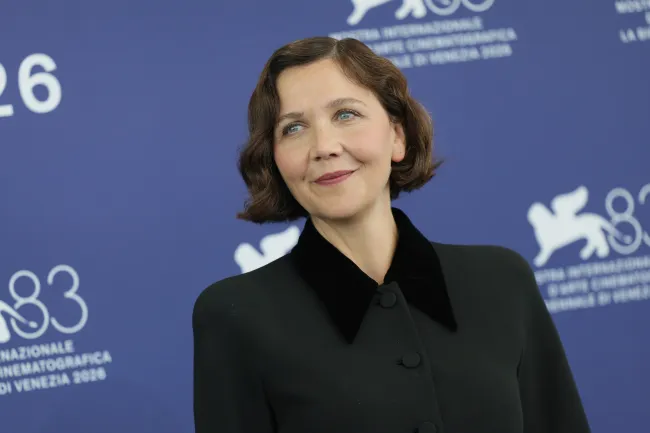
Earlier this week at the 2026 Venice Film Festival, Maggie Gyllenhaal — president of the festival’s main competition jury this year — pointedly addressed the subject. Asked about the striking lack of women directors in competition at the festival’s 83rd edition, the actor-director called it “a systemic problem,” adding, “It’s much harder for women to get films financed.”
“Could it be possible that women, having had a different experience of being alive in the world, want to make movies that are not always deemed high art,” continued Gyllenhaal, who released her second directorial effort, The Bride!, earlier this year. “Who decides what’s good? Who decides what is valuable?”

Gyllenhaal’s comments are sure to be felt across the rest of fall festival season, which continues with the Telluride, Toronto, and New York festivals over the next month. With that in mind, Gold Derby posed some of these vital questions to industry experts to get their take on the challenges facing female directors during this key time in the awards season calendar.
Stacy L. Smith, associate professor of communication at USC Annenberg and founder of the Annenberg Inclusion Initiative, tells us that Gyllenhaal’s question about quality is not borne out by the data. “There is no difference in critical reception,” she notes. “If we’re looking at the average score, almost identical, women are at 57.6%, men are at 55.6%. So when it comes to quality, there is no difference now.”
As for the issue of representation on the fall festival circuit, the lineups of the various fall festivals certainly provide plenty of evidence supporting Gyllenhaal’s statements. Venice initially announced a competition lineup with just one film directed entirely by a woman, May el-Toukhy’s Woman Unknown. The festival subsequently added Naza, co-directed by Rachel Szor and Yuval Abraham, bringing the number of competition films with a woman director or co-director to two. Naza will also play NYFF when that festival begins on Sept. 25.

Kirsten Schaffer, CEO of Women In Film, says that Venice’s numbers are difficult to defend, particularly given the range of films being made by women and the subjective nature of artistic judgment.
“I think it’s not acceptable,” she emphasizes. “We have seen other festivals really work hard to change their percentages, to make a commitment, and there are many, many excellent films made by women. As Maggie rightfully called out, the perception of the quality or value of the film ranges across the board. There’s no singular vision for what an excellent film is.”
Martha M. Lauzen, founder and executive director of the Center for the Study of Women in Television and Film at San Diego State University, also cautions against the idea that festival programmers can operate without bias. “Any festival programmers who claim they are free of bias are also suggesting they are not human,” Lauzen notes. “’Quality’ and ‘greatness’ are social constructions that are loaded with personal preferences and institutional biases.”

Schaffer similarly argues that the problem begins before programmers ever see a finished film, but does not end there.
“It’s both a systemic problem, which I think Maggie also named, and it’s a festival selection problem,” she says. “The systemic problem is that women aren’t getting enough money to make their movies and they’re not getting enough money on the distribution and marketing side, which means those movies aren’t doing well enough at the box office, which means they’re having a hard time making their next movie. And then we’re stuck in this cycle.”
Smith says that cycle extends beyond the initial financing of a film. “Women directors are typically receiving fewer dollars for their films,” she explains. “The financing point is lower; the marketing budgets are lower; the distribution density is lower. That’s really important because that means their films are being seen on fewer screens in the United States or in fewer territories internationally.”

Toronto offers one of the clearest contrasts with Venice. More than two-thirds of this year’s TIFF Docs lineup is directed by women, including Rebeca Huntt’s Rapinoe, which opens the documentary program, Maiken Baird’s Edward Said: Between Worlds and Barbara Kopple’s Union Town. And the opening night selection is Being Heumann, Siân Heder’s follow-up to her Best Picture-winning CODA.
Cameron Bailey, CEO of the Toronto International Film Festival, says that Gyllenhaal’s comments resonate with the festival’s programming team, noting that TIFF has long been focused on equitable representation both on screen and off. “We were one of many film organizations that signed a 50-50 pledge many years ago that included many different things,” Bailey notes, also citing Rachel Morrison’s Love of Your Life, Courteney Cox’s Evil Genius and Rebel Wilson’s Girl Group as other high-profile TIFF premieres from female directors.
“Part of it is about what’s in your official selection,” Bailey adds. “And of course, it’s true that women are not represented on an equal level in terms of what gets made yet. In terms of what we select, we’re always looking for great movies directed by women, but it goes beyond that. It’s also about who’s on stage speaking, who is seen as an industry expert, who are we inviting to speak as industry experts in the market and elsewhere?”

The BFI London Film Festival presents another striking counterpoint. Of the 251 works featured at this year’s 70th edition, 109 are made by female filmmakers, representing 43% of the program. Six of the 10 films in the Official Competition are directed or co-directed by women.
Telluride falls somewhere between those extremes, with its 2026 main program featuring titles like Nanette Burstein’s Carl Sagan: We Are Made of Star Stuff, Joanna Natasegara’s The Disciple, Elizabeth Chai Vasarhelyi and Jimmy Chin’s Everest: The Other Side, Marie Kreutzer’s Gentle Monster, Małgorzata Szumowska and Michał Englert’s The Idiot(s), as well as Christine Molloy and Joe Lawlor’s Act 3.
Looking ahead to NYFF, Ava DuVernay’s 14th will close the festival with its world premiere. Elsewhere, the 34-film Main Slate includes Valeska Grisebach’s The Dreamed Adventure, Sandra Wollner’s Everytime, Marine Atlan’s La Gradiva, Isabelle Stever’s I Rarely Wake Up Dreaming, Tizza Covi’s The Loneliest Man in Town, Julia Loktev’s My Undesirable Friends: Part II – Exile and Angela Schanelec’s My Wife Cries.

The broader Hollywood numbers suggest there is still a long way to go. According to Lauzen’s latest Celluloid Ceiling report, women only directed 13-percent of the top 250 domestic-grossing films in 2025. In 1998, women accounted for 9% of directors on those films. That’s an increase of just four percentage points in 28 years.
Lauzen argues that the industry’s problem is not a shortage of talented women waiting to be discovered, but a system that repeatedly defines certain filmmakers as safer or more valuable investments. “The myth-making machinery in the film industry has produced ‘boy wonders’ since the early days of film as a business,” she says. “As long as women are perceived as riskier hires, this system will simply reproduce itself.”
Schaffer points to another persistent assumption: that films made by women are somehow less universal. “I think there is a gender bias,” she says. “There’s still this perception that the films that women make are not universal, and that they’re only for female audiences, which I think is incorrect. At the same time, if they were just for female audiences, that’s quite a large population. Either way, it’s a problem.”

But Schaffer also points to signs that the cycle can be broken, citing executives and filmmakers who have helped create opportunities for women. “There are some people who break the mold, Paul Feig being one of them,” she notes. “He has done a great job in a variety of different ways, bringing in the next generation of directors and working with a lot of women. There are other men who do that, but they’re few and far between.”
She also points to studio executives like Pam Abdy, president of the Motion Picture Group at Warner Bros., and Donna Langley, chairman and chief content officer of NBCUniversal, as examples of women in positions of influence who have helped put more women filmmakers into the pipeline.
WIF also tries to address that visibility gap during awards season. Each December, the organization publishes a voter guide highlighting women working behind the camera who it believes are Oscar-worthy and potentially overlooked.
“I think we need more women in decision-making roles and in those green lighting roles to ensure that the films getting made do reflect the population,” Schaffer says. “From an artistic or curatorial perspective, we’re also just missing out on all these interesting voices and stories we haven’t heard before.”
