
The 83rd Venice Film Festival is off to a running start, promising plenty of glamour, a smattering of awards-bait movies, and lots and lots of spritzes — be they Aperol or Campari.
Spritz of choice may be one of the few things folks are civilly agreeing to disagree on as Venice has a low rumble of angst-ridden gossip this year. As Day 1 goes into the books you can hear the rumble: Where is Hollywood? Where is Iñárritu and Digger? Where is Luca Guadagnino, who is here, but with a seven-hour documentary about Italian maestro, Bernardo Bertolucci, and not with the Sam Altman AI film Artificial that’s now bound for New York. Did Venice pass entirely on Mike Leigh’s new film, Tender Loving Care? Did the absent studios decide to sit out because they took note from Warner debuting One Battle After Another outside of a major festival last year and still hauled in major nominations and hardware?


One person who is here — and most definitely representing the best of Hollywood — is George Clooney. The Jay Kelly star received the Golden Lion for Lifetime Achievement Award at the Opening Ceremony with the sort of grace, panache, and self-deprecation that he has honed to Jack Benny-esque perfection.
After watching a career retrospective — framed by the end scene of Jay Kelly, which premiered at Venice last year — Laura Dern presented him with his award, and she mused that their professional association and friendship began with the 1983 exploitation flick Grizzly II: The Revenge. (Their other co-star, Charlie Sheen, was left unmentioned).
Plaudits for Clooney also came in from Alexander Payne, Noah Baumbach, and Brad Pitt, who implored the festival to do anything for the man but not to let him dance. Clooney was thankful, grateful, and eloquent, making sure to call out his wife and children. “My two kids are the only two people that thought I was good in Batman & Robin. I haven’t let them see the whole film. Don’t watch it ‘til the end, it’s terrible.”

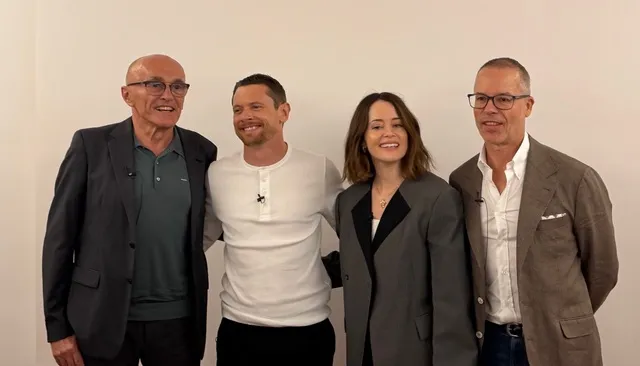
As Puegot after Puegot arrived at the red carpet drop off, a kind of “unboxing” event occurred. Wow, there’s Jonathan Bailey. What’s Zazie Beetz doing here? Or Nina Dobrev? Or Brittany Snow? The cast of Ink, of course, emerged from the cars including Claire Foy, an ebullient Danny Boyle, Guy Pearce, and Jack O’Connell, who was apparently misinformed that layering was the best way to beat the Italian heat.
Inside, the air conditioning was merciful as director Danny Boyle’s Ink opened the festival. The film recounts what happened when Australian media titan Rupert Murdoch (Guy Pearce) and Larry Lamb (Jack O’Connel) transformed a struggling paper into the tabloid powerhouse The Sun. Claire Foy plays a confederate of Lamb’s, who helps retool the paper into something that will actually sell, until she begins to see the dark results of power, money, and fame.
Ink is more political and timely than Boyles’ past awards contenders, so it seems less sure of recognition at first glance. Back in 2009, Slumdog Millionaire received 10 Oscar nominations and won eight statuettes, including Best Director and Best Picture. And in 2010, 127 Hours was nominated for six Oscars, including Best Picture and Best Actor nom for James Franco, but went home empty-handed.
Boyle’s new film is frenetic and radiates a kind of evil All the President’s Men vibe, but it’s making so many trenchant points that it has a hard time making any of them stick. The best bet for awards recognition are the performances O’Connell and Pearce, but will likely lean towards O’Connell as Pearce’s Murdoch recedes to a supporting role in the film’s back half. Screenwriter James Graham, adapting his own Tony and Olivier winning play, is also a possible Best Adapted Screenplay candidate. It helps that the reviews were generally positive, and additional festival playdates at Telluride and Toronto will bring the film more… well, ink.
At a press conference earlier in the day Boyle insisted that there was a direct line from the taboos that The Sun smashed to today’s slash-and-burn media outlets, particularly television and the internet. He also mentioned that the film was an ode to the end of an era of journalism and print editions themselves. While making the film, Boyle noted that newspapers are so obsolete to younger generations that when the Netflix marketing team did some research on the title, many under-35s thought it was referring to tattoos.
I can’t drink to that, even if it’s a spritz.
