
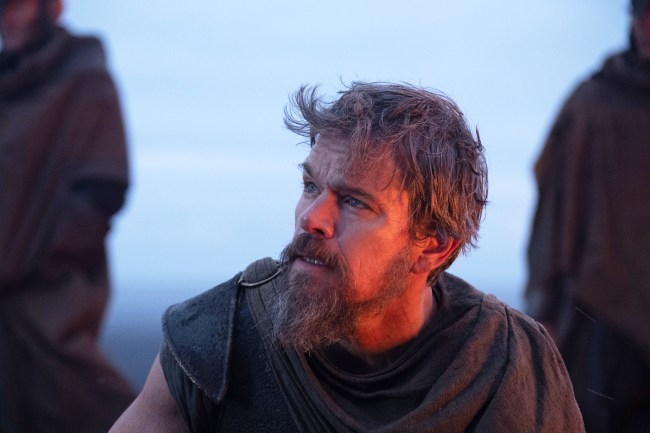
Three years after dominating the Oscars with Oppenheimer, Christopher Nolan is back with his latest film, The Odyssey. There have been countless oral and stagebound versions of Homer’s epic from time immemorial to the present, but over the past century, several feature films have tackled the story either as an adaptation or an inspiration.
While Nolan’s take should be the first direct cinematic adaptation to receive Oscar attention, other reinterpretations of The Odyssey themes, characters, or structure have been honored by the Academy. Here’s a look at the most notable.
2001: A Space Odyssey (1968)
Stanley Kubrick’s sci-fi classic may not be a direct adaptation, but the title intentionally evokes Homer, replacing the ancient seas with outer space and transforming the voyage into one of human evolution. While not an instant hit with critics upon release, the film itself is now widely regarded as a masterpiece.

It received four Oscar nominations for:
- Best Director for Stanley Kubrick; lost to Carol Reed for Oliver!
- Best Original Screenplay for Stanley Kubrick and Arthur C. Clarke; lost to Mel Brooks for The Producers
- Best Art Direction; lost to Oliver!
- Best Special Visual Effects (won)
Apocalypse Now (1979)
Francis Ford Coppola’s adaptation of Joseph Conrad’s 1899 novella Heart of Darkness also owes a big debt to The Odyssey. The main character, Capt. Benjamin L. Willard (Martin Sheen), undertakes a long river journey through increasingly strange and dangerous territory during the Vietnam War. Each stop along the river introduces a different “episode” with its own surreal challenges.
It received eight Oscar nominations for:
- Best Picture; lost to Kramer vs. Kramer
- Best Director for Francis Ford Coppola; lost to Robert Benton for Kramer vs. Kramer
- Best Supporting Actor for Robert Duvall; lost to Melvyn Douglas for Being There
- Best Adapted Screenplay for Francis Ford Coppola and John Milius; lost to Robert Benton for Kramer vs. Kramer
- Best Art Direction; lost to All That Jazz
- Best Cinematography (won)
- Best Film Editing; lost to All That Jazz
- Best Sound (won)
O Brother, Where Art Thou? (2000)
Joel and Ethan Coen’s modern satire loosely adapted the original poem with the setting of the American South during the Great Depression. The plot includes equivalents of Sirens, a Cyclops, and other episodes from the epic. Plus, George Clooney’s character’s name was “Ulysses,” which is the Roman name for “Odysseus.”
In addition to two Grammy Awards for its seminal soundtrack, including Album of the Year, O Brother received two Oscar nominations for:
- Best Adapted Screenplay for the Coen brothers; lost to Stephen Gaghan for Traffic
- Best Cinematography; lost to Crouching Tiger, Hidden Dragon
Cold Mountain (2003)
Anthony Minghella’s adaptation of Charles Frazier’s 1997 novel follows a similar premise to Homer’s story. William “W. P.” Inman (Jude Law), a Civil War soldier, struggles through countless dangers as he tries to return home to Ada Monroe (Nicole Kidman), the woman he loves.
It received seven Oscar nominations for:
- Best Actor for Jude Law; lost to Sean Penn for Mystic River
- Best Supporting Actress for Renée Zellweger (won)
- Best Cinematography; lost to Master and Commander: The Far Side of the World
- Best Film Editing; lost to The Lord of the Rings: The Return of the King
- Best Score; lost to The Lord of the Rings: The Return of the King
- Best Song for ‘Scarlet Tide’ and ‘You Will Be My Ain True Love’; both lost to ‘Into the West’ from The Lord of the Rings: The Return of the King
Inside Llewyn Davis (2013)
Thirteen years after O Brother, the Coen brothers made another film that borrowed Odyssean motifs of wandering, temptation, and the search for home. In this one, the story followed a folk singer (Oscar Isaac) who struggles to achieve musical success while keeping his life in order.
It received two Oscar nominations for:
- Best Cinematography; lost to Gravity
- Best Sound Mixing; lost to Gravity
Interstellar (2014)
Over a decade before Nolan took on the task of adapting The Odyssey, he created an original film that echoed Odysseus’s prolonged voyage. Set in a dystopian future where Earth is suffering from catastrophic blight and famine, a group of astronauts travel through space in search of a new home for humanity while one of them (Matthew McConaughey) is longing to reunite with his family.
It received five Oscar nominations for:
- Best Production Design; lost to The Grand Budapest Hotel
- Best Score; lost to The Grand Budapest Hotel
- Best Sound Editing; lost to American Sniper
- Best Sound Mixing; lost to Whiplash
- Best Visual Effects (won)
The Martian (2015)
A decade before Project Hail Mary blew up on the big screen, another adaptation of an Andy Weir novel found success with critics, audiences, and the Academy. Ridley Scott’s iteration has been viewed as an Odyssean journey, with an isolated hero (Matt Damon) using ingenuity to survive after getting left behind on Mars and does everything he can to return home to Earth.
It received seven Oscar nominations for:
- Best Picture; lost to Spotlight
- Best Actor for Matt Damon; lost to Leonardo DiCaprio for The Revenant
- Best Adapted Screenplay for Drew Goddard; lost to Adam McKay and Charles Randolph for The Big Short
- Best Production Design; lost to Mad Max: Fury Road
- Best Sound Editing; lost to Mad Max: Fury Road
- Best Sound Mixing; lost to Mad Max: Fury Road
- Best Visual Effects; lost to Ex Machina
Now, Christopher Nolan has arrived with his adaptation of The Odyssey. According to Gold Derby’s early predictions, it’s expected to receive several Oscar noms, including Best Picture, Best Director (Nolan), Best Actor (Matt Damon), Best Supporting Actress (Anne Hathaway), and Best Adapted Screenplay (Nolan).
