
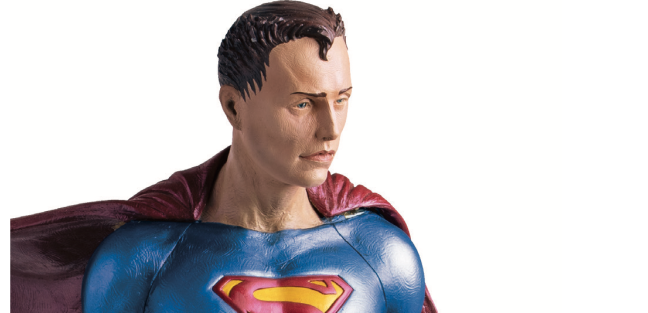
By the early 1990s, according to Ilya Salkind, his father sold the rights to Superman back to Warner Bros. (supposedly without telling him) and the studio found itself firmly back in business with filmed adventures of the Man of Steel several years earlier than they had expected to be. The immediate result was the television series Lois & Clark: The New Adventures of Superman, as well as the commencement of developing a new big-screen version.
This would eventually lead to Superman Returns (2006), but there were a lot of attempts in getting there. The development process began in 1995 with Jon Peters as producer and Jonathan Lemkin as writer. Like much of what would follow, his script — Superman Reborn — would use the comic books’ “Death of Superman” storyline as a launching point. In this case, Superman dies while stopping Doomsday, but before doing so tells Lois he loves her. She then finds herself the subject of an immaculate conception, and quickly gives birth to a baby who in three weeks grows up to be a resurrected Superman.


Superman Lives was next up. In 1996, writer Kevin Smith handed in a story outline that met with the approval of Peters — who, with Peter Guber, had produced 1989’s Batman — with a number of conditions that seemed too ridiculous to be true, including not wanting to see Superman in actual flight, the character not spending much time in his red-and-blue uniform, and the hero battling a giant spider in the third act, all of which Peters denies.

What the script did have was the idea of Brainiac sending Doomsday to kill Superman, and then teaming up with Lex Luthor to make sure the job is done. One of the suggestions that Smith made for director was Tim Burton, which, given the success of Batman, made sense to both Peters and Warner Bros. So, Burton came aboard, but Smith’s script was dropped and writer Wesley Strick (Batman Returns) was brought in.

Two elements that stick out about his efforts were the idea of Superman being an “existentialist,” feeling himself a true outsider among humanity, and Brainiac and Luthor at one point merging into a single being known as Lexiac. It was also this point that legendary comic fan Nicolas Cage (whose most recent films at the time had been The Rock and Con Air) was brought aboard to play Superman — a controversial choice, needless to say. (But then so was Michael Keaton as the Dark Knight.)

Smith says with a laugh, “If somebody was, like, ‘Would you like to see a Nic Cage Superman movie?’ I’d be, like, ‘Yes, take all my money, because I’m going to see what that looks like.’”

And Cage — who was even fitted for a costume designed by legendary multiple Oscar winner Colleen Atwood (Edward Scissorhands) — certainly had his own take on the character: “I came on board the Superman project because I wanted to say something to children. I know Superman appeals to all groups, but it comes from the child’s universe. I remember what it felt like as a child in school being teased. And if there’s one kid out there who’s being called a weirdo or a freak or something, and he goes home and he’s just not having a good day in his life, and his life at school is hell — if he sees Superman and he says, ‘Well, Superman is a weirdo. He’s considered different. Maybe I’m Superman,’ that’s enough for me to feel good about making the movie.”

When Strick’s script was deemed too expensive to produce (about $190 million), he was let go and replaced by Dan Gilroy (who would go on to write The Bourne Legacy and Nightcrawler), whose version of the script managed to bring the projected budget down $100 million, but then the studio pulled the plug on the project completely after a number of expensive box office failures.

In 1997, what audience did finally get was the film Steel, featuring basketball star Shaquille O’Neal as John Henry Irons, from the “Reign of the Supermen” comic book storyline. In the film he’s a military scientist who uses technology he’s developed to turn himself into the weapons-powered title character to battle others using that same technology. It did not go over well: the film earned a global gross of $1.8 million against a $16 million budget.
Excerpted from Superman: The Definitive History by Edward Gross and Robert Greenberger. Copyright 2026 DC & Warner Bros. Entertainment Inc. Published by Insight Editions. Superman and all related characters and elements are owned by DC & Warner Bros. Entertainment Inc.
Click for full-sized pages

