
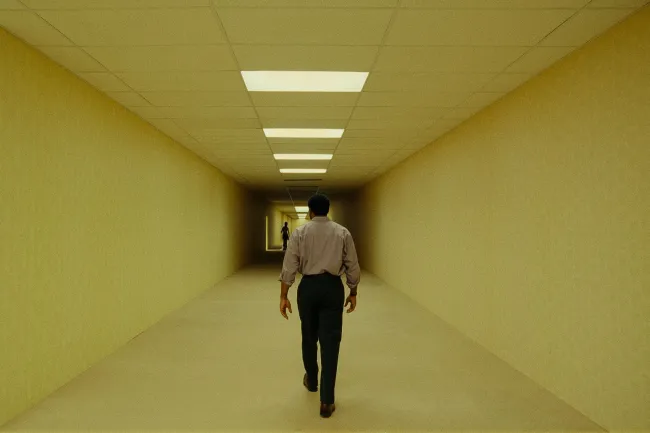
The horror in Backrooms stems from the familiar-yet-wrong feeling that its yellowed carpet and wallpaper evoke, and because of that, the visual effects team behind the horror hit were faced with the immense challenge of not just making a physically impossible space believable, but all-too real.
Visual effects supervisor Edward J. Douglas came onto Backrooms after working with producer Chris Ferguson on the Oz Perkins films Longlegs and The Monkey, so he was well-versed in frightening effects. During Douglas’ first meeting with director Kane Parsons, the two bonded over video games and began a collaboration that would include a short footage test and then the film itself.

Because Parsons had created the original YouTube series with the open source CGI software Blender, he understood some of the language of visual effects, a skill that would become invaluable when trying to communicate his vision to heads of departments like Douglas.
Gold Derby spoke with Douglas in the days after Backrooms‘s massive $81 million opening weekend about how the film’s visual effects merged with practical sets to push the liminal spaces to their nightmarish extremes.

Gold Derby: Backrooms is currently a massive success story. How does it feel for something you worked so hard on to be embraced like this?
Edward J. Douglas: It’s pretty amazing. You do a lot of projects. Some of them hit, and some of them don’t. It’s always amazing when you put so much into it and you think you have something that could be really special, and it actually finds that audience. I’ve been lucky to have that happen a couple times in my career, and every time, you think, “Maybe this is it,” and then I just feel so grateful to have a big part of it again.
The whole phenomenon of Backrooms started with a viral image that inspired director Kane Parsons to make a YouTube series with Blender. How did working with a filmmaker who understood the fundamentals of CGI affect your process?
Kane had such a clear vision of what he wanted to say and how he wanted things to look. We really did build this project as yet another episode in the YouTube series — just now we’re in live action. And we’re building so much physically, but he still approached it in the same way. Throughout the whole film, he would previs things, designing them in Blender the way he’s used to, and that was his communication tool. I had never worked on a film where a director was building the previs himself, but from day one, it was about “How do we make Kane Parsons’ Backrooms?” It wasn’t about “How do we make Hollywood’s Backrooms with Kane Parsons’ name on it?”
So much of the film’s aesthetic is purposeful lo-fi and tactile. Where was your department mainly coming into play?
When we started, Kane developed this giant Blender map of 100,000 square feet of backrooms, and [production designer] Danny Vermette said, “Well, there’s no way we’ll ever get this much stage space, much less this much wallpaper and carpet.” So we started breaking down what we needed to film, which really is, “How do we create a space for the actors and the cinematographer to play and move. Then when can we hand off to my world of expanding that universe out?” When we found our stage spaces, the production design team laid it all out and found 30,000 square feet that they had to use as puzzle pieces throughout. Then we’d turn this corner and we have this vast space. We’re never walking down there, so that could be a blue screen. That’s where we extend. We turn this corner and we run out of set, so when we turn this corner on one stage, we walk into a blue screen and pick it up on another stage, which we seamlessly connect and blend.
One of the more impossible spaces was the Vertigo Room, which featured many levels going down infinitely. How was that achieved?
The Vertigo Room was a really fun scene. We built a lot of it, but it wasn’t one of our bigger sets. We built walls, a ceiling, and that narrow walkway for [Renate Reinsve’s character, Mary] and the stairs. It’s about building everything we possibly can. I feel like I’m the first person on set saying “No, this doesn’t have to be VFX. How much can we build and then plus later?” If you’re not grounded in something real on camera, then we don’t have something for the actress to play off of, for the cinematography and the lighting to play off of, for the for the director to feel. So we want to build everything we feasibly can.

Was there any effect that was especially difficult to pull off?
One of the challenges we knew would be tough was the wall clipping — people passing through walls. It’s such a simple idea. It’s like you have these two computer models that just slide through each other. But it’s not a fantasy movie. There are no effects and sparkles and ripples and shimmers. It just has to be completely clean and perfect. The furniture store basement and the the first backroom space were right next to each other with a door that the actors could pass through. In VFX, we would put that wall back in, and then animate in the clipping. We had reference cameras to show that exact lineup, and then some really meticulous animation work, because every shadow had to be reprojected back onto that wall. It’s the shadow that makes it, so that was meticulous work. The team at Mr. Wolf VFX pulled off many of those shots.

Another fun thing we got to do was reverse engineer the original backrooms image. That was one of the early things we did in post-production. We took the original 4chan image that was Kane’s inspiration, and I did a deep dive, understanding the lens, the distance, the space that that was in, and recreated it in pixel-perfect detail. That gave us our ground truth, the foundation of building everything out. The original backrooms image wasn’t actually yellow walls. It was more of a white-beige wallpaper with yellow color shifts on it, but of course, when Danny and the team built the sets, we knew we had great-looking actors, so to keep their skin tones healthy, we would bias the wallpapers on set more to yellow, so that the actors in the light would be more in a normal color temperature.

This interview has been edited for length and clarity.
