
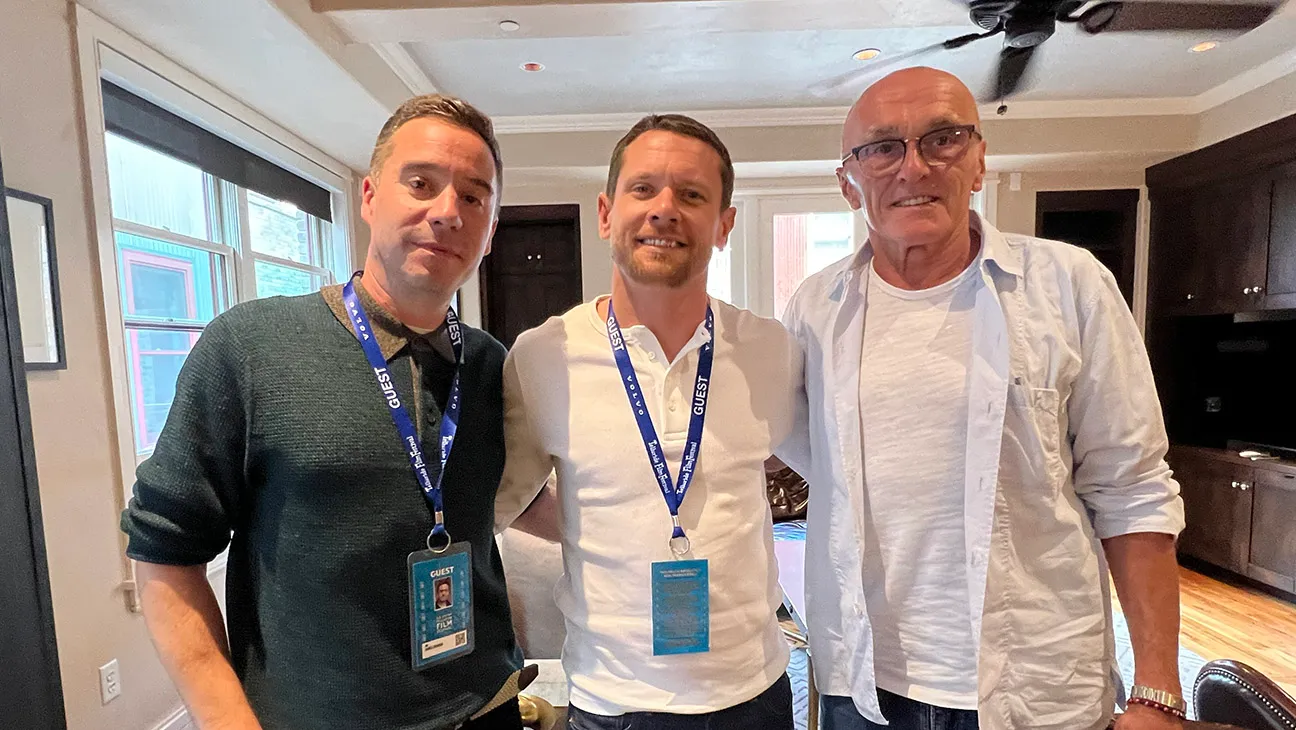
Hot on the heels of Wednesday evening’s Venice Film Festival world premiere of Ink, a film about the relationship between businessman Rupert Murdoch and newspaperman Larry Lamb on London’s Fleet Street back in the 1960s, the film’s director Danny Boyle, writer James Graham and star Jack O’Connell (who plays Lamb opposite Guy Pearce’s Murdoch) flew in to Telluride for the film’s North American premiere on Friday — and granted their first joint interview to The Hollywood Reporter.
A transcript of that conversation, lightly edited for clarity and brevity, appears below.
***
Congratulations on the film’s great reception in Venice — and on opening night, no less!
JACK O’CONNELL I’m only just evaluating it now, to be honest, because it happened so quick. It’s apparent, being in Telluride and speaking to people, that it went very well.
JAMES GRAHAM The glamour there is extraordinary. You feel the history of Italian cinema walking on those cobblestones and even just seeing the number 83 [this was the 83rd edition of the fest] — my God, 83!
DANNY BOYLE It was very beautiful. It’s a miraculous city, but I’d never been to the film festival, so it was just surreal to be there. I kept saying ahead of the fest, “I’m not sure this is a Venice opening film, I don’t know why Alberto [Barbera, the Venice Film Festival’s director] picked it,” but it seemed to go OK! When we were making it, we never thought anyone would see it internationally. We knew it would have an appeal in Britain because everybody there knows what The Sun is and it’s got a notoriety. But to be selected for a huge international film festival? And then for Telluride? Julie [Huntsinger, the Telluride Film Festival‘s director] selecting us was a big boost too — it’s very difficult to explain how much it means. Film festivals are really incredibly important for films like this.
Let’s talk about how this all began. James, you wrote the play of the same name about a decade ago, and I had the wonderful opportunity to see it on Broadway in 2019…
GRAHAM Did you? Oh my gosh, thank you for going. I’ve lived with this story since 2016. We started off in a very humble off-West End theater in London, a small space with 350 seats. I was so proud of that production and the people who built it with me. Danny, you’re surprised the film is in Venice and Telluride — we were surprised that the play moved to the West End and then Broadway, because it’s a very unapologetically British thing! But I believe in that age-old dictum that the more culturally-specific you make something, the more universal it is. This is an origin story, very much set in London, on Fleet Street in the 1960s, but every single person around the world, I think, will be able to draw the line between that moment — the crossroads in our discourse and our news — to what we’re all living with today with social media, AI, truth and post-truth.
Danny, you caught Ink on the stage?
BOYLE Oh yeah, it was a wonderful evening. It was more about Murdoch, who was played by a dominant live actor, Bertie Carvel, who is also in our film [as The Mirror editor Hugh Cudlipp]. But I kept thinking, “It’s really about the other guy, isn’t it?” Larry was from the North, and I’m from the North as well, and I thought, “It’s his story, isn’t it?”
James, you then independently adapted your play into a screenplay, sent it around, and learned that Danny wanted to make it with you?
GRAHAM Yeah. I don’t think I knew that Danny had seen the play at that point. But as a British screenwriter, I was thrilled with his response.
BOYLE And so it flowered. I knew reading it that it wasn’t going to be exactly like the theatrical production, because film is different. You’re going to see Larry’s mind, which you don’t in the theater, and you’re going to see the kidnapping, and you’re going to see the Page 3 girl. So we started to work on it, and it was tough to put together because we didn’t have enough money. We couldn’t raise the money. A lot of people thought theater plays don’t really work in film, and they were all frightened of Murdoch and legal problems. So we have to give a big thanks to Studio Canal — they didn’t give us enough money, but they did give us some money, and it allowed us to make it. I’d worked with Jack on [2025’s] 28 Years Later and I knew I wanted him to do it, and I knew I wanted Guy to do it. You jump through hoops to get the actors you want sometimes because financiers are all like, “Oh, can’t we have…” All that stuff goes on. But anyway, we got it!
JACK O’CONNELL We finished Danny’s 28 Years and then I went on to Sinners, so there was a gap, and then I got the initial call about Ink, which was a surprise. I felt really very honored and wanted to know more. I hadn’t heard of Larry Lamb. My agent had. But once I started digging into him and understanding his influence I thought, “Oh, wow, OK.” I very much wanted to be involved, but it was still quite early on in terms of finding the financing when Danny reached out to me.
BOYLE We didn’t have the money, did we? I said to you, “I can’t guarantee it.”
O’CONNELL You’d spoken to Guy.
BOYLE I wanted Guy, but the financiers said, “Well, there’s all these other famous Australians…” And I was like, “I really want Guy.” So you have to jump through hoops. But Guy was very good — I swore to him that if I could get him and get enough money, I would do it with him and Jack, and he stuck with us. So all praise to him, really.
Jack, had you and Guy ever met before?
O’CONNELL This was the thing that we first met on, but I’ve been a fan of Guy’s for a long, long time. I’m a big fan of Animal Kingdom — he’s phenomenal in that — so when this got floated, I thought, “Oh, well, fingers crossed we find some dough.” Plus, I’d been into the theater to see James’ productions in the past.
Danny, you’ve made several films about real people — among them 127 Hours and Steve Jobs — plus your films have such a pace and energy to them, which was also the case with James’ play…
BOYLE It’s funny with stage plays. There are some that they make into films and they still feel like stage plays, but there are also others that are amazing, most notably Amadeus and Dangerous Liaisons. I also think there’s misthinking about adaptations of plays. They often say there’s too much dialogue, but one of the great things about them is good dialogue, so if you lean into that you’ve got cracking scenes. So that was a big part of it rather than thinking, “How do we make it more cinematic?”
GRAHAM I wanted to come at it with humility. Even though it’s done well on stage, and there’d been Tonys and things like that, I didn’t take for granted that you can just lift something from a Word document into a Final Draft document, hope you get a good director and good actors, and somehow it’s OK. I wanted to learn. Danny won’t take any credit for this, but he should: the script I sent him needed work, needed a director’s eye. I needed to be led through some Cinema 101 — how it moves, the rhythm of it, the escalation of it. We got offers after the stage show, as you can imagine, for a limited series — eight episodes or something — but for me, there’s something about the singularity of its proportion: this newspaper has got one year to beat The Mirror, and at the end of it, they either do or they don’t. I think there’s something about that single night’s experience, and it just felt like cinema to me.
Jack, my understanding is that Danny had a full newsroom built so that you could shoot there in 360-degrees, and that you guys also shot on real locations like Rules, the oldest restaurant in London, and on Fleet Street itself. Can you talk about how those sorts of things impact a performance?
O’CONNELL When you’re being offered authenticity — the things you see and smell, the stuff you hear like the sounds your feet make on a floorboard — it’s great. Our set designers were our costume designers too — Carson McColl and Gareth Pugh — and they did the 28 Years film too, so there was a bit of history there. I really do worship and adore working with them.
Danny, you mentioned Amadeus and Dangerous Liaisons as strong examples of play-to-film adaptations, and I read that you revisited those films before making Ink. But when someone says they’re making a film about newspapers, the film that comes to mind first, at least for me, is Citizen Kane. Charles Foster Kane and Rupert Murdoch both basically were rich guys who said, “I think it might be fun to run a newspaper.”
BOYLE Oh, my God, yes. And there are few little homages in there. It’s fun when you can reference it in some way. But the great thing about having a really good script, and not enough money, is you just pursue the script.
Danny, your films have featured so many great performances; it can’t be a coincidence. What’s your secret?
BOYLE If you pick good actors, you’re ninety percent of the way home. The three in this one [O’Connell, Pearce and Claire Foy] are actually very similar: They do their own work, and it’s quite sacred and thought-through, and then they bring it. I love that because they’re doing all that work for you. And you really notice it when you get actors who don’t put that work in!
GRAHAM I remember walking into your [O’Connell’s] dressing room the first time we met, and we were talking about Larry, and I was saying, “I’ve never been able to find a voice recording of him.” And Jack went, “Here,” and played it on his phone. I was like, “How did you fucking find that?! For seven years I’ve been looking for that!” And Jack found that.
O’CONNELL Well, to be fair, it was through Danny’s contact. He works with an archivist and has access to the quieter corners of archives.
BOYLE We also had three people advising us, very famous old journalists, Eve Pollard, Roy Greeslade and Roger Alton. They came in, and we talked to them with the actors, and then we invited them on a second visit to look over our set — I was looking for tips. Then they heard Jack doing Larry’s voice, and Roy said, “That’s him!”
James, you have likened Larry to The Joker from Batman. Can you elaborate?
GRAHAM An audience is surprised that they want to spend time with this guy and go on a journey with him. They get seduced, in a way. I bet that’s not dissimilar to some of the seduction you see in Silicon Valley and the tech companies. And the MAGA movement has a bit of that. You can see how people get sucked into this seduction when you’re winning after everyone told you you would fail. I think there’s something Joker-esque about that. Larry’s a disruptor. But I believe that Lamb would’ve much preferred to have been celebrated and included in polite society than on Fleet Street. I can think of some political leaders who followed a similar path who actually just wanted to be loved, and when that love was denied, they just struck a match and got a fuel canister out, but I don’t think that makes them happy. You can see at the end, in that gorgeous scene with Guy and Jack, that Larry is hollowed out. He would’ve preferred to have been celebrated and hoisted up. In the absence of that, he destroys the thing he loves.
And Danny, the comp you have raised is Michael Corleone in The Godfather, Part II…
BOYLE It’s difficult to say this in front of Jack because he gets embarrassed, but absolutely. Jack’s a little young for the part of Larry, but that didn’t matter — you don’t give a fuck about Pacino’s age, do you? He’s ordered the death of his brother and yet you’re still drawn to him. That’s tough to do!
In a really powerful way that reminded me of the ending of BlacKkKlansman, your film’s closing montage connects the era that you guys are focused on in the film all the way through to the present. Larry Lamb died in 2000, but Rupert Murdoch is still freaking at it!
BOYLE Trump is more famous than Murdoch, but Trump hasn’t been front and center in our lives for as long as Murdoch has — Murdoch has been front and center for 60 years! And he has had a tremendous impact on us as a powerful person influencing media. The film is an ignition point for where we are now. It’s there in the play, but in theater you’re mainly there to celebrate the live and the actors, you’re not there to go, “Hang on a minute, fucking hell!” But we were able to do that with our epilogue. It was tough because getting permissions for a lot of that stuff, and we don’t have permissions for some of it. It’s easier to get away with it in America because you have freedom of expression in your Constitution. We don’t have a constitution, and these people are protected by copyright law. So we’ve had to be brave and just keep going because it has a real emotional effect upon people, I think.
GRAHAM It’s our moral responsibility, as Danny was saying, to draw that line from then to now, but I really don’t want to ever be the kind of writer that projects too heavily my own politics onto a thing. I think it’s great when you can write a play or a film and you can just ask loads of questions and let the audience answer. Was Murdoch cynical? Did he love news? Was he a businessman more than a newsman? Did he want to burn it down? Did he want to build it up? That’s for the audience to decide. I want Fox News viewers to come and watch this as well readers of The Guardian and the New York Times.
O’CONNELL I’m really proud of the line that this film treads. It just documents how influential this meeting was.
