
They say that in the age of mass communication, cultures become homogenized, so that nearly everywhere in the developed and more quickly developing world you’ll find blue jeans, instant noodles and cellphones. But the taste for regionally specific entertainment stays strong — especially when it comes to visual fiction for and about young people, who hunger for stories about other kids like themselves, speaking with their dialect, displaying manners and customs that are familiar and settings they recognize.
All of this is to say that maybe you need to have been a Sicilian teenager in 2012 to really respond to Giovanni Tortorici’s Ketticè; many others might feel a little irked and bored by this tale of mostly vapid but good-looking teens getting high and messing their lives up in Palermo. The presence of Luca Guadagnino’s name in the credits as a producer and Monica Bellucci’s entertaining but all-too-scant turn as the main character’s tetchy mother may attract offshore interest, especially among streamers in need of fresh content.
Ketticè
The Bottom Line
Dude, where’s my Cinquecento?
Venue: Locarno Film Festival
Cast: Salvatore Gallina, Rachele Testagrossa, Monica Belluci, Davide Cirri, Rocco Sanfilippo, Anita Teresi, Giulio Amico, Salvatore Claudio Gallina di Lorenzo, Riccardo Abbate, Vincenzo Pirello, Nicolo Ferrante, Tommaso Cristiano Wirz, Ida Poerio, Marino Iaco, Stefania Raffadali
Director/screenwriter: Giovanni Tortorici
1 hour 47 minutes
The fact that writer-director Tortorici (Diciannove) was born in 1996, thus was 16 in 2012, is probably the main reason the film is set in that period, although it could just as easily have been set in 2025 or the late 00s, so long as it was a time when social media was up and running. In Ketticè’s time frame, all the kids are still blithely using Facebook to message each other, update their status and bully one another, the platform having not yet become the domain of the old, cranky and terminally uncool. This matters because quite a lot of the action happens digitally, with characters’ messages and posts appearing onscreen as they make assignations or insult one another and so on.
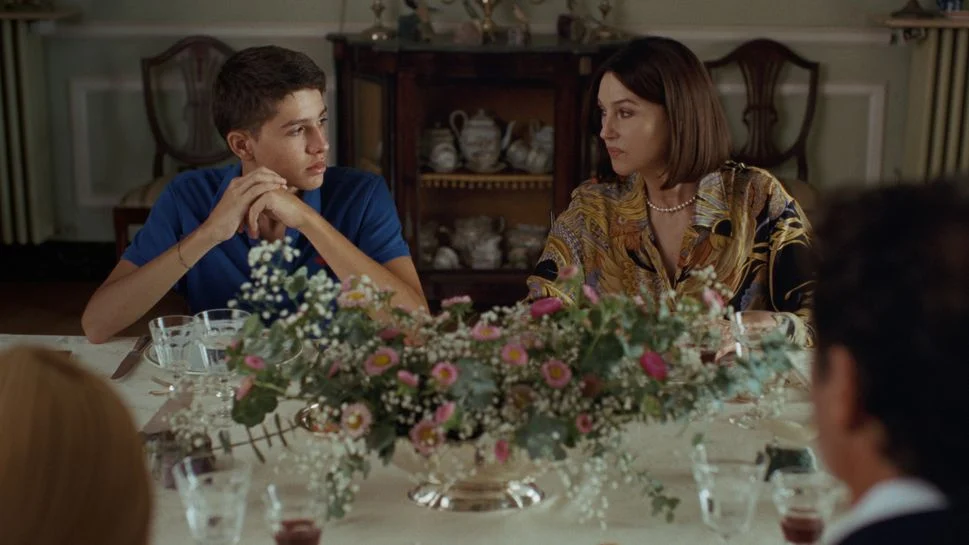
When not indirectly increasing Mark Zuckerberg’s growing billions, 16-year-old Giuilo (Salvatore Gallina) is a pretty normal kid growing up in Palermo, in Sicily, attending a private school and living in a large, antique-stuffed villa with his reasonably well-off parents (played by Bellucci and Tommaso Cristiano Wirz). An early dinner scene with Giulio’s imperious nonna (Stefania Raffadali) establishes that she’s the one with most of the money and power in that family, much to the chagrin of Giulio’s mama, who spends a lot of time sniping at her husband and mother-in-law and wishing she was back up North where she was raised. (Bellucci was born in Umbria, and even those who don’t speak Italian might be able to hear that her accent is quite unlike the distinctive Sicilian patois.)
As not just the only son but the family’s only child, Giulio has it pretty easy, with plenty of latitude to come and go as he pleases, and his own fairly new little car that he drives to and from school and around town to meet up with his friends. As the action starts, he has been one of the star players on the local soccer team — which in Italy is practically like being in a religious order — but his engagement with sports is about to wane. Although he has plenty of fairly indistinguishable male friends to hang out with and a pretty girlfriend, Elena (Ida Poerio), he seems a bit bored and restless.
Soon, he’s broken up with Elena, who admittedly accepts the split without much drama, and starts seeing his old friends less in favor of his newest buddy, Ketty (Rachele Testagrossa), a working-class girl famous for getting into fights with other girls and generally being something of a hellion.
They meet in a club and have that most teenage of introductions, a long kiss on the dance floor. But the most interesting thing about the film is that after that, Ketty and Giulio just stay friends — two heterosexual kids of different genders who happen to like each other’s company. Also, they both like smoking weed, and the slightly more streetwise Ketty easily persuades Giulio to ditch school and drive them out to the rundown suburbs to buy from street dealers. Then they roll a joint, hotbox in the car, and either go their separate ways or hang out more. The weeks pass on this rinse-and-repeat cycle until Giulio’s grades start to suffer, his soccer coach is furious at him for missing practice and, somewhat sinisterly, his ex-girlfriend Elena becomes a heroin addict, just in time to make Giulio start to question his life choices.
The end arrives disconcertingly abruptly, but one can infer that Giulio eventually gets his act together and maybe considers a career in filmmaking. But the feeling lingers that he might have done well to pay attention to his perceptive, long-suffering Italian teacher (Davide Cirri) and picked up a few more tricks where it comes to narrative structure; the script that his real-world equivalent Tortorici turns in here is a little low on incident, drama, humor and any kind of serious point.
On the plus side, as yet another portrait of kids these days, this one seems pretty tuned in to the younglings and their ways, and Tortorici gets solid performances from his likable cast, even if one or two can’t stop themselves from looking straight at the camera. The aforementioned rapport between two kids of the opposite sex that’s untroubled by any romantic angle is especially persuasive. It’s just a shame that the kids themselves aren’t very interesting — unless you happen to find teenagers fascinating in any form.
