
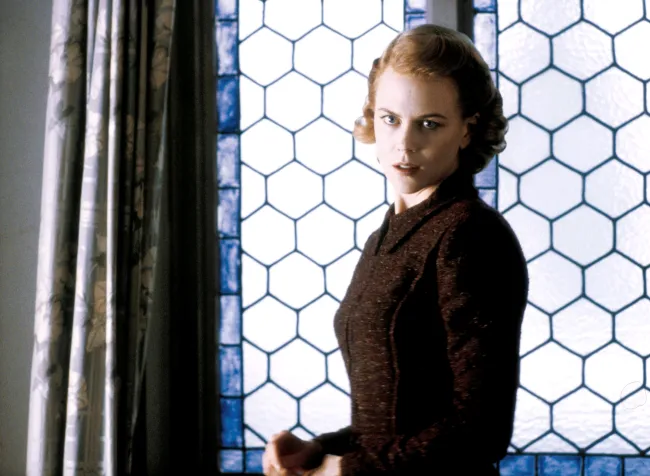
Some ghost stories are popular for centuries, but it’s only taken 25 years for The Others to become a contemporary genre classic.
Released on Aug. 10, 2001, Alejandro Amenábar’s Gothic horror film stars Nicole Kidman as Grace, a mother who cares for her two young children, Anne (Alakina Mann) and Nicholas (James Bentley), both whom apparently suffer from a life-threatening photosensitivity disease, in a remote countryside manor while she waits for her husband to return from World War II. In need of assistance, she hires a trio of servants — Betha Mills (Fionnula Flanagan), Edmund Tuttle (Eric Sykes), and Lydia (Elaine Cassidy) — as the housekeeper, gardener, and maid who previously worked in the house years ago.

“Fionnula taught me how to use a map and Eric brought me to the really famous restaurants in Madrid,” Cassidy tells Gold Derby now about her experience acting alongside Flanagan and Cassidy in Spain. That off-camera closeness translates into the relationship that the silent Lydia has with Mrs. Mills and Mr. Tuttle — and we learn the reasons for her silence as the movie unfolds.
After the servants move into the house, Anne claims she sees ghosts, including a young boy named Victor. Despite Grace’s initial skepticism, eerie occurrences suggest what they’re dealing with might indeed be supernatural. Halfway through The Others, Grace’s husband Charles (Christopher Eccleston) does indeed return to his homestead, briefly reuniting with his family before abruptly leaving the next day. Things get even stranger when Anna and Nicholas discover the tombstones of the newly returned servants.
That leads to one of the biggest, most surprising plot twists of the early 2000s horror canon. It’s ultimately revealed that Grace, her children, and the staff have been dead the entire time — and Victor is actually the living child of the family that’s moving into their home. A séance reveals the backstory: after Charles died in the war, Grace suffered a mental breakdown, killing her children and then herself. But then she seemingly awoke again, leading her to assume she and her family had been given a second chance at life. The truth now revealed, Grace and her children prepare to live alongside whoever moves into the house next.

Thanks in part to that killer twist, The Others become a late summer hit at the global box office, earning over $200 million worldwide. It also received awards recognition, including 15 nominations and eight wins at that year’s Goya Awards — Spain’s version of the Oscars — and Kidman received a Best Drama Actress nomination at the 59th Golden Globe Awards.
While Grace is the central figure of the film, Lydia is perhaps the most interesting character in The Others. During the course of the story, she — and we — learn that all three servants died of tuberculosis decades before. Cassidy says that Lydia’s shock at discovering that she’s dead causes her to cling to Mrs. Mills and Mr. Tuttle for comfort.
“Her body’s crawling into itself and she’s fearful, but she felt safe with the housekeeper,” the actress explains. “They kind of became her parents because when she died, she’s also grieving the loss of her family, so she inherits them as a family by default.”
Cassidy admits that she never thought too deeply about Lydia’s backstory during shooting, because she was so focused on portraying the character in her current state, and didn’t want to overcomplicate the character. In fact, she’s not sure whether Lydia is completely aware of what her past life was like since she’s having a difficult time process that she’s dead.

“They’re all in limbo in a void that is nothingness, and that’s a catalyst for why Lydia is how she is in the film,” Cassidy notes. “If she had the sense of her previous life that would have been progress for her. But she’s stuck in the house, and being in that void continues to scare her because if she had a sense of perspective and depth then she’d maybe start to heal.”
Cassidy also believes that Lydia’s emotional paralysis — and reliance on gestures instead of speech — is the reason why she’s unable to warn Grace and the children about their own ghostly status. “The language she understands is emotion and feelings,” she muses. “I think if she had the opportunity, she would have written down ‘We’re dead’ or she would have communicated what she learned.”
As for the actual twist itself, Cassidy recalls initially being disappointed when she read Amenábar’s script, mainly because M. Night Shalamyan’s The Sixth Sense had just been released two years before, and had a similar twist where Bruce Willis is revealed to have been a ghost the whole movie. “I didn’t want it to seem like we were just ripping off the twist of The Sixth Sense because the script was already in the works, and it was the timing of the projects,” she says now.
But Cassidy emphasizes that she’s grateful that audiences recognized The Others as its own film. “I thought the twist was brilliant,” she notes. “I was just like, ‘Damn! I wish we were first,’ but it’s still unique.”
While she hasn’t rewatched The Others recently, Cassidy can vividly remember seeing the movie for the first time in theaters with her friends in Ireland. (The movie didn’t have an official premiere in her native country.) And she says that she’s recently had the desire to rewatch it with her own children, who are both teenagers.
“I’d like to have to watch it with my kids and to be able to see it through their lens when they’re watching it for the first time and see what they’re picking up on,” Cassidy says. “They’re very sophisticated and savvy so I wonder what they would pick up on.”
