
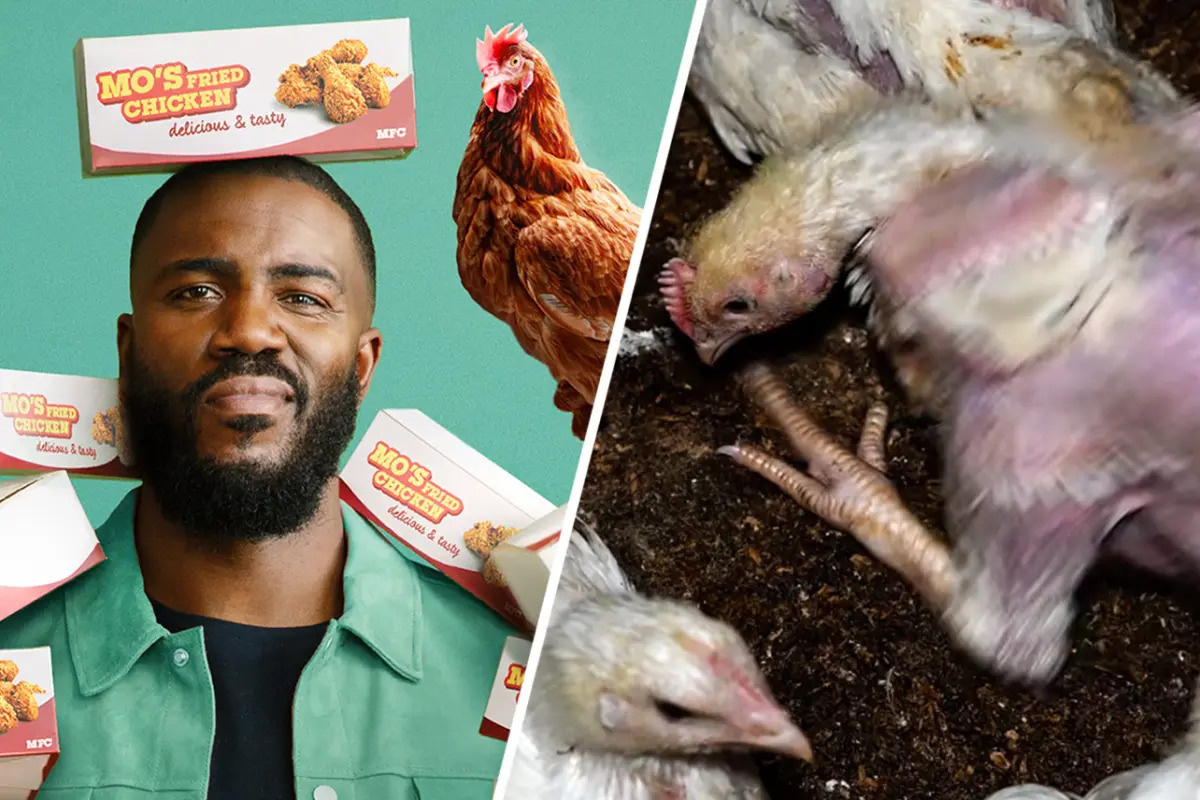
If you love fried chicken as much as British comedian Mo Gilligan, you might—like him—think that there’s nothing that can turn off from those savory, crunchy, finger-licking-good tenders. But I challenge viewers to get through Gilligan’s new Netflix documentary, Big Chicken: A Fast Food Conspiracy, without second-guessing every Popeyes, KFC, or Wingstop order for their rest of their lives. (Or at least, for the next week.)
Produced by Mindhouse, the same production company behind the Louis Theroux: Inside the Manosphere documentary, and directed by Liana Stewart, Big Chicken is pretty much a redo of Morgan Spurlock’s 2004 documentary Super Size Me, in which Spurlock at nothing but McDonalds for 30 days straight. (Spurlock even made a 2019 sequel about fast-food chicken.)
But clearly, both Brits and Americans need all the reminders they can get when it comes to just how harmful fast food chicken is to our health, to workers, to the environment, and, of course, to chickens. From Popeye’s sandwiches to McDonald’s nuggets to KFC’s popcorn chicken buckets, fast-food fried chicken has exploded in popularity over the last decade. If you’re telling yourself that ordering the chicken sandwich is “healthier” than the Big Mac, you’re about to get a reality check, courtesy of Gilligan.
In Big Chicken, which began streaming today, Gilligan commits to eating nothing but fast-food fried chicken for breakfast, lunch, and dinner for 28 days straight. Being such a big lover of the cuisine, he thinks it will be easy. But his journey uncovers many horrifying facts about fast food and the chicken industry. Here are the most disturbing facts I learned from the documentary.
Most of the chicken you eat are baby chickens.

Perhaps you’ve already heard that chicken farmers use growth hormones and selective breeding to make their bird grow unnaturally big, and unnaturally fast, a practice that began thanks to the “Chicken of Tomorrow” contest that followed WWII.
“If babies grew at the same rate, your two-month old would be the same size as a fully-grown pig,” Gilligan says in a voiceover in the film.
Today, it takes just six to seven weeks for chickens to become plump enough to slaughter—meaning most of the chickens you eat are under two months old. “Chickens today are giant babies,” explains food and flavor writer Mark Schatzker in the film.
The flavor of chicken has to be added, because natural chicken tastes like almost nothing.

In the documentary, food and flavor writer Mark Schatzker stress to Mo that, “You’re not tasting chicken. You’re tasting what they put on chicken, what they’re putting in chicken. But you’re not tasting chicken, because chicken doesn’t have any flavor any more.”
Why? Because the chickens are slaughtered so young. “It’s like veal, but even blander,” Schatzker says. “It’s cheap, it’s plentiful, but it doesn’t taste like anything. It’s like potato chips. It’s the seasoning, the flavoring. You haven’t been tasting what nature created, you’ve been tasting what people have created.”
That’s why when Mo picks up a bag of frozen chicken at the grocery and reads the ingredient list, he finds things like “chicken broth” and “chicken flavoring.”
Chemicals used for silly putty and condoms go into fried chicken sold in the U.S., thanks to regulation loopholes.

In the documentary, Mo learns that a single Popeyes chicken sandwich contains 142 ingredients, a lot of them being unknown chemical additives.
Laura Schmidt, a professor at the Institute for Health Policy Studies at the University of California, outlines a major problem when it comes to regulation of food safety in the U.S.
“‘Natural and artificial flavors,’” Schmidt explains, pointing to a phrase often seen on the ingredient list for fast food fried chicken, and other processed foods. “That’s the question mark, because it’s a bunch of chemicals that they don’t have to list. Those chemicals may not be regulated, because there’s a loophole in federal regulations in the U.S. Even in Europe, when they go regulate a chemical additive, they ask the company to prove it’s safe. In the U.S., they don’t. The companies decide what chemicals are safe.”
Some of those chemicals that go into fast-food chicken include dimethylpolysiloxane, a chemical also sold as Silly Putty, and another ingredient that is also used for lubricant in condoms.
Addiction to fast food is real.

About halfway through the film, Mo Gilligan pays a visit to Ashley Gerhard, a Professor of Psychology at University of Michigan, who studies the affects of fast food on mental health. Prof. Gerhard walks Mo through a questionnaire about his mood, his coping mechanisms, and more, which she later reveals is the same questions used to diagnosis addiction to drugs and alcohol.
“Twelve percent of children would meet the criteria for addiction with ultra-processed food. As a mother that really scares me for the future, for our children,” said Gerhard.
Consuming fast food is linked to depression and anxiety.

“These types of foods, it does make you moodier. One of the biggest links is actually depression and anxiety,” Ashley Gerhard, Professor of Psychology at University of Michigan, explains to Mo Gilligan.
Later, we see how true this is when Mo fully breaks down in tears while describing his mood, after a few weeks of eating nothing but fried chicken for breakfast, lunch, and dinner.
“Eating this food and I don’t feel like myself,” Gilligan tells the camera. I look in the mirror and I don’t look like myself. I feel low, man. I feel so low. I feel so by myself.” Then he breaks down into sobs.
Workers in U.S.-based chicken processing plants urinate on themselves while working.

Alice Driver, an investigative journalist and author of the 2025 book Life and Death of the American Worker, is interviewed in the documentary about labor practices at meat-processing factories owned by mega-corporate chicken producers like Tyson Foods and George’s Inc.
“Workers showed me videos from inside the facilities,” Driver explains. “There’s workers that have to kill the chickens that aren’t actually dead. The birds are coming down the line 175 birds a minute. People are working elbow to elbow with very sharp knives, with these metal mesh gloves. You’re de-boning the chicken in three to five seconds for eight to ten hours at a time. Workers told me, ‘There is no rest, because they’re trying to turn me into a machine.’”
Because there are no breaks—even for the bathroom—workers will soil themselves right there on the factory floor.
“When workers want to go to the bathroom, and no one gives them a break, they urinate on the line, peeing on themselves,” says Magaly Licolli, a human rights activist who fights on behalf of poultry workers in Arkansas. “We have heard a lot of cases of workers being forced to wear diapers.”
Major meat companies like George’s Inc. and Tyson’s Foods have employed contractors who use child labor.

As Mo digs deeper into the labor practices of Tyson, he uncovers a 2023 report that the department of labor discovered over 100 children employed by a contractor working illegally inside 9 major meat packing plants, including George’s and Tyson’s Food.
Neither Mo, nor any of the activist or journalists he works with, are able to set food inside a Tyson meat-processing plant. However, Mo speaks to an anonymous undocumented worker, a “chicken catcher,” who has worked with farms contracted to many of these big chicken company. The worker confirms he works alongside many child workers—15-, 16-, 17-year-olds—including a child worker who he witness fall sick with a fever, thanks to the dangerous chemicals in the work environment.
“He cried and nearly passed out,” the worker tells Mo.
(In response to the report, Tyson Foods issued a statement claiming the company “is committed to compliance with all labor laws and holding those we do business with to the highest standard of accountability.”)
Earlier this year, KFC, Popeye’s, Nando’s and Wing Stop withdrew from their pledge to stop using fast-growing chickens in the UK.

Netflix’s Big Chicken documentary ends with one last disturbing fact, which is delivered to the audience via text on the screen.
“In 2019, KFC joined the Better Chicken Commitment, audited by an independent third-party, in which they pledged to improve animal welfare and stop using fast-growing chickens in the UK by 2026. Popeyes, Nando’s, and Wingstop followed,” the text reads.
This is followed by a card that reads, “In February 2026 they all withdrew and set up the Sustainable Chicken Forum regulated by… themselves.”
